


Why are we encouraged to sing psalms, hymns and spiritual songs to ourselves and with others? In this column, Cultivating Songs of Faith, we explore that question by looking at one particular hymn each season, offering the story of its creation from the life of its author or composer. What you see here is a reflection rather than a formal academic history. I hope to help you to taste, see, and rediscover what is good in great hymns, and also occasionally enter into the conversation they have with ancient psalms and modern spiritual songs.

“There has never been the slightest doubt in my mind that the God who started this great work in you would keep at it and bring it to a flourishing finish on the very day Christ Jesus appears.”
—Philippians 1:6 MSG
I have a dear friend who has just reached her 98th birthday. Bettina considers it her calling to pray for other people, a beautiful gift that every one of her friends feel incredibly grateful for. Another woman at my church is the caring spouse of a husband who has suffered with chronic pain for years. When she walks into our empty sanctuary on Sunday morning as the music team is rehearsing, she sings along and raises her hands in worship. I have told both of them that I think they are saints; they truly inspire me by their single-minded devotion to serving their Lord in the place He has planted them.
What are the qualities in people that make you view them as saints? Do they resemble biblical characters like Daniel or David? Are they people who would otherwise be ordinary, but have an extraordinary connection with God? Carrey Wallace in her book, The Stories of the Saints, describes them this way:
Saints aren’t people who are always good and never afraid. They’re people who believe there must be more to life than just what we can see. This world may be hard and unfair, but saints believe in a God who is bigger than the world, whose law is love, and whose justice is mercy.[1]
Ordinary people who hold on to an extraordinary God, that is who I think saints are. Their lives are guided by their faith, as the stories of the saints in chapter 11 of the book of Hebrews tells us.
I think fidelity is a quality that defines the life of all saintly people. Like my friends Bettina and Betsy, it is fidelity to the life to which God has called them that cultivates a life of faith. Faith and fidelity go hand in hand, faith being the posture of the heart and fidelity the outworking of that faith expressed in actions. Without faith you cannot face the challenge of the choices that must come each day. To remain true to that faith is to cultivate fidelity. We first fix our eyes on Jesus, which then enables us to run the race with endurance.
Jesus is our perfect example:
Therefore, since we are surrounded by so great a cloud of witnesses, let us also lay aside every weight, and sin which clings so closely, and let us run with endurance the race that is set before us, looking to Jesus, the founder and perfecter of our faith, who for the joy that was set before him endured the cross, despising the shame, and is seated a the right hand of the throne of God. (Hebrews 12:1-2, ESV)
It was this phrase “so great a cloud of witnesses” that inspired the hymn “For All the Saints.” This hymn has a special place in my heart, partly because I can remember singing it through tears at my mother’s and my aunt’s funerals. Every year on All Saints Day (which is November 1) our church will open the worship with this hymn. It is a beautiful way to remember all of the faithful that have gone before us, and to call ourselves to the same kind of life marked by fidelity.
The Rev. Doctor William Walsham How (1823-1897) wrote the text to the hymn in 1864, originally titled “For All Thy Saints.” He served as the Anglican Bishop of Wakefield, England. He was nicknamed “the poor man’s bishop” because of his care for the poor of London’s slums and the factory workers of West Yorkshire. He wrote the hymn as a way to teach people the heart behind the statement in the Apostle’s Creed: “I believe in the Communion of Saints.”
For all the saints, who from their labours rest,
Who Thee by faith before the world confessed,
Thy Name, O Jesus, be forever blessed.
Alleluia, Alleluia!Thou wast their Rock, their Fortress and their Might;
Thou, Lord, their Captain in the well fought fight;
Thou, in the darkness drear, their one true Light.
Alleluia, Alleluia!
Bishop How wrote eleven verses for this hymn! In the text he mentions apostles, martyrs, evangelists, and soldiers holding true to their faith. He never names a single saint by name, instead focusing on the connection we have with these people, the communion that binds us all together as one. He calls us to draw courage from their stories as we sing:
And when the strife is fierce, the warfare long,
Steals on the ear the distant triumph song,
And hearts are brave, again, and arms are strong.
Alleluia, Alleluia!
The tune that is usually sung with these lyrics is not the one that the poem was originally published with. Ralph Vaughan Williams, the great English composer, specially composed a tune for the text in 1806. He had embarked on a huge project of creating an English hymnal and included this hymn. It is a powerful, soaring melody with rich harmony that stirs my soul to sing. The tune is named SINE NOMINE, meaning “without name.” This title mirrors the lyrics which honor ALL the saints, especially those whose names are known only to God.
It is in the final two verses of “For All The Saints,” which I have never seen printed in any hymnal, that Bishop How asks us to recall the day when the entire Communion of Saints will join together in glorious praise with one voice:
But lo! there breaks a yet more glorious day;
The saints triumphant rise in bright array;
The King of glory passes on His way.
Alleluia, Alleluia!From earth’s wide bounds, from ocean’s farthest coast,
Through gates of pearl streams in the countless host,
Singing to Father, Son and Holy Ghost:
Alleluia, Alleluia![2]
Would you know a saint if you bumped into one? C.S. Lewis said, “There are no ordinary people. You have never talked to a mere mortal.”[3] In 2022 I had the chance to view the Ordinary Saints project, a collaboration between Bruce Herman (painter), Malcolm Guite (poet), and J.A.C. Redford (composer.) Together they created a beautiful collection of art that highlights a series of “ordinary” faces who are dear in some way to the artists. As I studied the paintings and listened to the accompanying poems and music, I began to realize just how extraordinary these faces are. They are all members of the communion of saints, just like you and just like me.[4]
Can you envision yourself as one among this great company? If you believe in Jesus, then you will stand with them someday.
No matter how stumblingly and bumblingly we hold on to our faith (this is a phrase my pastor uses often), it is God who ultimately will get each of us to the finish line. It is His fidelity, His unshakeable tenacity, His faithfulness that holds on to us. The road of our fidelity is paved with our Lord’s faithfulness to us.
And that is why Paul can say in his letter to the Philippians that he has every confidence that the God who started this work in us will bring it to a “flourishing finish.” Together with the very saints we have been talking about, as a member of the faithful communion we believe in, we will stand before God someday and with one glorious voice praise Him. Alleluia!

[1] Carrey Wallace, The Stories of the Saints: Bold and Inspiring Tales of Adventure, Grace, and Courage (New York, Workman Publishing, 2020) p. ix. This book was written to introduce children to the stories of the saints. I bought it for my grandchildren, but love reading it myself.
[2] Listen to this beautiful hymn here.
[3] C.S. Lewis, “The Weight of Glory,” originally a sermon given at Church of St. Mary the Virgin in Oxford on June 8, 1941
[4] You can discover the entire collection of poems, music and paintings in “Ordinary Saints” here.
The featured image is courtesy of Julie Jablonski and used with her kind permission for Cultivating.
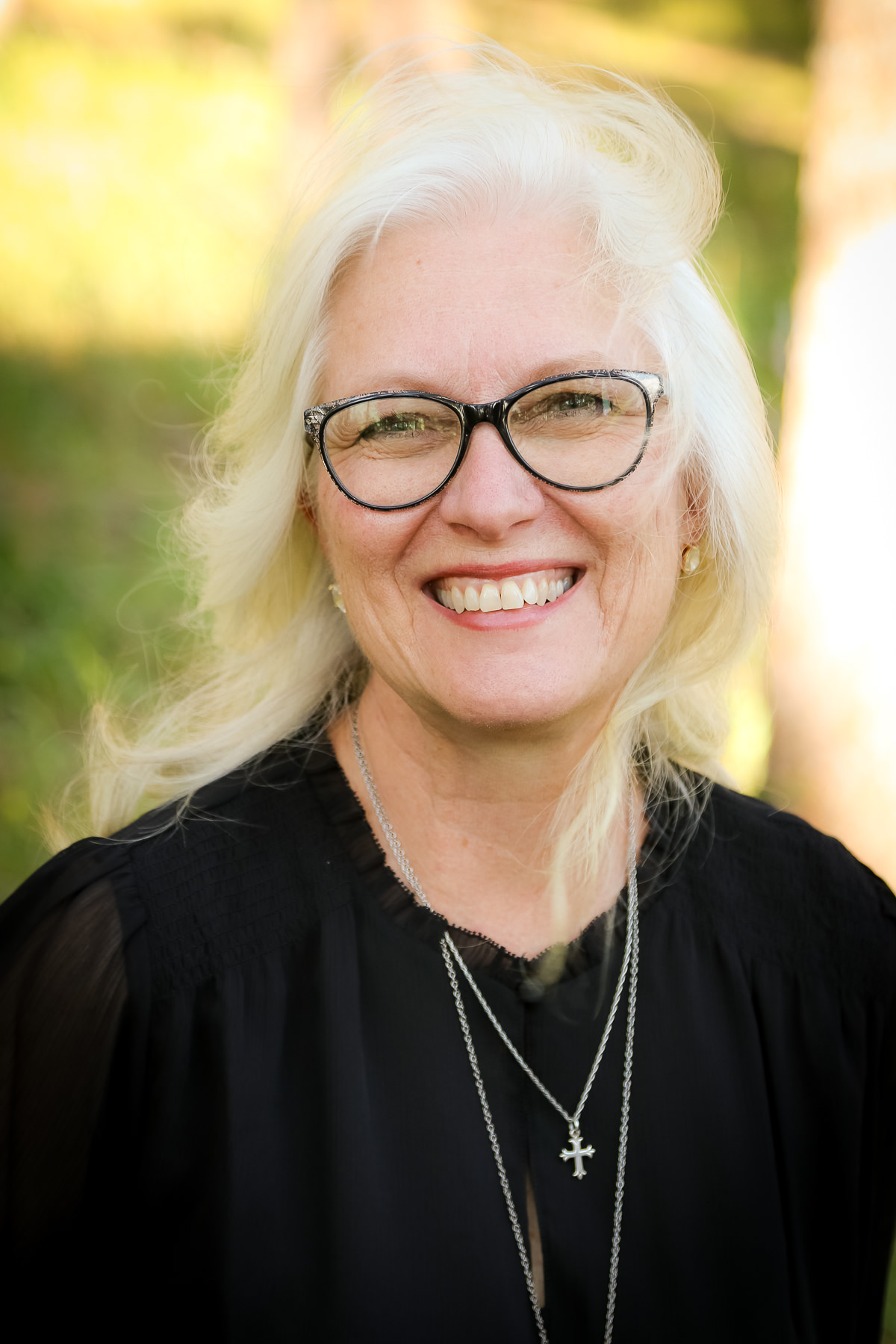
Terri Moon is a musician and a lover of Jesus. She delights in playing the music of Bach, growing English roses, baking up a good batch of scones, and all good, true, and beautiful things that point to Him. She has found that the most fulfilling adventures come through collaborating with others, and to that end she and her husband Steve (also a member of The Maker’s Project) serve gladly in their church and also on the leadership team of the Anselm Society. Together they raised four children and are now proud grandparents. Hosting friends in their Colorado home is one of their favorite joint adventures.
Terri holds a master’s degree in violin performance, and has collaborated in many concerts and taught students of all ages for 40 years. Her lifelong passion is the intersection of music, worship, and spiritual formation, and she longs to bring to life the beauty of the Church’s heritage in the arts. Terri currently serves as the Music Director of Holy Trinity Anglican Church in Colorado Springs.

Thank you, Saint Terri! We haven’t met in person, but I know your heart and you are SUCH an inspiration! My Hubby Dave and I overlapped with Greg & Nancy Brown in Woodbridge, VA many years ago. Such WONDERFUL friends and fellow pilgrims! I “met” you in the England/C.S. Lewis music commitment that included the Browns, and was derailed because of COVID. I Introduced Greg to hammered dulcimer, Nancy was my beloved prayer partner, I was privileged piano instructor for the or their 2 older boys, Nancy and I did hammered dulcimer/recorder gigs and were in church ministry together.
May THE JOY OF THE LORD continue to be your strength and inspiration! Have a blessed Thanksgiving, Avent, and Christmas!🎶✝️
P.S. We attend a dynamic startup ACNA church here in the Eastern panhandle of WV, have planted a daughter church in PA, and are now the Cathedral Church of the Ascension, for the All Saints
Diocese.
Oh, Margie! I have heard so much about you and am so glad that you wrote this note to introduce yourself! I can say without a doubt that it was you and Nancy praying that got us through that difficult time. I saw that clearly afterwards and told Nancy that though it was hard for her to be prevented from playing in our concert because of sickness, she and you were engaged in the most important work of all. I am eternally grateful! Thank you from the bottom of my heart!
What a joy to hear of your long friendship with Greg and Nancy, and how fitting that you are now a member of a church in the All Saints Diocese. I’m glad to get to “meet” you, Saint Margie, and I look forward to the day when we can worship our Lord all together. We will then have the opportunity to talk at length and discover so many more stories of God’s faithfulness in our own lives; how they have intersected in the beautiful tapestry that only He can see now. One day we will see even as we have been seen. Many blessings to you, friend!