


Three short siren blasts echoed throughout the floor.
Robb stood in his hotel room on the 17th floor of the Park Place Westminster Bridge. The top floor. It was 8 a.m.; he’d been up and dressed since 4, still unable to switch completely to London time. He was sipping coffee and staring at the view. It wasn’t the iconic view of Parliament and the clock tower; his room faced east, with large windows framing St. Paul’s Cathedral across the Thames and the skyscrapers of the City of London beyond.
Urged by his father, stepmother, and niece, he was taking a holiday, a much-needed holiday from work, the divorce, and the aftermath. He had primary custody of his four sons, and his parents were caring for them while he was gone.
Robb had left the States and been in London for four days now. After shaking jet lag, he’d already visited the British Museum, Westminster Abbey, the Houses of Parliament, and the Tower of London. He’d seen a play at the Old Vic Theatre, a drama about Ireland and the Troubles. Tomorrow he would be at the National Gallery; the art museum was hosting a massive Van Gogh exhibition that was sold out for months. He’d taken a friend’s advice and bought a membership that got him a ticket for members’ day.
He had no idea what the siren blasts meant. But he could hear chaos outside his door. He opened it to see the hotel maids knocking on doors and yelling “Out! Out!” in heavily accented English. He pulled his passport from the room safe and grabbed his laptop and phone, quickly shoving everything into his small computer bag. He snatched his windbreaker from the closet. Then he stepped into the hall.
Guests, some still in nightclothes and some dressed but barefoot, were rushing into the hallway, guided away from the elevators and toward the stairs by the shouting maids. He was glad he’d dressed early.
Yes, you paid more for rooms on the upper floors, because of the views. But you also had more stairs to descend if you had to evacuate. Traffic on the stairs indicated the hotel was indeed being evacuated.
The crowds in the stairwell were close to hysteria. No one knew why the evacuation had been ordered. Everyone had heard the three short siren blasts. Fire? Bomb threat? Terrorist threat? Some people had clearly just been awakened.
Because the hotel catered to international businesspeople and tourists, the stairwell was filled with a polyglot of languages, and everyone was talking. A veritable Tower of Babel, Robb thought to himself. He heard English and other European languages like German, French, and Spanish. He heard what sounded like Hindi and a hubbub of Chinese; Chinese tourists were all over London.
As the descending people joined others exiting the lower floors, traffic slowed with the crush, increasing the sense of panic. Robb hugged the stair rail next to the wall; he’d already seen people trip as they half-ran down the middle of the stairs. People were being jostled and sometimes pushed aside.
Directly in front of him, a tiny, elderly woman descending very slowly was bumped and began to fall. Robb reached out and grabbed her, pulling her back to her feet. They were between the 11th and 12th floors. He began to move around her when he realized she would be vulnerable to more bumping. Without thinking, he positioned himself directly behind her, forcing others to move around them. He was jostled and bumped himself a few times, but he kept one hand on the stair rail.
Because she was in front of him, he couldn’t see her face, only side views as they turned on the floor landings. She seemed to be European, perhaps even British. She was dressed well with what Robb could see were expensive clothes. He guessed her age at late 70s or early 80s. She was trying to maintain a sense of calm and decorum, but Robb could see the fear in her tensed shoulders.
Three more siren blasts, louder because the siren was inside the stairwell, increased the crowd’s panic. With the computer bag strapped on his right shoulder, he kept his left hand on the woman’s upper arm, ready to grab if she started to fall.
By the 7th floor, he could smell the faint odor of smoke, although he couldn’t see any. The crowds had thinned; now it was only a few late stragglers passing them quickly.
On the 5th floor, he heard a voice shouted from below through a megaphone. “Is it all clear?”
“No!” Robb said, shouting. “Two of us are still making our way down.”
He heard no response.
During the final four flights to the lobby, Robb was able to walk slowly alongside the elderly lady. She kept her right hand on the rail, while her left clung tightly to his arm. The strength of her grip surprised him; it told him that, despite the outward calm, she was very much afraid.
“Are you OK?” he said, as they descended the final flight.
She glanced at him briefly and shook her head. Whatever nationality she was, she didn’t understand English.
They reached the lobby and were quickly escorted outside by a hotel staff member. Hundreds of people were milling about the side street. Two firetrucks were parked on Westminster Bridge Road. Men and a few women wearing fire helmets and lime-green reflective emergency jackets seemed everywhere.
He found a ledge on a flower planter and motioned to the lady to sit. He didn’t have any choice but to sit next to her; she wasn’t letting his arm go. He reached into his computer bag and found his unopened bottle of water. He offered it to her.
She nodded in thanks and took a long sip, still holding tightly to his arm. They sat in companionable silence for a time. Robb could hear snatches of conversation, something about a trash fire on the 6th floor.
He felt the lady shiver with the slight breeze. It was late March, and the early morning temperature was around 50. He pulled off his windbreaker and draped it around her shoulders. She smiled and leaned her head against his arm. He moved his arm around her shoulders and let her lean against him.
They had been sitting for about 10 minutes, waiting for the all-clear and OK to return to the hotel, when a man in his 50s, with a florid face and a stomach bulging at his belt, came running up, followed by a woman in a tight-fitting dress and high heels. The man initially scowled at Robb, until the elderly lady sat up and fired off a stream of words.
Robb didn’t speak the language, but he knew it was Russian.
The man’s expression changed; he smiled at Robb and pulled him into a crushing hug. He kept murmuring what sounded like “placebo” but which Robb would later learn was “spasibo,” or “thank you.” The man let go and shook Robb’s hand vigorously.
The younger woman stepped forward. “We don’t speak English much. British?”
Robb shook his head. “American. My name is Robb Bennett.”
All three Russians understood the word “American.” The man beamed; the younger woman nodded. “We thank you,” she said. “Mama said you help.”
“I was glad to,” Robb said. The three nodded at him, but he wasn’t sure they’d caught the meaning.
The hotel concierge began shouting “All Clear” in a loud voice, and the crowd began to move toward the lobby. Robb figured the elevators would be jammed for a while, so he held back.
The elderly lady removed his windbreaker and handed it to him, and then she surprised him by giving him a tight hug. Then she turned, and the three moved toward the lobby, soon lost in the crowd. He never saw her or the couple again.
Robb eventually returned inside the hotel, but instead of waiting for an elevator, he made his way to the hotel restaurant, taking the escalator to the second floor. A cup of coffee and a croissant would just about do the trick, he thought.
Ten days later, the wonders of London and southern England behind him, Robb stood at the checkout counter. The clerk smiled as she pulled up his bill on the computer. She frowned for a moment, then smiled again, printing out a copy of the bill.
“All paid up,” she said cheerfully.
“Wait,” Robb said, “there must be a mistake. I haven’t paid yet.”
She shook her head. “No mistake. All paid up. Several days ago, a fellow guest used his card to pay your bill. He didn’t say why; he just said it was a thank-you.” She paused. “Actually, he didn’t say it. His wife did. They were Russian, and he didn’t speak English.”
Robb stared. “Did he leave his name or contact information?”
“No,” she said. “Just a thank-you.”

Editor’s note: For earlier installments of this story by Glynn Young, read The Christmas Nobody Wanted and The Christmas Solo.
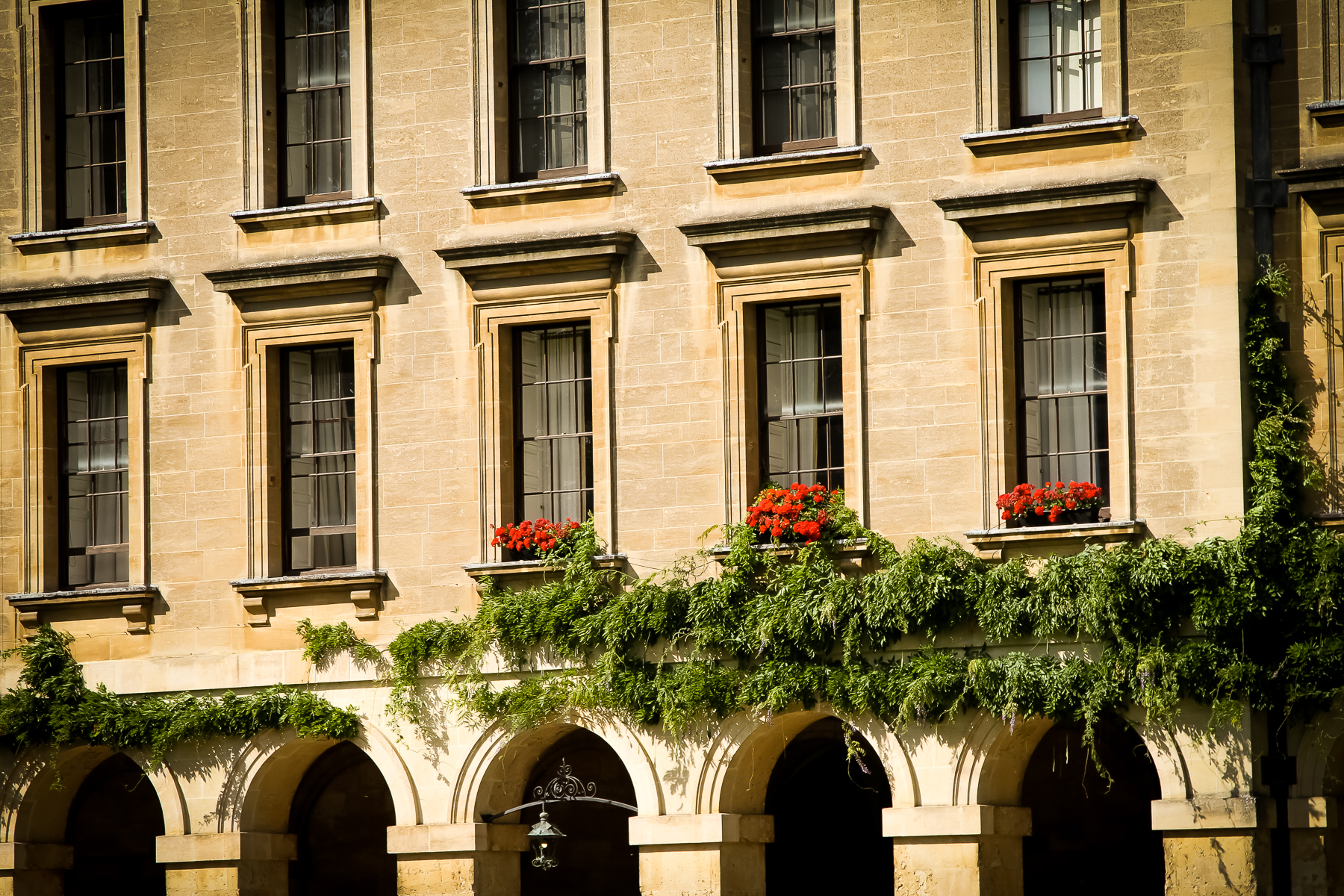
The featured image, “New Buildings Magdalen,” is courtesy of Lancia E. Smith and is used with her glad permission for Cultivating.
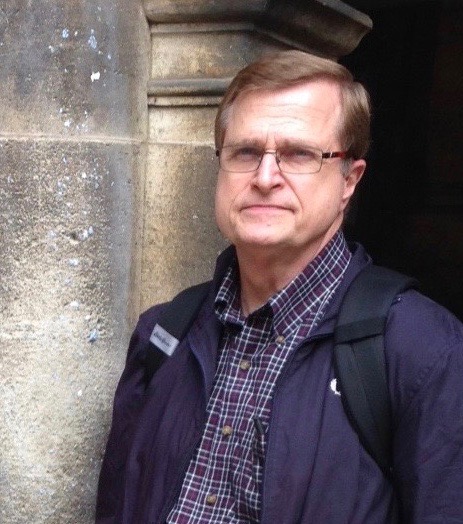
Glynn Young wrote his first story when he was 10 – a really bad mystery having something to do with a door behind a grandfather clock and a secret cave. At 14, he discovered Great Expectations by Charles Dickens, but he secretly wanted to write James Bond stories. At 21, he became a Christian, and the verse he was given, Philippians 1:6, became the theme of his life.
Glynn received a B.A. in Journalism from LSU and a Masters in Liberal Arts from Washington University in St. Louis. He spent his professional career in corporate public relations, and mostly executive speechwriting. Since 2009, he’s been an editor for Tweetspeak Poetry, writing a weekly column. Since 2011, he has published five novels in the Dancing Priest Series, the nonfiction book Poetry at Work, and the historical novel Brookhaven.
He and his wife Janet live in suburban St. Louis.

Add a comment
0 Comments