


We have a song,” John Lenton said, clearing his throat nervously. “For the Christmas program.” He hesitated.
Robb Bennett waited. He sat at his office desk across from Matt Lenton and Dejuan Jefferson, his church pastor. They’d arrived without an appointment or even a quick heads-up.
Lenton continued. “It’s new, the song, I mean. A friend of mine in Nashville wrote it, but he’s got no takers on recording it. He asked me if I might consider using it for our Christmas Eve program.”
Robb still didn’t speak. He’d been a fixture in the worship band for years, playing guitar. He’d never sung a solo, preferring a less visible role. But months ago, just weeks before Robb’s marriage blew up, Lenton had heard him practicing by himself in the church sanctuary. He’d asked Robb to consider a solo during worship service, and one had been scheduled. Then Robb’s wife, Lindsay, had told him she had fallen in love with someone else and filed for divorce, and left Robb and their four boys the same night.
The court hearing had been ugly, turning into a media circus. One of the most prominent area oncology doctors had filed for divorce from the metropolitan area’s most prominent homebuilder. By the time the October divorce hearing ended and final decisions were handed down, Lindsay’s reputation had been destroyed. She’d set off a hand grenade within her own family and that of her parents. Friendships had been destroyed, relationships ruptured. Even her brothers and their wives had stopped speaking to her.
And Robb had been left with the emotional wreckage that had been his own family, eight-year-old twins Stephen and Danny and five-year-old twins Joshua and Caleb. Outwardly, he was bearing up, protecting the boys to the extent he could and being there with them when he couldn’t. When he was asked about himself, which was often, he merely said he was OK, taking one day at a time.
Robb was not OK. He was hurting. He was second-guessing himself on everything now. Decisions that had come so easily—estimates on home remodeling and new construction, when to pay a bill, what Bible verse or passage to use for devotions with the boys, even what clothes to wear each day—had become agonizing. Friends, customers, and people at work, used to his confidence, were finding themselves off-kilter.
The outcome of the divorce hearing brought no joy; his attorney had gone for Lindsay’s jugular. He knew it might have been the only reason he was awarded full custody of the boys, but it almost destroyed him to see the damage done to Lindsay. Somewhere in the patient, relentless court questioning of both him and his now former wife, he’d lost faith, and trust, in himself.
“It’s not an easy song to sing,” Lenton said. “In fact, it’s downright difficult. I can see why my friend has had trouble getting anyone to consider it.” He paused. “We were wondering if you could take a look at it.”
“For what purpose?” Robb said.
“To sing it in the program,” Dejuan Jefferson said. “It’s meant for a tenor to sing. And nobody could sing it like you could.”
Robb frowned and shook his head. “Dejaun, I’m in no position to help. I’m focused on the boys and work. I really don’t have the time. And, right now, I don’t think I have it in me to return to music, and especially something like a solo.” He paused. “Lindsay always said how much she loved to hear me sing, and it’s like every time I try, I’m reminded of how I’d sing for her at home, and then what happened. I should have seen it, the first crack in our marriage. She stopped asking for a song.” He looked down at his hands. “I know I’ve got to get over this, but it’s still too raw, too painful.”
The two visitors were quiet for a moment, but the worship director was nothing if not persistent. “Well, we hoped you might just take a look at the song and tell us what you think. Whether it’s one we should include in the program or not. I’ll be honest, Robb. Not having you in the band these past six months has left a gap. We have good musicians, but none of them gets music like you do.” Lenton set the manila folder on Robb’s desk. “We’ve scheduled one practice for the entire program, the night before Christmas Eve. The choir is rehearsing all the music, in case any soloists have to bow out.”
Robb was inclined to firmly say no, he wouldn’t even look at it. But he looked at the two men, men he considered good friends, and especially Dejuan, who had spent more hours praying with him, standing alongside him, and supporting him through the whole divorce. And they weren’t the only ones. The church had been his main support system.
“OK,” Robb said, “I’ll take a look and tell you what I think.”
Both men stood, shook his hand, and turned to leave.
Dejuan spoke. “Robb, I know you’re hurting. I can’t even begin to imagine the pain. But at some point, you’re going to have to decide to trust yourself again.” Robb nodded at Lenton, and they left.
Robb sat quietly, staring at the manila folder. The divorce had hollowed him out. His self-confidence had evaporated. Everything he thought he knew and believed about his marriage had been a fiction, a story, a story that had become a nightmare. When the nightmare had finally ended, he was a shell of the man he’d been. Or at least that’s what it felt like. He was a man who loved totally and with every ounce of his being, and his marriage had been a fabrication.
His four boys kept him focused. They’d been insulated to some degree from the chaos and media frenzy; attending a private classical Christian school had helped. Teachers and students tended to be protective. Still, news had filtered down. The orderly world the boys knew had capsized, and they, and their father, were still trying to right their ship.
He picked up the manilla folder and looked inside. It was sheet music with lyrics. He did what he’d always done with a new piece of music. He skimmed the sheets, listening to the melody in his mind. The piece was longer than usual; he guessed it ran just over seven minutes. He saw the two choruses, sung by a choir. The soloist parts would be a challenge, abrupt changes in keys, no rests, and almost continual singing alone and with the choir.
Then he read the lyrics.
He read them again.
He glanced at the copyright. Matthew Hennessey. Robb had never heard the name, or what songs he might have written.
But if Matthew Hennessey had not experienced what Robb had gone through for six months, he’d experienced something very much like it.
It was a song written for Christmas, a song about the nativity. But it was sung by someone who knew pain, searing, hollowing out pain. It was a song of hearing God’s voice in the winter wind, of seeing God humble Himself in the form of a newborn child. It was a song of an age-old promise being kept, of a man terrified for protecting his wife and the child she bore. It was the song of a broken world, sung by a broken man, realizing what he still had, the mercy he’d been granted.
Robb had never heard the nativity story told this way before.
He felt the tears on his cheeks.
John Lenton and Dejuan Jefferson had not spoken to or heard from Robb Bennett since that day in the office. The night before the Christmas Eve program, they were both in the church sanctuary. The musicians and the choir were practicing, Lenton directing them through the program. Dejuan was there to practice his short sermon, placed right before the final song. Which now looked like it would have to be sung entirely by the choir. Lenton knew only one tenor who could pull off the ending solo the song required—at least only one who was accessible, and he wasn’t there.
The rear door of the sanctuary opened. The choir, warming up, suddenly stopped singing. Their stares caused both Lenton and DeJuan to turn around.
Robb Bennett was walking down the aisle, carrying his guitar case. He walked up to Lenton.
“OK,” he said. “OK. Show me where you want me to stand.”

Editor’s note: For an earlier installment of this story by Glynn Young, read The Christmas Nobody Wanted.
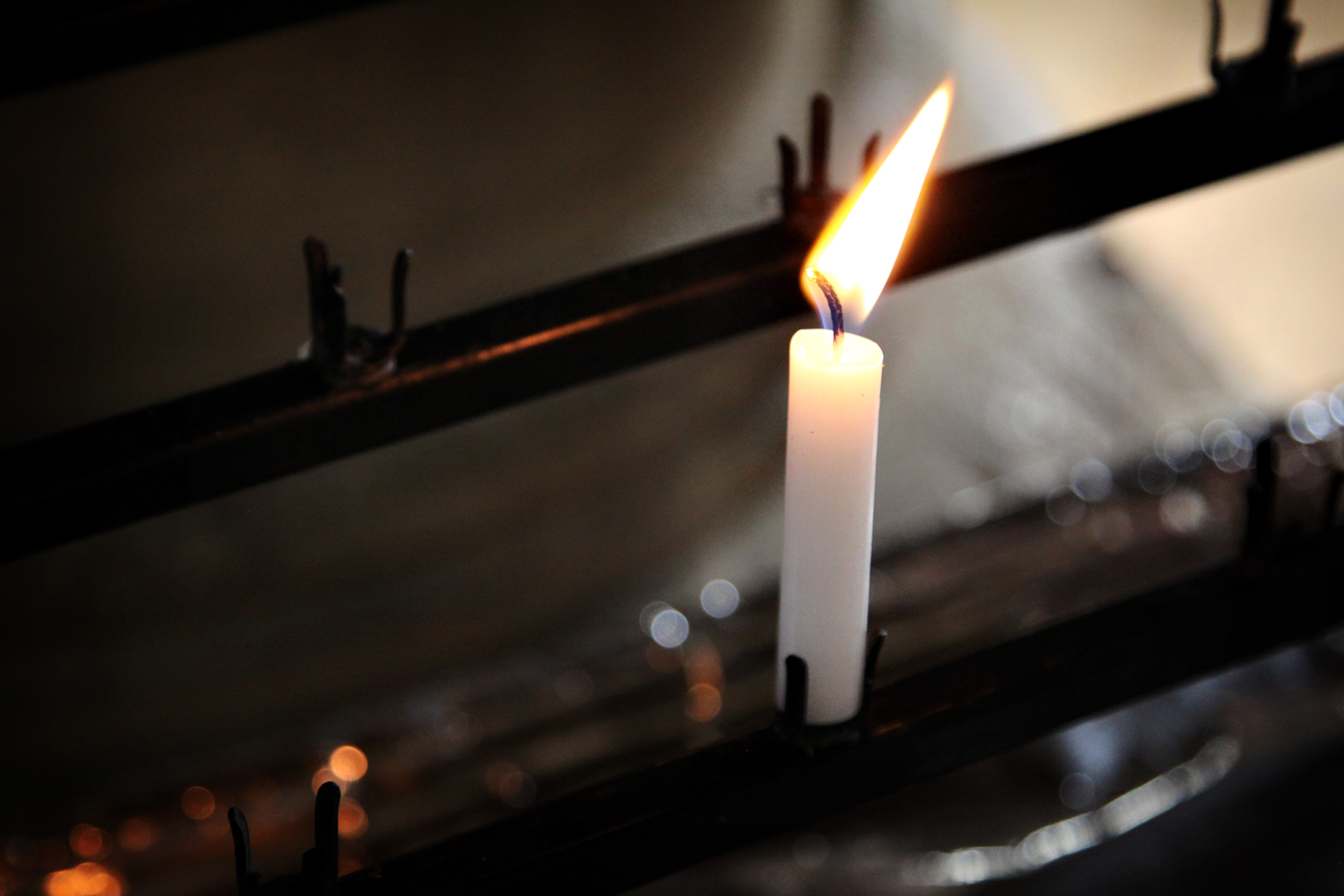
The featured image, “A Candle For Remembrance,” is courtesy of Lancia E. Smith and is used with her glad permission for Cultivating.
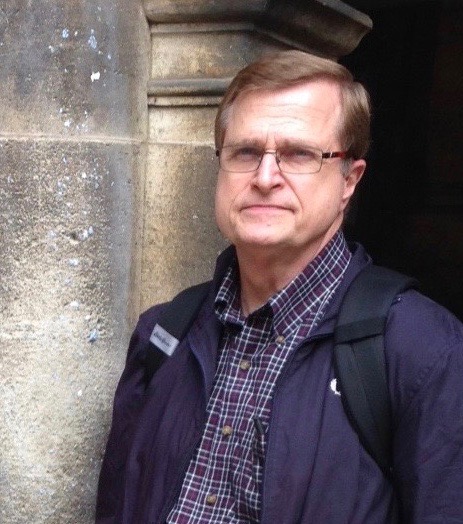
Glynn Young wrote his first story when he was 10 – a really bad mystery having something to do with a door behind a grandfather clock and a secret cave. At 14, he discovered Great Expectations by Charles Dickens, but he secretly wanted to write James Bond stories. At 21, he became a Christian, and the verse he was given, Philippians 1:6, became the theme of his life.
Glynn received a B.A. in Journalism from LSU and a Masters in Liberal Arts from Washington University in St. Louis. He spent his professional career in corporate public relations, and mostly executive speechwriting. Since 2009, he’s been an editor for Tweetspeak Poetry, writing a weekly column. Since 2011, he has published five novels in the Dancing Priest Series, the nonfiction book Poetry at Work, and the historical novel Brookhaven.
He and his wife Janet live in suburban St. Louis.

A fantastic story by a fabulous writer that I’m so honored to know. You roped me in from beginning to end, Glynn. Blessings!
Martha, thank you!