


The Cultivating Poetry column will explore both the writing and reading of poetry, and the practical ways this intersects with how our souls are formed. We will consider a range of poets, both contemporary and historical, looking for their invitation to us to see differently, to inhabit the world, together finding courage to live as a poeima in this beautiful, terrible world we have been given.

The afternoon was warm, the kitchen full of sun, when my friend’s mother emerged from her bedroom with a tangled ball of necklaces cupped in her palm. She lamented the time it would take to extract the one she wanted, which had been a gift from her mother. “It’s right here, but I think it’s lost.” “May I try?” I asked. She brightened. “Yes! Please! If you can get it out, you can have the rest.”
I could have the rest? There was a single pearl in the midst, something that looked expensive, and inside I could barely believe my thirteen-year-old luck. “Are you sure you don’t want this pearl too?” I asked. She shrugged, then shook her head. “I think the whole thing is a lost cause.” So I began to plot how I would tease out clasps and charms from the tight knot to untangle her necklace and lay claim to that singular pearl. I took it home and worried it, sometimes loosening a knot, sometimes laying it down again without any progress. But I kept picking it up again.

Freshly graduated from college, I seized the chance to work part-time for an evangelical student ministry, the same one that my parents had worked for my entire life. It was sold as an opportunity to go deeper with Bible study and theology, things I loved and was hungry for. This religious world had clearly defined roles for men and women, and yet I was recognized as a leader and often welcomed to occupy spaces normally reserved for men. The pastor of a group I joined for a while after college told me I was an “interesting blend of giftings.” I wrestled with God regularly, was willing to teach, and I challenged leadership to think deeply, and often differently. Others called these male gifts, which, though I couldn’t find that idea backed up in Scripture, caused me to feel ashamed. Again and again, I was misnamed.
Part of this year included staffing a summer program for college students from around the country. During the training week leading up to receiving our teams of students, one of the veteran staff showed us pictures of “kingdom workers” who had been raised up through his ministry. All these years later, I realize that my body knew then what my mind was not safe enough to put into words. As he spoke from the front, my heart pounded; my face was hot. Every one of those workers was a man. I approached this ministry veteran at the break, asking with a light voice that did not match my internal churning, if he would share about women, not just men. Once we were seated again, quiet, and with our attention on him, he addressed my question. I don’t remember names, but I do remember his repetition, which still echoes in my soul: “This woman married this man, who did great things for God’s kingdom.” My place, as a woman, could not have been made more clear. I swallowed hard and told myself to get over it, but in the presence of the obvious outworking of this limiting theology, my heart shriveled. I spent the summer sleeping on a mattress on the floor, pouring most of my waking hours into leading women just a couple of years younger than me, who mostly just wanted to find a man to marry.
This narrowness was not new. It was present in every layer of my early formation. I was already used to trying to fit myself into something I was told would be acceptable to God, something that was not me. I learned early to pretend. I knew that I did not fit this mold of an evangelical woman, but I tried, because that was how one survived. I learned to choose image over authenticity and became a contortionist, shrinking and hiding and twisting where I was told I was too much or that it wasn’t a space God created me to occupy. I was taught to swallow my words, to not name what I saw, while watching men be blessed to raise their voices, no matter what they had to say. These voices that told me to abandon myself were framed not only as human truth, but God’s truth. From the beginning, my ability to trust myself was undermined, framed as sin.
But Imago Dei was never meant to fit a mold.
In my particular religious world, I was taught that trusting these voices of male authority in my life was the same as trusting God. I walked away from myself, because I thought God wanted me to distrust the wisdom of my body, to silence myself, to give my authority away, and to regard aspects of my humanity as shameful. I learned to ignore the dissonance that existed between the words that were taught and how selectively they were lived out. And so I came to believe that my gifting was somehow wrong, that somehow in the abstract God loved me and called me His workmanship, but really, I was a mistake. This lens colored how I saw myself, not just in religious spaces, but everywhere.
During that summer, I worked alongside a man a few years older than me who was in seminary, training to be a pastor. One day, after I had shared my love for writing poetry with him, he asked me, “Why would you spend time writing poetry when you are so good at discipling women?” My answer caught in my throat. The implication of his question was clear enough: Stop playing with poetry, get back into your box. Poetry, too, was something God didn’t value. I didn’t know how much more I could shrink, but I tried.
Mary Oliver’s book Thirst shimmers with the appetite of her generous spirit. Woven throughout are poems in which she wrestles with the representation of God she found in the church. I have found it to be a tender companion. In “The Beautiful, Striped Sparrow” she begins,
In the afternoons,
in the almost empty fields,
I hum the hymns
I used to sing
in church.
They could not tame me,
so they would not keep me,
alas,
and how that feels,
the weight of it
I will not tell
any of you” [1]
I finish the poem, set the book beside me, my body heavy with resonance. These words settle and I feel the pierce of how I, also, was taught that I needed to be tamed.
I began to read Dorothy Sayers while studying in England, and as I am untangling this part of my story, her words about being a woman with Jesus have challenged what I thought I had to receive as divine truth:
“Perhaps it is no wonder that the women were first at the Cradle and last at the Cross. They had never known a man like this Man—there never has been such another. A prophet and teacher who never nagged at them, never flattered or coaxed or patronised; who never made arch jokes about them, never treated them either as ‘The women, God help us!’ or ‘The ladies, God bless them!’; who rebuked without querulousness and praised without condescension; who took their questions and arguments seriously; who never mapped out their sphere for them, never urged them to be feminine or jeered at them for being female; who had no axe to grind and no uneasy male dignity to defend; who took them as he found them and was completely unself-conscious. There is no act, no sermon, no parable in the whole Gospel that borrows its pungency from female perversity; nobody could possibly guess from the words and deeds of Jesus that there was anything ‘funny’ about woman’s nature.” [2]
Many Christian contexts have uncritically espoused a posture that tells women they are second-class and that’s the way God designed it to be. The damage this does goes deep. But just because things can be pulled from the Bible to support all manner of evil, doesn’t mean these things are true; I am learning, again and again, that God’s heart looks like Jesus. Every. Single. Time.
In Genesis 12, God appeared to Abram, calling him out from Haran, the crossroads where his father had settled. He was invited by God to “lech-lecha”, the imperative “go” and a reflexive verb “go to yourself,” or “walk yourself toward yourself” and leave his father, his kindred, and his land. In this reading, rather than movement toward God requiring the abandonment of myself, I must walk toward myself to follow where God is calling me to go. This voice is different from the ones that formed me, shaming me again and again toward smallness and separation from the poiema God created me to be. Like Abram, I am on a journey out from the crossroads of fundamentalism back toward myself, leaving the voices of shame and control, as I listen anew to my embodied experience, listening for echoes of the voice of Love. I walk, trusting that untangling from harmful theology is faithfulness, and that I don’t have to do this perfectly to be worthy of love. As I go, I find what I once thought was incurvatus in se is actually the opposite. My sin as a woman—rather than making myself too big—is actually shrinking myself into myself. Repentance, for me, becomes choosing the risk of taking up the space I was created to take up, following God as He unfolds the mystery of the life that only I can live.
It is so much easier to look from the outside in on someone else’s story, to name the wolves in sheep’s clothing, to point out bad theology. But to untangle this from one’s own life is another thing entirely. To turn toward and trust the very thing I was taught was transgressive is something I will be doing for the rest of my life. It is also coming home. John writes in Revelation: “And they overcame him because of the blood of the Lamb and because of the word of their testimony, and they did not love their life even when faced with death” (Revelation 12.11 NASB, emphasis mine). Like those who overcame, I am in the midst of finding the words of my testimony. While the blood of the Lamb is essential, it is my work to find my voice and to untangle the words of my testimony, even when the process feels like it will kill me.
With time and stubbornness, I untangled the whole ball of necklaces. I returned the one, and kept the others. I still have the pearl. And with time and stubbornness, I continue to untangle the knots in my formative theology, and allow myself to be untangled, not resulting in merely right thinking, but in the slower work of right being, of shalom. I believe that in every place where the truth of who I am and who God is got tied up in knots and stuffed in a drawer, God is with me with eyes of love, as I do the patient work of walking myself back toward myself.

[1] Mary Oliver, Thirst.
[2] Dorothy Sayers, Are Women Human? Penetrating, Witty and Sensible Essays on the Role of Women in Society.
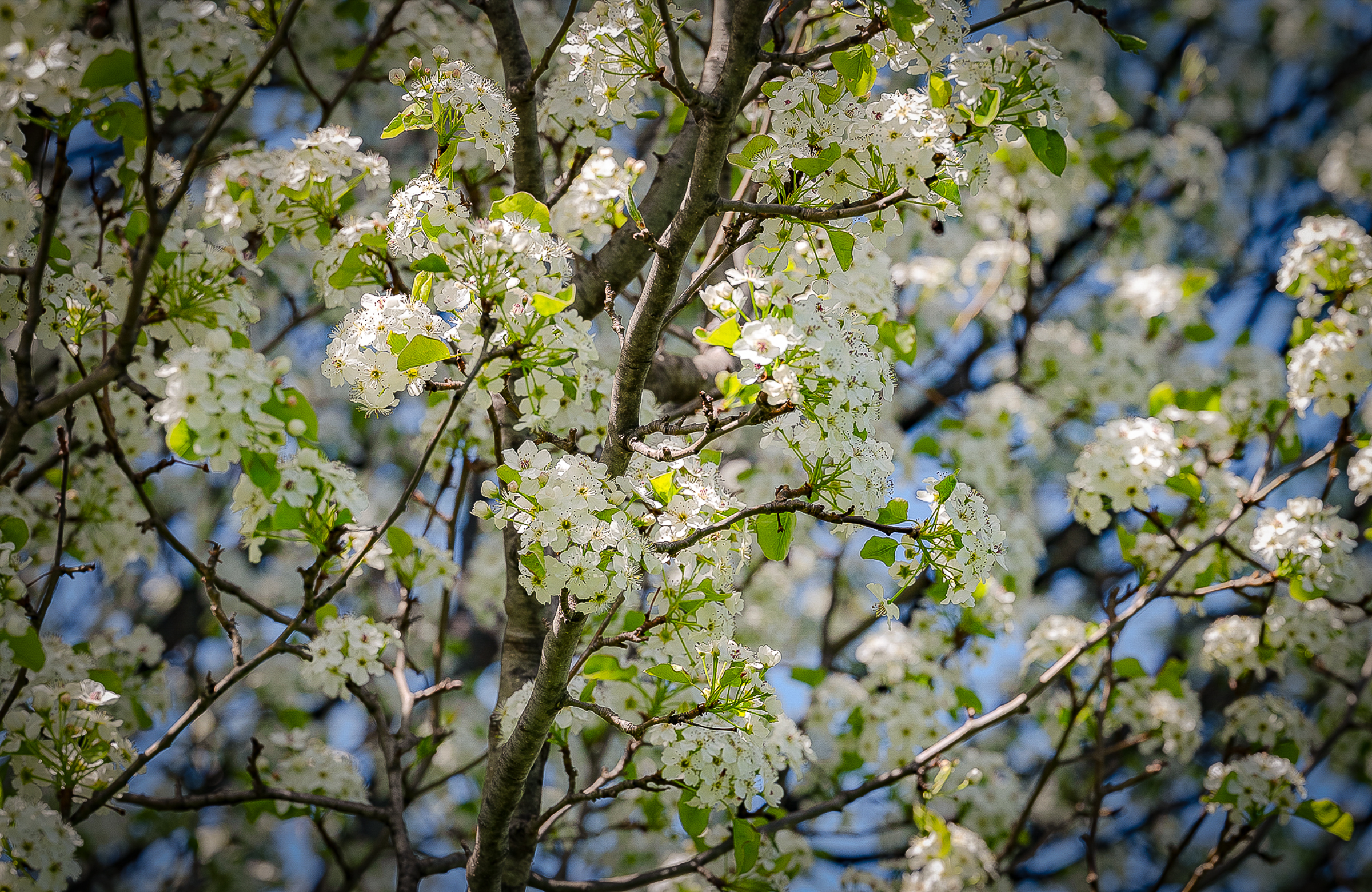
The featured image, “Symphony In White,” is courtesy of Julie Jablonski and is used with her kind permission for Cultivating.

Amy Malskeit, a columnist for Cultivating Magazine, holds an MA in creative writing from Lancaster University in England. Her poetry and creative nonfiction explore questions about God, faith, and the soul, letting these refract through the small moments in her life.
She lives in the foothills outside Denver where she plants her garden and makes her home with her husband, two children and a sassy Tibetan Terrier. When she’s not reading or writing, she enjoys laughing with her family, finding ways to swim in an ocean, and nurturing ways of living creatively.

Relating this journey to the image of the knotted necklaces puts it in a different context to explore along with the words “not resulting in merely right thinking, but in the slower work of right being”–thank you for this.
Love this Amy. Thanks for sharing!