


You keep track of all my sorrows.
You have collected all my tears in your bottle.
You have recorded each one in your book.Psalm 56.8 (NLT)
One day, as I was driving my seven-year-old daughter to school, she told me how frightened she was of crying in school that day. She’d felt sad lately, and a few recent teary moments in class left her feeling confused and alone. I tried to encourage her, explaining that God is always with her and loves her so fervently that He catches all her tears and puts them in a bottle. To my surprise, she perked right up.
“Really?” she said.
“Yes, really.” I replied.
Later that day, as I drove her home, she told me about her day.
“And Mama,” she began, “I started to cry, but then I remembered that God was putting my tears in a bottle and He loves me, and I felt better!”
My heart swelled with gratitude to God as I offered up a silent prayer of thanks.
But I knew that even as I spoke those words to her that morning, I struggled to believe that they applied to me, too. Why is it so difficult for adults to trust that God cares about our tears? “Surely He has borne our griefs and carried our sorrows . . .” (Isaiah 53:4 ESV) We want proof—we want God to walk through our front door and sit us down, listing all the reasons we should trust Him when our lives go awry.
But truthfully? God has given us ample evidence of His tender love, and it’s right outside our doorsteps.
Most of modernity has forgotten how much we depend (quite literally) on the soil, the air, the water, and the cycle of seasons for our sustenance. We forget because the majority of us aren’t outside working with the soil anymore. Even online grocery orders have us a step removed from physically touching the produce in the grocery aisle—turning over a shiny apple, smelling the fragrance of a vined tomato, or knocking on a melon to gauge its ripeness, filling our carts with our “yield.”
No, I’m not denigrating technology, but I am suggesting that the nearer we are to the land we subsist upon, the easier it is to understand the language of God.
George Washington Carver wrote, “Reading about nature is fine, but if a person walks in the woods and listens carefully, he can learn more than what is in books, for they speak with the voice of God.”[1]
Christ taught His audience through parables of the land not just because they knew it so much more intimately than you and I do, but because He made it, and it speaks with His voice. We order our lives by the physical world around us, deriving meaning from what we observe and experience. Poets and artists are especially famous for drawing from the patterns of nature to illustrate the raw places of the human heart. C.S. Lewis is no exception. His poem The Naked Seed unashamedly employs imagery from the natural world to analogize the human experience. In the poem, he describes his grief-stricken state and addresses God directly. He writes,
“My heart is empty. All the fountains that should run
With longing, are in me
Dried up. [. . .]
If thou think for me what I cannot think, if thou
Desire for me what I
Cannot desire, my soul’s interior Form, though now
Deep-buried, will not die,
—No more than the insensible dropp’d seed which grows
Through winter ripe for birth
Because, while it forgets, the heaven remembering throws
Sweet influence still on earth,
—Because the heaven, moved moth-like by thy beauty, goes
Still turning round the earth.”[2]
Humans share a common DNA with creation; the dust of the earth is in our very bones and blood. We exist in a symbiotic relationship with nature, and the more we understand this relationship, the more we hear God’s voice echoing in the wind and calling to us from the waters.
In the ancient world, cisterns collected rainwater and fed it into wells and pools throughout the cities. Today, modern home gardeners living in areas prone to drought use rain barrels to collect rain water and use it to slake the thirst of their gardens when moisture is scarce. In the Middle East, particularly in ancient times, the precious oils of plants were secreted and kept in bottles and jars to be used for sacred occasions. Today in the West, we use tiny glass bottles of essential oils for healing ailments, or for the pleasure of basking in their fragrance filling our living rooms through misty diffusers.
These resources are all garden-grown and heaven-sent—a means of God’s goodness and provision. If we collect the sources of nature for life-giving purposes, what does it mean that God collects our tears from the deep wells and cisterns of our grief?
Nature teaches us about the love and faithfulness of God because it, too, was stamped by His hand at the creation of the world. He speaks through it. He knows our sorrows. He lived our sorrows. God embedded the patterns of resurrection into creation itself that we might see and believe, thousands of years later, that Christ is Lord, death is defeated, and Love has won.
But the beautiful irony is that doubting is a part and parcel to believing. As the apostle John writes in Scripture, even those closest to Jesus doubted the reality of Christ’s return; the disciple Thomas refused to believe it without “proof.” And what does Christ do? He invites him to come and touch the scars in His hands and tangibly believe that Christ is both Lord over and Creator over all creation; over life AND death. God invites our doubts. He does not scold Thomas for his unbelief. He allows Thomas to contend with his doubts in the loving presence of the very One he doubts. I can almost imagine His words:
“Come. Touch my hands. Trust that I am He. Trust that I walk with you, always. Trust that death has no hold on Me—or you.”
My story is not unlike Thomas’s. Mine took place in my garden, and it involved the great reckoning of my heart: believing God was still good in the face of my mother’s untimely death.
In those first few weeks after the funeral, I continued my plans to carve out a small garden plot in my backyard. Each heavy shovelful of dirt was accompanied by anger and sobs roiling in my chest. My hands grew calloused, my nails dried out in the dirt, and my joints ached with the ceaseless labor. As I railed against God, I thought my conversation was one-sided. But I was wrong.
He spoke to me through the soil I was laboring in. In the days and months that passed, in watching, firsthand, teeny tiny seeds grow into blooming three-foot tall flowers stalks, my faith was resurrected; I began to trust that somehow, in some way, God wept too, and that beyond my immediate reality, He held my mother lovingly—compassionately, and safely. Someday, somehow, I will understand it fully. But I learned that my garden offered the quiet invitation to believe that the Lord loved me both intimately and infinitely.
The tears that fell to the soil from my dirt-streaked cheeks were precious to Him—held in an empathy deeper and older than creation itself. In a mysterious way, as the soil mingled with my tears, the DNA of the Creator, murmured.
It’s as though He said,
“Come. Plant a garden. Touch the soil. Make a hole, like the holes in My hand, place into it a seed, and believe in Me . . . and the life to come.”
Some days, I still doubt. I still tell my daughter truths that I cannot always whole-heartedly embrace. But trusting the silent voice I hear in my garden? I remember resurrection—I remember new life comes, and I remember hope is alive.

[1] From George Washington Carver: In His Own Words, edited by Gary R. Kremer (University of Missouri Press, 1987)..
[2] The full poem may be found in Poems (Harper Collins), a collection of C. S. Lewis’s poetry first compiled in 1964 by Walter Hooper.
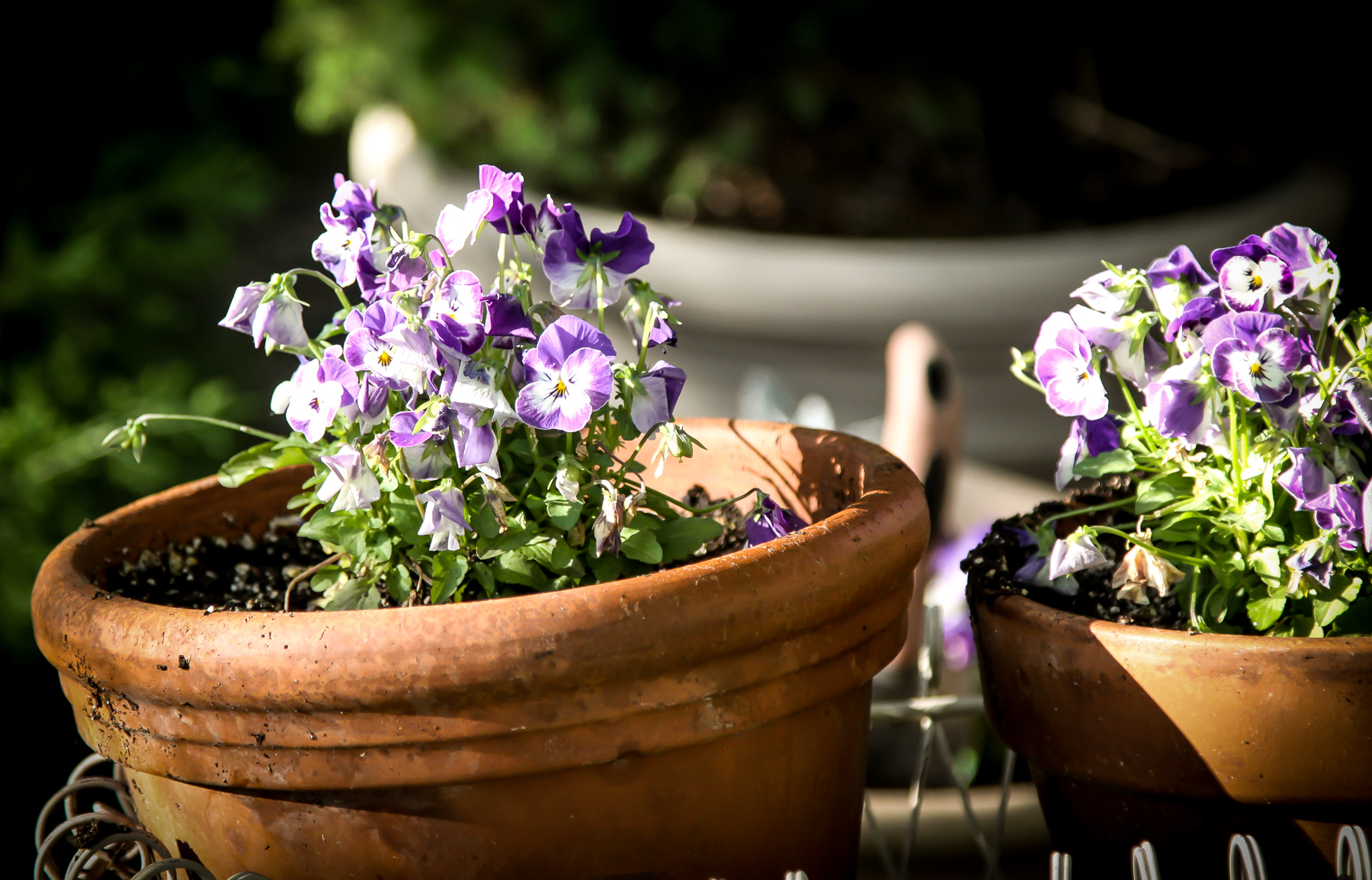
The featured image, “Violas in Terracotta,” is courtesy of Lancia E. Smith and is used with her glad permission for Cultivating.

A founding member of The Cultivating Project, Christina has been fascinated by beauty her whole life. Color, texture, pattern, fragrance, melody, light – all of the boundless ways in which creation shines – ignites her imagination, compelling her to create. Even as a wee sprite, Christina was dedicated to wordsmithing and sketching her way through its marvels in an attempt to capture, at least partially, the imprint of the Creator within it. But writing and drawing are not her only creative endeavors; several years ago she took on the laborious (but rewarding) task of nurturing a garden in the dismal soils of the Rocky Mountain foothills, and has eagerly employed her spade (alongside her pen) as a tool to cultivate and curate the beauty around her.
She has two little gardeners-in-training who embody all these marvels and more in their merry little faces. She and her husband Brian are the founders of the Anselm Society based in Colorado Springs, whose mission and calling is a renaissance of the Christian Imagination. She serves as the Director of the Anselm Society Arts Guild and her creative work can be found at LiveBeautiful on Substack and on Instagram.

This is the kind of essay that demands to be read slowly, and returned to again and again. So much goodness, so honestly said. Thank you for handling the difficult truth so beautifully — that pain and sorrow are real and will always be with us. And *He* is real and will always be with us.
Ah, thank you, Mandy. Yes. That is most certainly the hope I had tried to convey. It still takes faith to put it into action, day by day. But I’m learning.