


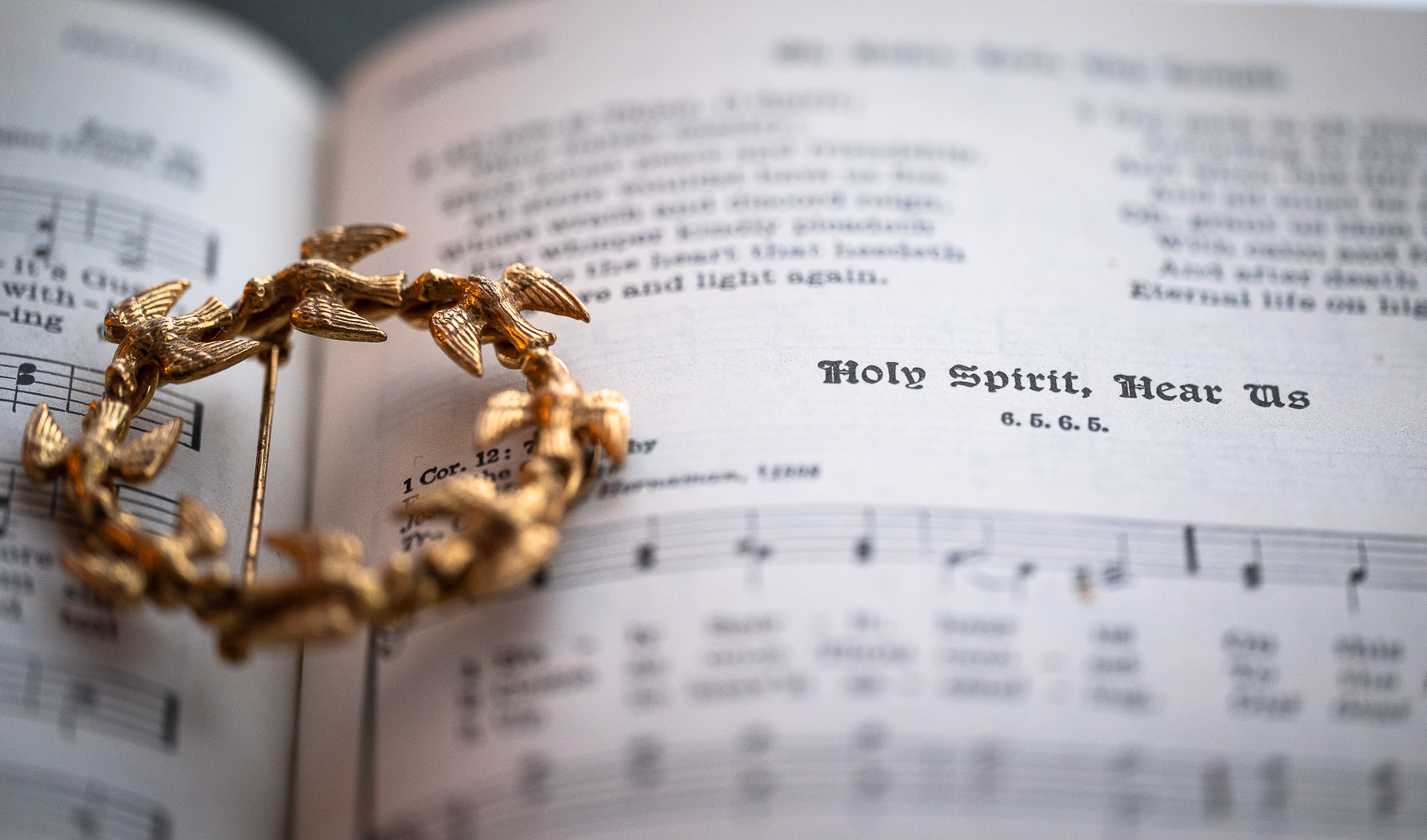
Why are we encouraged to sing psalms, hymns, and spiritual songs to ourselves and with others? In this column, Cultivating Songs of Faith, we explore that question by looking at one particular hymn each season, offering the story of its creation from the life of its author or composer. What you see here is a reflection rather than a formal academic history. I hope to help you to taste, see, and rediscover what is good in great hymns, and also occasionally enter into the conversation they have with ancient psalms and modern spiritual songs.

It is in moments when I am surprised by unexpected beauty that my heart is irresistibly drawn to marvel at the goodness of God. Remembering His goodness, my soul begins a journey towards gratitude.
I have memories of being surprised by a sunset streaking color across the sky, marveling at a particularly bright full moon at night, or seeing a rainbow appear after a rainstorm. An experience of beauty in the present has a way of connecting our soul to memories from the past, like a golden thread weaving it’s way through the tapestry of our lives.
An experience like that was the inspiration for Swedish poet and minister, Carl Boberg in 1885. He was walking with friends, returning home from an afternoon service at a church in their village near the sea. He witnessed the grandeur of creation displayed in a series of natural wonders in a single afternoon. Boberg wrote of the experience:
“It was that time of year when everything seemed to be in its richest colouring; the birds were singing in trees and everywhere. It was very warm; a thunderstorm appeared on the horizon and soon there was thunder and lightning. We had to hurry to shelter. But the storm was soon over and the clear sky appeared. When I came home I opened my window toward the sea. There evidently had been a funeral and the bells were playing the tune of ‘When eternity’s clock calls my saved soul to its Sabbath rest.’ That evening, I wrote the song, ‘O Store Gud.’”
Boberg wrote his text in Swedish, and a literal English translation of the first verse reads this way:
O great God, when I behold that world
You have created with your omnipotent word,
How your wisdom guides the threads of life,
And all beings are fed at your table:
Refrain:
Then my soul bursts forth into praise:
O great God, O great God!
Then my soul bursts forth into praise:
O great God, O great God!
Boberg’s poem with the original eight verses and repeating refrain was published in a local newspaper the next year. He later discovered that the words fit nicely with an old Swedish folk tune and a new song found it’s way into a hymnal in 1890. After this humble beginning, the story of “O Store Gud” and it’s travels across the world are almost as surprising and dramatic as Boberg’s experience of that summer thunderstorm.
First, Boberg wrote a ninth verse and sold the rights to the song to the Mission Covenant Church of Sweden and it appeared in their hymnal. Then, an American college professor discovered it and translated it carefully into English. In 1925 it was included in American Covenant Hymnal with the title “O Mighty God.”
It was in 1931 that another English version, this time a paraphrase, was begun by the British missionary Stuart Wesley Keene Hine (1899-1989.) While on an evangelistic mission in Ukraine, Hine heard a Russian translation of a German version of the song. He was so taken with it that he immediately set out to rewrite the poem into English. He gave this new version the title, “How Great Thou Art.”
Hine sang the song in Russian during evangelistic services, while continuing to tweak his English version, even adding completely original verses like this one:
And when I think that God, His Son not sparing,
Sent Him to die, I scarce can take it in;
That on the Cross, my burden gladly bearing,
He bled and died to take away my sin.
Hine was forced to leave Ukraine during the Holodomor famine in 1933, and ended up in Britain ministering to displaced Russians during the second world war. There he met a refugee, a Christian, who shared his story of being separated from his wife during the war. The man expressed his deep desire to be reunited with her in heaven where they and other believers would share eternal life together. This story inspired Hine, and he wrote the fourth and final verse of his poem:
When Christ shall come with shout of acclamation
And take me home, what joy shall fill my heart!
Then I shall bow in humble adoration
And there proclaim, my God, how great Thou art!
The final English version of Hine’s hymn set to the original Swedish tune was published with the title “How Great Thou Art” in a Russian gospel magazine in 1949. This magazine circulated around the world and the hymn became popular in every country that it reached.
Now the adventures of this hymn took several turns that could never have been imagined by either Boberg or Hine. A man from Pasadena California heard the song being performed in a small village in India, with harmony arranged by the tribesmen who sang it. He brought it back to California and shared it at a conference. This caught the attention of a former member of the Sons of the Pioneers, who was now the owner of the newly established Manna Music Company. And that’s how a former cowboy negotiated with the British missionary Hine for the purchase of a song originally written by a Swedish pastor!
But the journey of “How Great Thou Art” was just beginning. It was in the 1950s when George Beverly Shea sang it as the signature song of the Billy Graham crusades that the hymn became a favorite of people all over the world.
“How Great Thou Art” won Elvis Presley two grammy awards (in 1967 and 1974.) It was named as Britain’s favorite hymn in 2005. In 2011 Carrie Underwood’s recording of the song reached the No. 1 spot in iTunes’ “Top Gospel Songs” as well as its “Top 40 All-Genre Songs.”
Maybe part of the power of this song is that it taps into memories each of us have of God’s beauty and majesty revealed in the natural world. When we encounter His beauty we can’t help but respond in gratitude and praise, like the writer of Psalm 8:
“O Lord, our Lord, how majestic is your name in all the earth! You have set your glory above the heavens.” (Psalm 8.1, ESV)
Then sings my soul, my Savior God, to Thee;
How great Thou art, how great Thou art!
There is another remarkable thing that happens to us when we sing songs of praise like this one. Our soul is moved as we praise God, and in that very act of praise we find ourselves being transformed. As our minds begin to ponder His goodness, gratitude is rekindled in our hearts.
There is another setting of Psalm 8 that captures the wonder of God’s creation. It artfully combines the words of the text with creative melodies and harmonies that make my heart sing. It is a choral anthem titled “The Majesty and Glory of Your Name” written jointly by Linda Lee Johnson (words), with Tom Fettke (music.) If you love choral music, you will enjoy listening to this and letting your own soul be renewed in gratitude. It joins in the song of all creation, “O Lord, our God, the majesty and glory of Your name transcends the earth and fills the heavens.” [1]
O Lord my God, when I in awesome wonder
Consider all the worlds Thy hands have made,
I see the stars, I hear the rolling thunder,
Thy power throughout the universe displayed.
Refrain:
Then sings my soul, my Savior God, to Thee:
How great Thou art, how great Thou art!
Then sings my soul, my Savior God, to Thee:
How great Thou art,
How great Thou art
When through the woods and forest glades I wander
And hear the birds sing sweetly in the trees,
When I look down from lofty mountain grandeur,
And hear the brook and feel the gentle breeze.
(Refrain)
And when I think that God, His Son not sparing,
Sent Him to die, I scarce can take it in,
That on the cross my burden gladly bearing,
He bled and died to take away my sin.
(Refrain)
When Christ shall come with shout of acclamation
And take me home, what joy shall fill my heart!
Then I shall bow in humble adoration,
And there proclaim, “My God how great Thou art.”
(Refrain)

[1] I hope you love listening to this choral piece as much as I do. You can find it on YouTube here: The Majesty and Glory of Your Name.
The featured image, “Holy Spirit, Hear Us,” is courtesy of Julie Jablonski and used with her kind permission for Cultivating.

Terri Moon is a musician and a lover of Jesus. She delights in playing the music of Bach, growing English roses, baking up a good batch of scones, and all good, true, and beautiful things that point to Him. She has found that the most fulfilling adventures come through collaborating with others, and to that end she and her husband Steve (also a member of The Maker’s Project) serve gladly in their church and also on the leadership team of the Anselm Society. Together they raised four children and are now proud grandparents. Hosting friends in their Colorado home is one of their favorite joint adventures.
Terri holds a master’s degree in violin performance, and has collaborated in many concerts and taught students of all ages for 40 years. Her lifelong passion is the intersection of music, worship, and spiritual formation, and she longs to bring to life the beauty of the Church’s heritage in the arts. Terri currently serves as the Music Director of Holy Trinity Anglican Church in Colorado Springs.

Add a comment
0 Comments