


The Cultivating Poetry column will explore both the writing and reading of poetry, and the practical ways this intersects with how our souls are formed. We will consider a range of poets, both contemporary and historical, looking for their invitation to us to see differently, to inhabit the world, together finding courage to live as a poeima in this beautiful, terrible world we have been given.

I was living in a duplex with a shared back yard when I planted my first garden. My landlords offered me a small plot behind the garage to grow tomato plants, and a shaded spot to grow lettuce. I picked out too many packets of seeds at the grocery store, some tomato cages and bags of compost, and got to work. I planted herbs in soil so rich they couldn’t grow. My bumper crop of lettuce was such evidence of my success that I did not thin it, only to find hornworms thicker than my thumb devouring the tangle of leaves. It was a mess.
In Genesis, when God plants humankind (named ha adam in Hebrew, made of adamah, earth) in the garden, part of the role given to humanity is to shamar: to tend, or to cultivate. As I’ve followed the word shamar further into the Hebrew scriptures, I have thought of the literal gardens I’ve tended, wondering how my call to cultivate extends beyond literal plots of land, and where might this tending intersect with the work of forgiveness?
I loved my first garden, and it loved me back by not only feeding me, but showing me so much that I did not know. I had no idea how to tend the soil, how much room growing things needed, nor how much I liked to do things the way I thought they should be done. My soul needed to learn how wide the invitation to shamar reached. I needed to become a student of the soil, the seeds, and, in new ways, of myself. I had not yet seen that the death that happened in the first garden was not just a physical one, but the death of relationship with God, with myself, with the Other, and with the earth (adamah). And the story that unfolds through the First and Second Testaments contain invitation after invitation to find my way back to the garden of delight (eden), to tend to the places that have experienced death, and to do the hard work to create conditions for restored relationship in every place where death has had its way.
The word shamar is used over 400 times through the Hebrew Bible, often translated differently in English, so it is difficult to trace where the word appears. For instance, when Cain answers God’s question, instead of admitting to the murder of his brother, he asks, “Am I my brother’s shamar?” (Genesis 4.9). In other words, “Is it really my job to tend to my brother?” The answer, from the beginning, is meant to be yes.
We, the descendants of Adam, are all called to shamar. Where there are boulders in my field that will keep growing things from flourishing, I must remove them.
Genesis does not conclude until Joseph, a man who suffered brutality at the hands of his brothers, chose not to pay back what he had received, but to shamar, a tending that included forgiving his brothers’ evil actions against him. Genesis ends where the answer to God’s question is no longer Cain’s no, but Joseph’s yes.
Turning the page to Exodus, the newly-born Hebrew people are camped for the first time at Mount Sinai; Moses brings them the law, which includes the instruction to keep—shamar—the Sabbath. This God is inviting his people to see a fundamental difference from Pharaoh. Instead of demanding production and perfection, YHWH’s followers are given another mandate: to cultivate a regular rhythm of stopping to rest. When I stop, I am faced with my humanity, in all of its glorious mess: my exhaustion, my limits, my addiction to screens, the way my sense of self is shaped by how much I can produce. In Proverbs 4, we are to shamar our hearts, for from this heart flows life itself. When I make space to stop, I might turn toward this wellspring that bubbles up in the middle of the garden of my heart, tending to what I find there. I can walk the places where weeds wind around sprouts of good that are about to flower, the places where the soil is hard, or strewn with stones. Tending the garden of my heart invites me to come out of hiding, to tell the truth, to practice presence, and so present to what is, not what I would like to be.
Learning this kind of honesty with myself takes time.The kind of tending that shamar calls us to isn’t compatible with dishonesty or escapism; that’s not the narrow road Jesus spoke of. That’s the easy way out.
The first time I read Margaret Atwood’s poem [you fit into me] I was arrested by her economy, and her honesty:
you fit into me
like a hook into an eye
a fish hook
an open eye
In one stunning metaphor, Margaret Atwood cuts to the heart of betrayal, of the way things are so beautiful and good until they aren’t. Atwood’s narrator tells the truth in these four spare lines, and there begins a conversation, naming the wound, a place where death festers.
I cannot forgive until I name the truth of my experience to myself and to others. This truth telling is vital. Following my original calling to be human will unfold healing in and through me, but I can not enter this space of healing until I have named the wound. In this naming, I grieve the places where there is death, and in so doing, make room for life, for freedom, for wholeness. Jesus describes this spaciousness:
“Love your enemies, do good to those who hate you….[L]end, expecting nothing in return; and your reward will be great, and you will be sons of the Most High; for he is kind to the ungrateful and the selfish. Be merciful, even as your Father is merciful. Judge not, and you will not be judged; condemn not, and you will not be condemned; forgive and you will be forgiven; give and it will be given to you; good measure, pressed down, shaken together, running over, will be put into your lap. For the measure you give will be the measure you get back.” (Luke 6:27-38 NKJV)
There are times when I read these words and feel the impulse to double down on my efforts to walk even straighter and narrower than I already am. But the invitation to shamar is not a command to achieve. I am invited to participate in the restoration wrapped up in forgiveness, to contend again and again with the pain of what can feel unforgivable, but that doesn’t depend upon me.
Father Jacques Phillipe speaks to the struggle to forgive in his little book Interior Freedom. About Luke’s words he writes,
“These words are very demanding, but we need to understand the demand as a magnificent ‘gift’ God wants to give us. God gives what he commands, and this text contains a promise: God can transform our hearts to the point that they become capable of loving with a love that is pure, freely given, and disinterested as God’s own love. God wants to give us the gift of forgiving as he alone can do, and so make us like himself.” [2]
Forgiveness is not a work I must undertake alone, but, if I want to be human, I can open myself to partnership with God to allow God to do what only God can. This is the work of tending. If I let it, forgiveness brings me (again and again) to the end of myself, as I come to the table of the Eucharist: my body, broken for you. My blood, shed for you. When I lean into the messy, uncertain work of forgiveness, I grow up into my humanity, become more human.
At the end of Genesis, Joseph seems to have already forgiven his brothers when he first encounters them, encouraging them to “not be grieved or angry with yourselves, because you sold me here; for God sent me before you to preserve life.” (Genesis 45:5) But it is not until after Jacob dies that the brothers name their sin to Joseph. They do so, fearing that Joseph has held a grudge for the seventeen years they have lived in Egypt, and will be out for revenge, now that their father is gone. It is when they speak this truth that they allow the circuit of forgiveness to be closed. Truth-telling on both sides is essential to our call to shamar, to our journey toward forgiveness, toward becoming human, to tend the connections to our fellow humans without pretending. Without this, the stones remain, and real relationships can never flourish.
Forgiveness is not easy work. It is participating with God in the honest restoration of relationship—to God, myself and others. As much as it can depend upon me, the call to shamar is choosing to cooperate with life, not death. And when I struggle to face the wrong I am capable of, when I am the one in need of forgiveness, I am invited to move up and out of myself, to believe that grace is also for me.
This spring I planted my garden in the foothills outside of Denver. I didn’t crowd the lettuce; instead birds and squirrels bit the little leaves off all of my transplants. Most of my basil has died for reasons I don’t understand. My tomato plants were taller than I could reach until a summer hailstorm ravaged them. As I trimmed back broken branches, my lament was mixed with praise. I can’t garden this side of Eden with the certainty of fruit. I can keep tending the soil. This tender work of cultivating is the work of my life. I am a partner, but I do not bear the burden of how my garden grows. I am meant to be moving and growing, giving and receiving forgiveness, believing in a God who has not left me alone. And when I do this, becoming human alongside my brothers and sisters who are hard at work doing the same.

[1] Margaret Atwood, “[you fit into me]” from Selected Poems 1965-1975.
[2] Philoppe, Jacques, Interior Freedom.
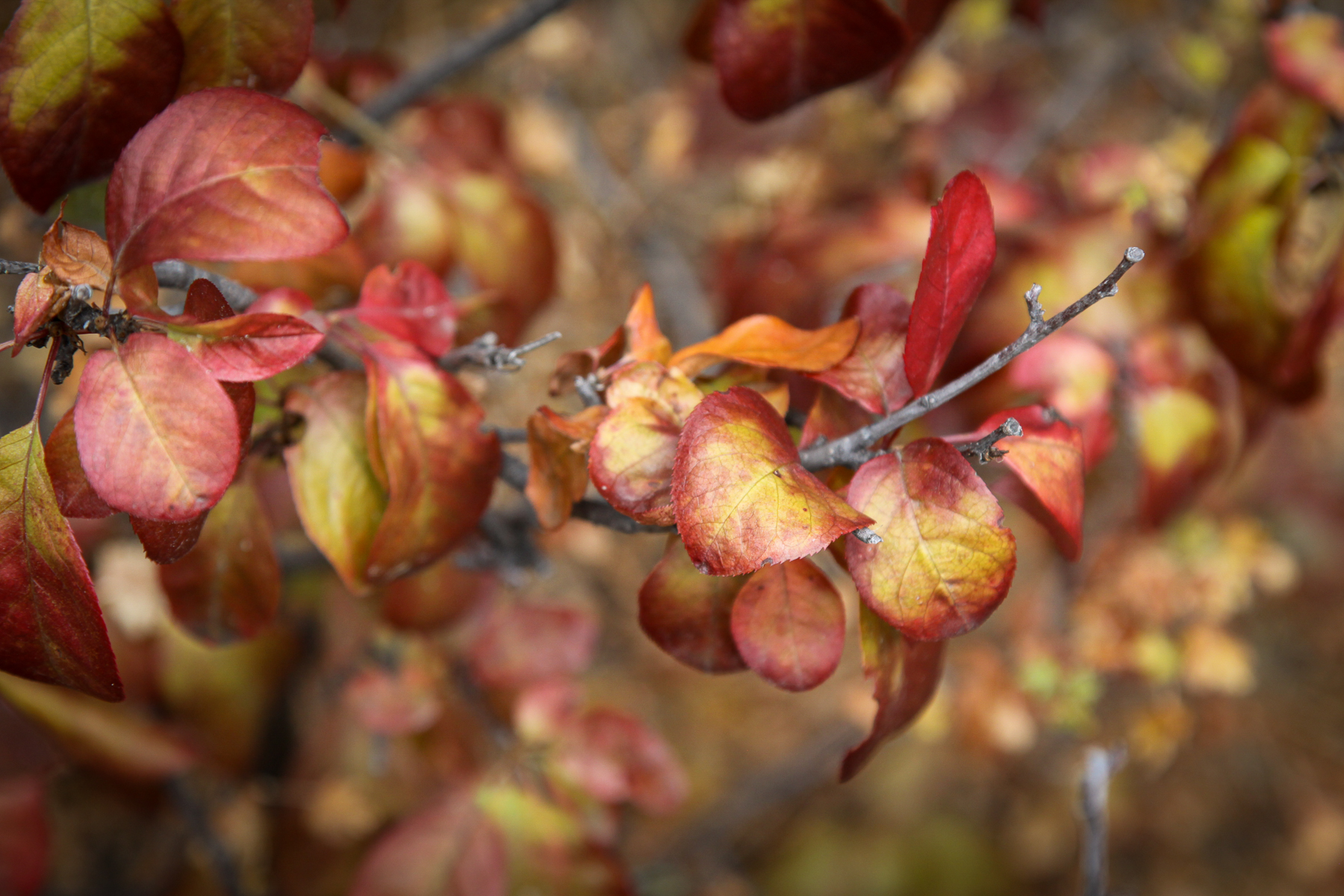
The featured image, “Apple Leaves in Autumn,” is courtesy of Lancia E. Smith and is used with her glad permission for Cultivating.

Amy Malskeit, a columnist for Cultivating Magazine, holds an MA in creative writing from Lancaster University in England. Her poetry and creative nonfiction explore questions about God, faith, and the soul, letting these refract through the small moments in her life.
She lives in the foothills outside Denver where she plants her garden and makes her home with her husband, two children and a sassy Tibetan Terrier. When she’s not reading or writing, she enjoys laughing with her family, finding ways to swim in an ocean, and nurturing ways of living creatively.

Add a comment
0 Comments