


Twenty-first century mothers are often offered a narrative in which they are martyrs and “hot messes,” lost in their roles as caretakers of tiny souls—but Cultivating Motherhood aims for something deeper and more grace-filled. As a mother, I know the need to cultivate a whole life rooted in Christ only intensifies as my daughter grows. My hope for this column is to share practical ways to still flourish and cultivate wholeness in Christ, while also inspiring our children to grow into sturdy oaks of righteousness.

“When people-pleasers have children, they have a choice. They can remain the same and feel constantly anxious, disappointed, and embarrassed. Or, they can change.”
— Rachel Joy Welcher, “Fits and Failures”[1]
My Molly-girl is going through a phase. If you’ve ever parented a toddler, you know what I mean: a phase full of angry screaming, constant clinging, and a bone-deep unhappiness no matter what Mama and Daddy offer or try.
(In her defense, I finally tackled her to the ground this morning and looked into her mouth: Sure enough, I found two enormous teeth cutting through her gums. Mystery solved. Bring forth the Baby Ibuprofen!)
This constant misery does not discriminate between the privacy of our apartment and other, more public spaces. Earlier this week I brought her to my parents’ home for a morning of play. By noon, she was inconsolable for no obvious reason: wailing, flinging her pacifier, hurling herself backwards in my arms.
We’d planned to eat lunch with my mom and sisters, but Molly’s behavior had my every nerve on edge. “Time to go home,” I declared, and I gathered up our things in a rush and headed out the door.
My mom followed me on my way out. As I opened my car door and settled Molly in her car seat, I apologized for the state of my car (messy). My mom laughed.
“You act like I’ve never seen a messy car before,” she said. “Or heard a fussy baby.”
It was said kindly, good-naturedly—but my conscience winced. Was I taking Molly home because it was the best thing for her at the moment . . . or was I concerned about what my family would think of my parenting skills?
My husband and I have borrowed from a few different parenting methods as our daughter has grown. We’d like to be firmer on some things yet considerably more lenient on others. While I’m more inclined towards being a disciplinarian, I’m also terrified of becoming the overbearing parent described by the Apostle Paul who drives his child away (Colossians 3:21).
What startled me that day at my mom’s house, however, was the shameful realization that my disciplinarian tendencies aren’t even about making sure my toddler acts like a respectable member of society (which is unrealistic in and of itself). No, I’m far more worried about making sure everyone knows I’m a good, responsible parent who makes her kid toe the line.
And honestly, that’s appalling.
In a remarkable essay titled “Fits and Starts,” fellow pastor’s wife Rachel Joy Welcher describes a difficult Sunday where her three-year-old daughter Hildegaard launched into a tantrum so ferocious that Rachel had to bring her home from church. Once home, “Hilde” and her baby brother succumbed to exhausted naps. But as Rachel grappled with her own shame and irritation over all her friends and fellow congregants witnessing her “failure” to control her child, she made a choice.
She chose to worship: “. . . for my own tired heart, and for my babies, who were just acting like babies. So I began to sing the Doxology, followed by Be Thou My Vision.”
The baby went slack in her arms. Drowsy Hilde relaxed, then whispered, “I wish I was better.” Her awareness of her own sin, even at her tender age, had risen to the surface.
Rachel, cut to the quick, writes to her daughter:
Am I preaching forgiveness while living out some sort of moralism? Am I heaping shame instead of grace on your baby shoulders? . . . Your little body and heart are already asking: How many times can I sin and still be loved?
As many times as it takes for you to realize that Jesus’ love is a well that never goes dry.[2]
When I first read this essay, I started crying right there. How often have I cowered in shame every time my baby made an unruly noise in church? To be fair, there was actually a time in our life as a family where we were made to feel shame for that, and it isn’t easy to recover from that kind of humiliation.
But here’s the hard truth: staying in that shame will not only harm and stunt my growth. It will harm and stunt Molly, too. She will grow up feeling shame and disgrace for the normal, developmentally-appropriate emotional hurdles common to all sinful little souls—and it will carry over into the way she views, regulates, and treats herself throughout the years.
Trust me: I know how it feels. And I don’t want to inflict that on her.
Going back to Rachel’s experience: Do you notice how she not only chose worship, but something else, as well? Did you see how she chose her children’s highest good?
I often make the mistake of thinking that knowing how to be well behaved is my child’s highest good. It’s not. It’s important—I do want my daughter to eventually know how to be an honorable, civilized member of society—but at the end of the day, it is not her highest good. Her highest good, instead, is that she rests in the love of her Father in Heaven, for her heart will be restless unless she rests in Him.[3]
This is what Rachel chose to focus on in that moment of deep, relatable stress and exhaustion: She directed her gaze and her little ones’ gazes to Jesus. She remembered what truly mattered. And she was faithful to it.
We—I!—have got to keep things in perspective. Yes, I should train my little girl in the way she should go—but I also need to disciple her in love, to remind her that Jesus’ love never runs dry, no matter how many times we stumble on our way to drink from Him. Yes, I will one day teach her to sit quietly in a pew while her daddy delivers God’s Word from the pulpit—but I also need to set an example for her of listening and worshipping with my whole heart, not because I want to make a good impression, but because I’m pursuing my own highest good.
Lancia E. Smith once wrote:
“Cultivating is more than gardening or land management. It is a practice, a way of life, a way of being. It is a reclaiming and defending of goodness. It is a choosing of life, over and over again.”[4]
Reclaiming, defending, choosing—these verbs all imply a faithful, relentless pursuit of something good and true and beautiful. It isn’t easy (nothing worth pursuing ever is). But Jesus Himself is relentlessly pursuing our highest good—union with Himself—and He has given us these precious little souls to shepherd and nurture and, yes, even cultivate for His glory. Union with Him is their highest good, too.
Let’s faithfully pursue that together, shall we?
Questions and Considerations:
- Consider the opening quote from Rachel Joy Welcher. Do you struggle with people-pleasing? If so, does it impact your relationship with your child(ren)?
- Think back to a time when you felt shame over something. What helped you fix your eyes on Jesus? How might you share that experience and practical solutions with your child when they feel shame?
- “Fidelity,” according to the Cambridge Dictionary, means “the state of remaining loyal to someone and keeping the promises you made to that person.” But it can also mean “the degree to which a copy of something shows the true character of the original.” How might our pursuit and cultivation of our child(ren)’s highest good help them discover their true identity rooted in Jesus?

[1] Rachel Joy Welcher, “Fits and Failures,” from her “Dear Hildegaard” Substack. As a young mom, I cannot recommend this sweet essay enough!
[2] Ibid.
[3] As Saint Augustine wrote in his autobiographical Confessions, “Thou movest us to delight in praising Thee; for Thou hast formed us for Thyself, and our hearts are restless till they find rest in Thee.”
[4] Lancia E. Smith, “Good, True, and Beautiful.”
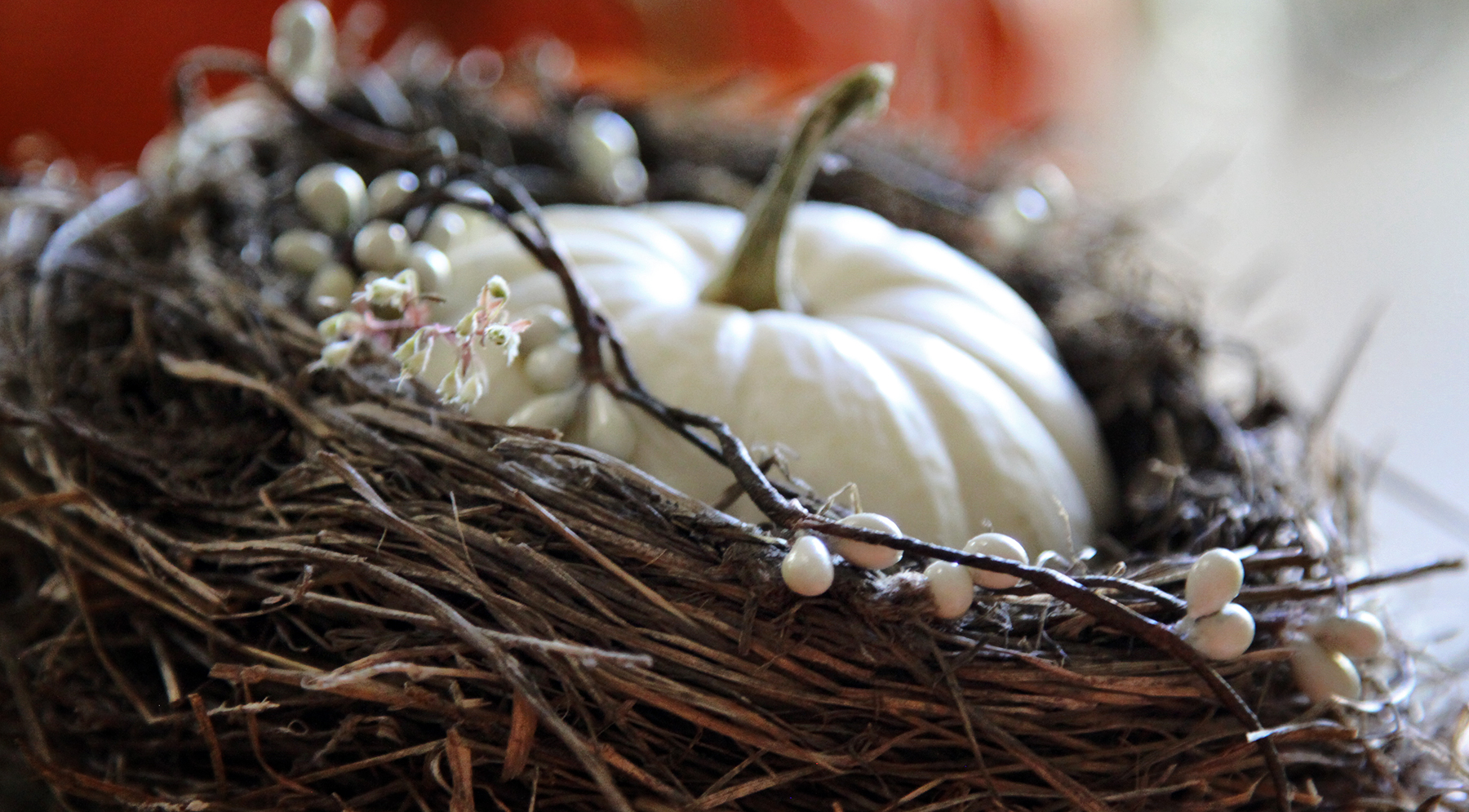
The featured image, “Baby Pumpkin in Nest,” is courtesy of Lancia E. Smith and used with her glad permission for Cultivating.

As someone who loves creating cosmos from chaos, Maribeth Barber Albritton is a storyteller at heart. Even in seasons requiring a fierce stubborn courage, she will be finding ways to tell herself and others a good, true, beautiful story. As part of that broader storytelling bent, Maribeth serves as Executive Director of Cultivating Oaks Press. She has contributed to the production of Cultivating Magazine’s online and print editions, and currently writes the Cultivating Motherhood column. She was privileged to serve as Executive Assistant at The C.S. Lewis Foundation from 2022-2024.
Her self-published science-fiction novel, Operation Lionhearted, was a double-finalist in the 2022 Realm Awards (Debut & Science Fiction Categories). These days, she writes “Letters from Crickhollow,” a Substack for those who want to cultivate beauty, grace, and courage in their busy lives.
Maribeth, her pastor-husband Casey, and their daughters Molly and Leslie live in Louisiana, where they love taking long walks through state parks and adding theological volumes, novels, and board books to their family library.

Add a comment
0 Comments