


The Cultivating Gardener is a column designed to engage all garden lovers, regardless of skill or experience, as we glimpse, together, the deep tenderness of God hidden in our own backyards. In this column you will find reflections, resources and tips designed to help you expand your vision of what it means to cultivate your own plot of land. As you pursue this good and holy work of garden-tending, my hope is that you will find your own heart lovingly tended by the Great Gardener of both our soils and our souls.

Three years ago, I received a diagnosis for my chronic pain. I was told I had Ehler’s Danlos Syndrome (EDS), and suddenly my life-long symptoms made sense; the agonizing mystery was solved. But there is no “fix” for it; I’m stuck with this condition for life. But I was told I could learn to manage it, and I was ready.
Since that day, under the guidance of an EDS specialist, I’ve undertaken the exhaustive journey into learning the physiological techniques that rewire my neurological pathways, teaching me to move my body in ways that preserve, rather than hurt it. In this way, I can learn to keep my symptoms (for the most part) at bay.
And friends, this journey is hard. There is a lot of grieving to do along the way. But in slowly training my way into success, I’ve found a camaraderie I didn’t expect:
A cohort of gardeners who mourn their bodily limits, as I do.
I was talking to my specialist the other day, and over the course of our conversation, she mentioned that gardening is one of the most physically taxing activities on the human body—especially EDS bodies. She told me that half of her patients come to her because they are desperate to get back into their gardens.
At first, that surprised me. But the more I thought about it, the more it made sense; who are we, as humans, if not first and foremost gardeners? Where were we placed, at the beginning of all things, by our Creator? (A rhetorical question.) Given our Edenic origin, I would argue that the desire to garden, in some shape or form, is inextricably tied to our identity as creatures made in God’s image.
Of course, I use the term “gardening” loosely; I know plenty of people whose idea of fun is most definitely not wiping the grimy sweat off their foreheads as they hunch over a garden bed, weeding. (For the record, very few of us gardeners would pick that as our top Saturday activity, either.)
But even for non-gardeners, that desire is still present, often manifesting as an “itch” to apply themselves to a project or creative endeavor of some kind.
The universal human yearning to create or contribute to society or “the world” in some vague way stems from our origins. Our hunger for Eden—for our homeland—propels us forward as we search for the next dream, the next burgeoning project, the next puzzle to solve. We probe the depths of our desire to engender goodness, hungering to taste the fruit of our efforts.
But when those desires are impeded by an unseen handicap, what then? When our physical bodies no longer cooperate, a piece of us dies.
Creativity – cultivation – fostering life of some kind matters.
A few days ago, I was chatting with some fellow Colorado Master Gardeners (MGs) during our volunteer stint at a local plant nursery, and this very topic came up.
They were both older than I was, and one of them (we’ll call him Pete) proved he was a veteran of the surgical knife. He listed all the procedures he’d undergone to replace worn out body parts; multiple hip, knee and shoulder replacements accompanied a series of spinal fusions. As he spoke, he shrugged. To him, it was worth it; he just wanted to keep gardening. But it was undoubtedly taking a toll, and I could see the tiredness in his eyes as the three of us bemoaned the inevitable: the moment our bodies break for the final time and bring our gardening days to an end.
To me, there’s no doubt: gardening takes a toll on our bodies. So the glaring question amidst all these facts is obvious: is it worth it?
For me, it’s a resounding yes.
But to what end?
For the life of the world. And what is life, if not love given for love’s sake?
Alexander Schmemann, Orthodox priest, writes,
One eats and drinks, one fights for freedom and justice in order to be alive, to have the fullness of life. But what is it? What is the life of life itself? . . . When all committees have fulfilled their task, all papers have been distributed and all practical goals achieved, there must come a perfect joy.[1]
Schmemann goes on to explain that Christ Himself is our entrance into that perfect joy; He is the God-man who sacrificed everything—the life of His very body, broken for love.
A friend once said, “It takes a lot of nerve to live into the Lord’s love.”
I would agree. I would also say that as gardeners, it takes a lot of grit. Gardening is never for the faint of heart, but in seeking to understand this love we are grounded, quite literally, in the center of our gardens. It is a sacred place where God desires to commune with us, as He communed with us in Eden, long ago. But while Eden was a place of ultimate communion with Love Himself it was also a place of ultimate betrayal, and that betrayal cost us everything.
“To love is not easy, and mankind has chosen not to return God’s love. Man has loved the world, but as an end in itself. . . . The world is a fallen world because it has fallen away from the awareness that God is all in all. . . . The natural dependence of man upon the world was intended to be transformed constantly into communion with God, in whom is all life.”[2]
But the parallel to the Genesis narrative is found in another garden; Gethsemane. It, too, was a place of ultimate love and bitter betrayal. The difference? Love allowed His body to be broken, beaten, torn, bruised, and ultimately killed, for the life of the world.
Being a gardener centers us right back in that place of love and sorrow. Why does the yield of our gardens delight us with their bounty? Why do we want to weep when our crop succumbs to pests? It’s not just because our hard work was wasted, or that our investments failed, or that the flowers we had so eagerly anticipated died before the harvest. It’s because our gardens – the place where life is cultivated, grown, and given—hold the heart of the greatest sacrifice of the ages. It is where our hungry souls find food; where traces of paradise hover around the garden’s edge and we find communion with the God who gave Himself for the life of the world.
“Take, eat, this is my body, which is broken for you . . .” (1 Corinthians 11.24 KJV)
To garden is to break ourselves for love. The ground we work teaches us, empirically, that Christ was a man of sorrows. But it also teaches us that He is the God of heaven. He walked the earth and He made the earth, and through the power of the Spirit, He walks it, still.
Over the course of that conversation at our plant nursery, my fellow MGs grew curious about my health journey with EDS and asked me to show them a few techniques I’d learned. I eagerly obliged.
But while one of them (we’ll call her Lisa) enthusiastically said she’s going to try some of those techniques herself, Pete cocked his head and eyed me suspiciously. I didn’t blame him. Implementing a technique once is one thing – proactively changing a neurological library of movement is another.
I could see that Pete had given up all hope of prolonging his gardening days. And I understood. Our bodies don’t remain spry forever. Everything we do—every step taken, every word typed, every hole dug, every book read, every breath inhaled—expends energy that costs us something in the end.
When our conversation resumed, Pete seemed dangerously close to concluding his efforts were a waste. That broke my heart. But his story was his own, and I didn’t know it as he did. So I said the gentlest thing I could to a man I barely knew.
“Well, at least you can rest in the knowledge that you’ve brought a lot of life into this world.”
And I think that is what gardeners do. We sacrifice and we love; both for the life of the world and the hope of the one to come.
My own silent liturgy for my labors in the garden is similar. I know that I will ache and pay the price. But it is worth the cost, for I find God in my garden. So as I grab my tools and walk into the day’s labors, I pray:
“Lord, this is my body, broken for You; for the life of the world, and the hope of the one to come. Amen.”
May you, too, meet God in your garden as you labor over the offspring of Eden. Your labor is not in vain.

[1] Alexander Schmemann, For the Life of the World (St Vladimir’s Seminary Press, 1998)13.
[2] Ibid,16-17.
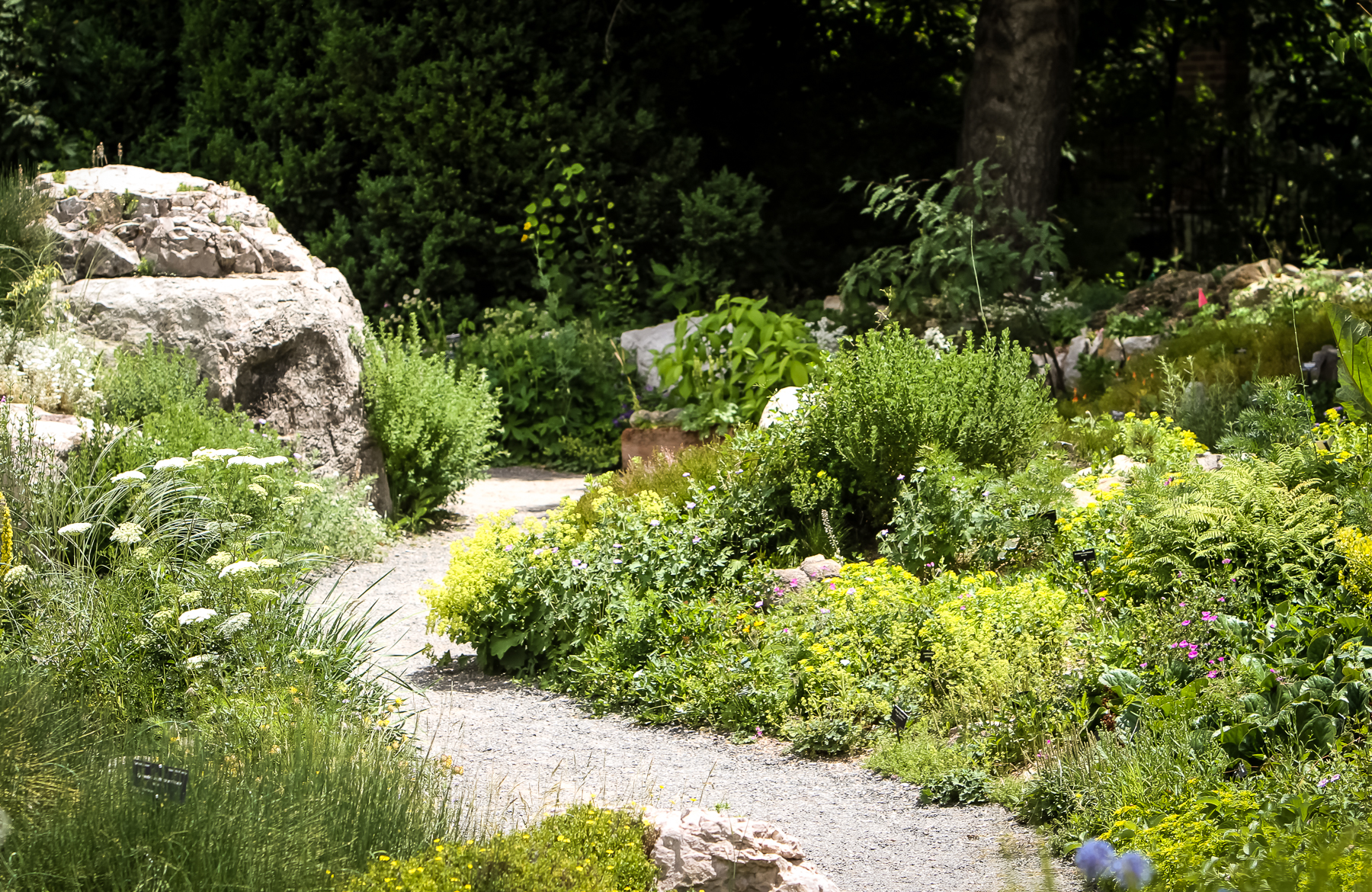
The featured image, “A Summer Pathway,” is courtesy of Lancia E. Smith and is used with her glad permission for Cultivating.

A founding member of The Cultivating Project, Christina has been fascinated by beauty her whole life. Color, texture, pattern, fragrance, melody, light – all of the boundless ways in which creation shines – ignites her imagination, compelling her to create. Even as a wee sprite, Christina was dedicated to wordsmithing and sketching her way through its marvels in an attempt to capture, at least partially, the imprint of the Creator within it. But writing and drawing are not her only creative endeavors; several years ago she took on the laborious (but rewarding) task of nurturing a garden in the dismal soils of the Rocky Mountain foothills, and has eagerly employed her spade (alongside her pen) as a tool to cultivate and curate the beauty around her.
She has two little gardeners-in-training who embody all these marvels and more in their merry little faces. She and her husband Brian are the founders of the Anselm Society based in Colorado Springs, whose mission and calling is a renaissance of the Christian Imagination. She serves as the Director of the Anselm Society Arts Guild and her creative work can be found at LiveBeautiful on Substack and on Instagram.

Rewiring the brain is fascinating. So is gardening. Thanks for sharing. Geinene.com is an artist who is inspired by neurology and it’s all over her work. After she had a daughter born with a neurological disorder she processed with God and paintbrush. She learned that some birds create new neurological pathways when they sing a new song. Geinene & I served together on the mission field and she’s the real deal. I’m going to share this with her.
Deb, thank you for your words! Yes, we have barely begun plumbing the depths of the neurological wonders of the brain! Bless your friend for delving wholeheartedly into the complexities to give glory to God and love her daughter! I will check out her work! Thank you for bringing it to my attention! (And thank you for reading my piece!)
Christina