


The last Sunday in church I wept through the closing song. We won’t be back for three months—it is our ninth summer away. The grief swept over me all at once, standing at the end of a familiar pew, hearing around me the familiar voices that I will not hear again for three months. Each May we pack ourselves up to the Colorado Mountains for a summer of camp ministry. Each August we return. The months between have become for me both a heartbreak and a grace.
At camp I weep through chapel worship almost half the time. The first several weeks pass in a blur of wildflowers and renewing old friendships, but as the second month passes and then the third, the ache for friends we’ve left behind intensifies. The music of our chapel services is loud and resounding each Saturday night. I choke on the words and wipe away tears and the melodies pull me tighter into the whirlpool of grief. I am trapped, circling round and round as the cycle of the last few weeks spins us slowly towards home. The only way up is to go down first.

When my daughter was just a toddler, any slow, tender song she heard would make her cry. Sometimes it happened during church, sometimes at home with a Spotify playlist. Each time her beaming little face would slowly become somber, then tears would well up in her sapphire-blue eyes. She would nestle her small cheek against my or my husband’s shoulder, pudgy hands hugging a comfort blanket to her chest. It was always a wonder to me—she rarely cried any other time.
Perhaps the princess in George MacDonald’s The Light Princess is the opposite of my little daughter. (This essay is full of spoilers—I am sorry.) At her christening, an evil witch curses the princess to be devoid of gravity. From that day forward, she floats through life, figuratively and literally. She could neither keep her feet on the ground nor be brought to take any hardship or grief with any seriousness. There is only one great love in the princess’s life: the lake that lies below her chamber window. In the lake her physical gravity, at least, is restored. She can swim and splash, dive like a fish and float like a lily pad. If the princess can be said to love anything, it is the lake. And then one day, it too is cursed. Slowly, surely, the lake begins to drain through a hole in the lakebed. The princess is distraught. She pines for her lake, lingers in the water, and begins to fade away herself as the waters disappear.
There is a prince who loves the princess, but his love is unrequited. Because she has no gravity and cannot be sincere or somber, she cannot truly love. As the prince watches her dying alongside the dying lake, he realizes there is only one way to save the princess. He must save the lake. He must go down to the bottom of the lake and stop the water from draining by putting himself in the hole. He sits there, pinned in place by the rocks while the waters rise around him. His only way to the princess is to die and leave her forever. The way up is down.
Camp is, in some ways, a game of follow-the-leader. My husband works here, and he loves it. I follow him to camp because of the strong conviction I have that camp is where God has led us. Grant and I are not just wandering out into the wild, we’re following an unseen fire and cloud like the Israelites as they left Egypt. But following God looks a lot like wandering off in the wrong direction. None of the Israelites who left Egypt had ever seen Canaan, the promised land. They left behind the only homes they knew. I want to scream it out sometimes: Home is that way! But for me, year after year, home is reached by leaving.
Following God led Israel down to the bottom of the Red Sea. Following led them to the end of their stores of food. Following led them on and on until their skins of water were empty and they cried out to Moses that they were dying of thirst. And forty years later when they returned to the borders of Canaan, they were stopped on the flooded banks of the Jordan River. Before them was the land of the promise and in their way once more were deep waters.
But every so often, there is singing. Miriam led the people of Israel in a song of rejoicing after they crossed the Red Sea. I wonder whether some weary Israelite mother hummed that tune again to herself on a sweltering afternoon while her baby fussed and her feet ached. Perhaps she thought of that song when her throat was too parched to whisper the words. Maybe her daughter hummed that old familiar song when she stood on the banks of the Jordan as the waters piled up on one side.
Jesus Himself wandered in the desert for His own season of testing. Did He have snatches of songs to murmur to Himself in the radiant heat of rock and sand? It would not surprise me—from the crucible of the cross He cried out a fragment of a Psalm. The song of David fulfilled its purpose as sacrament on the lips of dying Christ. Songs are a grace God offers us in fragments and snatches and full-throated chorus right in the midst of the wilderness.
Following God will lead me into cold, dark water, but He has given me music for the way.
Music is a tender grace that accompanied my daughter through her own wee heartaches. As soon as the song ended, so did her tears. The grief had passed. In some way, the music not only walked with her through those tender hurts but brought her to them. Those songs carried her to and through those tiny toddler pains which were still too deep for words. Perhaps the greater wonder is that she met both the grace of music and the aching of her heart with total surrender. The tears flowed unhindered. Never once did she ask us to turn off the music, only climbed into our laps and curled herself up. Maybe she too spun in the whirlpool of love and grief where drowning is just a stepping stone to dancing.
I read Dante’s Divine Comedy about the same time I was doing high school geometry. Ironically, it was the geometry that I loved. I did not have a good literary teacher to walk through Dante’s work with me, and I became fixated on the paradoxical shape of hell and purgatory. Hell was an inward spiral, a descent around the self-contained inside of a cone. His path wound tighter and lower until in the lowest, darkest regions of the pit, he emerged into purgatory—the great mountain that spiraled upward toward heaven. I could not comprehend the geometry of it and, in youthful impertinence, I wrote it off.
But Dante understood what the Light Princess and her prince learned: that dying isn’t dying at all when Love is leading you. Between purgatory and heaven, Dante sees a great burning fire. The heat of a thousand deserts burns in those flames, but like the Israelite wanderers whose clothes did not wear out, this fire does not consume but refines. [1] “The heat that fire produced was measureless – or coolness, in a vat of boiling glass.” [2]
Camp is the roaring fire, the shards of glass roiling like a flooded river. The road down to chapel winds downward beside a stream and there, gathered by the edge of the lake, I cry scalding tears while we sing. The music of the running water accompanies us down, down to the swirling center of camp. The water seems to speak, reminding me that to follow the thread of the stream down to the lowest point does not always mean drowning. This act of dying to myself is God’s charity towards me. In the geometry of heaven, the lowest point is the way up. Death is the first step in resurrection.
Once a year, on Easter Sunday, our church sings the beautiful hymn “Christ the Lord Is Risen Today.” It is full of triumphant alleluias. The final line of the fourth stanza caught my attention for the first time this year, and it took my breath away. In seven words, it sings out the pattern of descending in order to rise as clearly as Dante or George MacDonald ever could.
Ours the cross, the grave, the skies. Alleluia. [3]
In May we leave. I uproot from church and my school-year friendships for three months. Ours the cross… Boxes heaped in the living room, an abrupt return to still-cold mountain weather. The brook leads down and down towards the beating heart of camp.
We linger. The summer grows warm and languid. The slender stream is hardly more than a trickle in July and August. Camp friendships are renewed—we play on the sandy beach, stay up too late around the smoky campfire just to talk. I am like the prince: no sooner do I begin to drown than I am pulled out of the water. Ours the cross, the grave, the skies…
The world turns upside down. Holy geometry is at work. Charity, the love that gives, has led me here. The summer eddies to a close and I am rejoicing through the swirl of homesickness, grateful for what is given me: friendship at camp and for the open arms of a church that waits for us at home. Alleluia.

[1] Deuteronomy 29:5
[2] Dante, The Divine Comedy, “Purgatorio,” lines 50-51. Trans. Robin Kirkpatrick.
[3] Charles Wesley, “Christ the Lord Is Risen Today.”
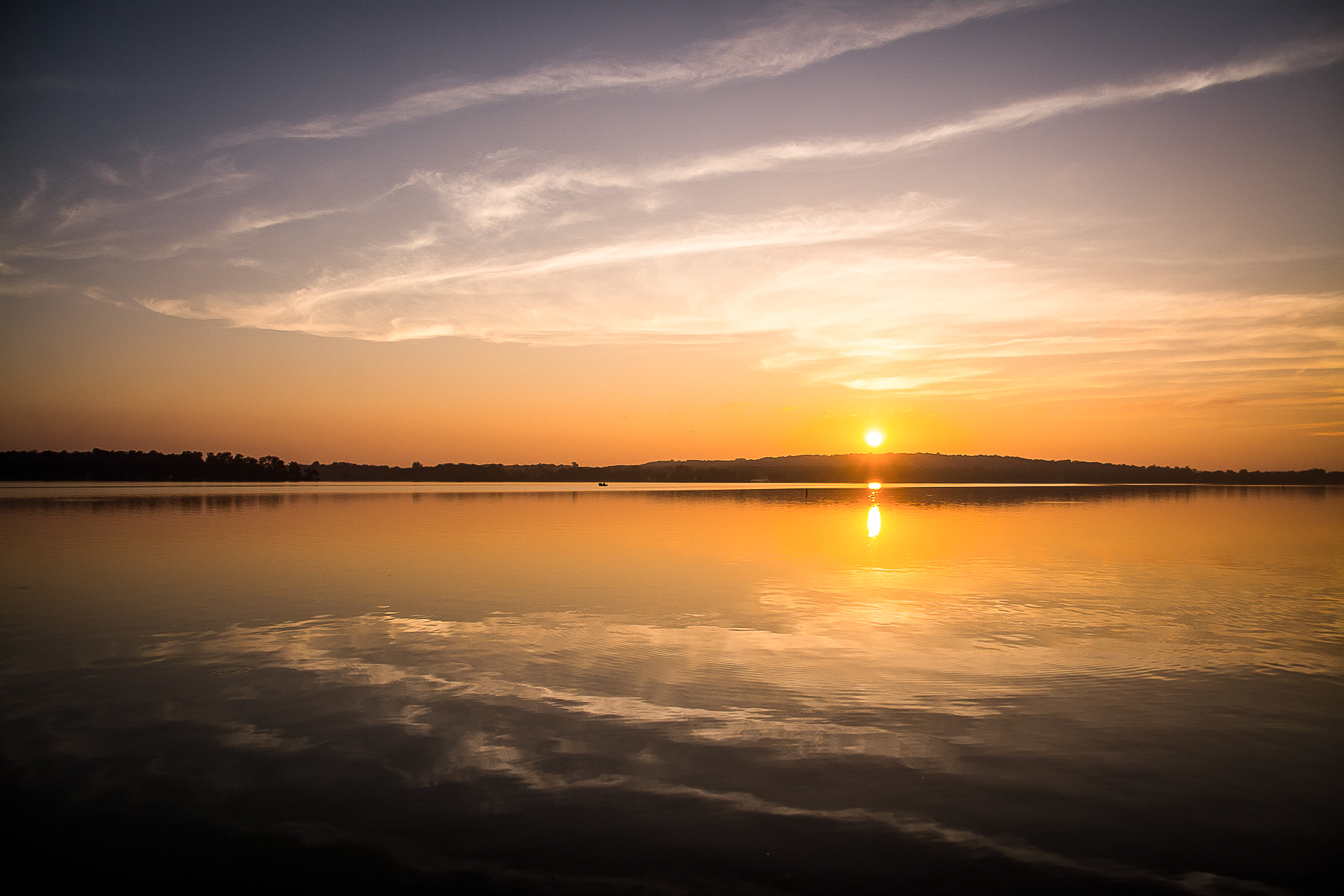
The featured image, “Sunrise at the Lake,” is courtesy of Julie Jablonski and is used with her kind permission for Cultivating.

Gianna Soderstrom is a contributing writer to Cultivating Oaks Press and the Anselm Society, and she serves as Assistant Director of the Anselm Society Arts Guild. Adventure-hearted, but also a connoisseur of cozy, book-ish evenings, she is delighted by coffee and cocoa but shockingly, not tea. She is equally fascinated and challenged by the myriad ways that small and steady faithfulness transform a strange place into a home. She is a writer, dreamer, wife to Grant, mama to E1 and E2, and more than the sum of her parts, just like you. Gianna writes here and everywhere else to mine hope out of our ordinary moments.

Gianna, I love this so much! I am so glad that the words of a hymn stuck in your soul and encouraged you through a challenging time. The way you processed all the emotions you felt is so tender and profound. Thank you for writing and sharing this with all of us!