


The Cultivating Gardener is a column designed to engage all garden lovers, regardless of skill or experience, as we glimpse, together, the deep tenderness of God hidden in our own backyards. In this column you will find reflections, resources and tips designed to help you expand your vision of what it means to cultivate your own plot of land. As you pursue this good and holy work of garden-tending, my hope is that you will find your own heart lovingly tended by the Great Gardener of both our soils and our souls.

“Oh beauty!” whispered Emily, passionately, lifting her hands to the stars. “What would I have done without you all these years?” Beauty of the night—and perfume—and mystery. Her soul was filled with it. There was just then, room for nothing else. She bent out [of the window], lifting her face to the jeweled sky—rapt, ecstatic.”[1]
Too often I believe that I am master of myself. I am too quick to languish in the mire of self-pity or lose myself in the deep well of anguish, infuriated that I can’t clamber my way out. After days of clawing at the walls of that dank well and exhausting both my stamina and my patience, I give up; I’ve had enough. I can’t do it. Nothing works. Nothing helps. Claustrophobic and desperate, I throw on a sweater, turn the knob of my back door, and walk out into my garden.
In my garden, I am an observer, not a master. Before I know it, I am soaking up a whole host of little encounters in my garden. There are a thousand things to see and feel, and when I pause to observe them, the most minute of details utterly enchant me; the bumble-bee burrowing into the ground to hibernate for the winter; the soft hoot of an owl as her swift shadow slips beneath the pearled moon; the glittering snow beneath the ember glow of a porchlight; the curl of hot breath as it escapes into the cold of the crystalline air; the puff of a sudden wind—so quick I want to ask it where it goes and why it hurries.
Only after allowing these enchantments to swirl around me does my self-pity ebb, and I find myself sighing with relief that I am not, after all, master of myself.
It took me many years to realize that this experience had a name: gratitude. I used to cringe when I heard that word spoken aloud. It conjured up old guilt from half-hearted “gratitude lists” scribbled onto crinkled notepad sheets, and the ghosts of my neglected good intentions returned to haunt me.
But gratitude, I think, is more akin to quietude—a settling of the soul upon a wider truth. It’s gazing with the inward eye upon the outer world. Gratitude is not born out of guilt, but out of enchantment.
And enchantment begins with watching and waiting—waiting for our breath to catch in our chest as a lone star winks out on a velvet horizon—waiting to see the Kingfisher dart through the bony rushes in a flash of cerulean blue—waiting to behold the extraordinary in the ordinary.
For it is only through openly observing our surroundings that wonder is born and we start to learn the language of the Psalmist’s heart as he says,
Oh Lord, my God, You are very great. . . . [You] cover Yourself with light as with a garment, [You] stretch out the heavens like a curtain. [God] lays the beams of His upper chambers in the waters – Who makes the clouds His chariot, Who walks on the wings of the wind. (Psalm 104:1-3 NKJV)
These are the words of a poet—a lyricist putting language to love. Poetry is soul-song put to words—a response to seeing, experiencing, observing, or feeling something other. The Psalmist lived the same days you and I do. He knew the difference between night and day, experienced dark and light, observed the unending yawn of the sky, gazed across undulating waters, felt the wind brush his face, and watched the clouds roll by. But he wrote of them differently—differently because he knew them—he had studied them, pondering how sudden sunbursts can gleam like chariot’s wheels, how the falling of an all-too-soon dusk can feel like a curtain falling on your daydreams, and how the brightness of a sunny morning is an exposition of all things good, true and beautiful, and thus exposes the heart of God.Of course God wears light like a garment. . . .
Psalm 104 is a psalm of gratitude. Of a person—a poet—who has studied God’s world and found it, good.
If I only knew, in my fervent days of “try harder, stupid,” that I didn’t have to conjure a joyous gratitude out of the barrows of my guilt—that all I had to do was walk outside and allow myself to be swept away by beauty. Oh how I wish I knew!
Mary Oliver knew. So much of her poetry was born out of her nature walks and garden rambles. I often read them, living in her mind, inhabiting her footsteps as I read her flavorful words. Her poem The Plum Trees says it well:
Such richness flowing
through the branches of summer and into
the body, carried inward on the five
rivers! Disorder and astonishment
rattle your thoughts and your heart
cries for rest but don’t
succumb, there’s nothing
so sensible as sensual inundation. Joy
is a taste before
it’s anything else, and the body
can lounge for hours devouring
the important moments. Listen,
the only way
to tempt happiness into your mind is by taking it
into the body first, like small
wild plums. [2]
I can see her in this poem, walking the plum orchard, effortlessly employing every single one of her five senses at once as she allows herself to be enveloped by each moment of beauty. “Taste and see that the Lord is good.” I have a feeling that Oliver would argue that He tastes a lot like wild plums. . . .
Poets observe. They listen, watch, and learn the essence of a moment, a feeling, an object before stewarding words into a phrase, a line, a sonnet that spans its fullest potential.
And herein lies the beauty: a true gardener has a poet’s heart. She knows the miracles of the seed—the smell of life-giving soil, the texture of the ideal soil ratio—clay and silt sliding perfectly between thumb and forefinger. We gardeners watch, learn, love, and steward our land—shepherding soil-borne beauty into its fullest potential.
Does gratitude require a sort of emptying? A letting go? Perhaps. Conviction and repentance certainly can play a part. But guilt? If there is an emptying of self-pity, guilt must go, too, for guilt will draw our gaze inward until it warps into shame.
To be truly grateful we must hold it all—the guilt, the angst, the watchfulness and the wonder—in a sort of tension; a tension that holds taut the line between the leavings of yesterday and longings for tomorrow. Beauty waits for us to simply behold her as she is, today, inviting us to feast on her fathomless succulence.
And I know I can’t be truly satisfied—truly grateful—unless I look, and really look, at something. Not with longing, but through longing.
Allow me, friends, as always, to leave you with some practical tips for cultivating gratitude this winter through your garden:
- Spend five minutes gazing out your window. Set a timer if it helps! It may be gray and cold, but there is so much to see. Nature slumbers in the cold but wakes now and then to wink an eye at her admirers. See if you can catch her eye.
- Pick up bird-watching. After all, birds are part of the garden’s ecosystem, and while many birds fly south, others remain, and you will probably find yourself drawn to a species you hardly noticed before, and begin watching their odd habits with renewed interest.
- Borrow some books from your local library on gardening, soil health, entomology, or the biology of plant life. It’s a good balm for the heart that aches to garden again, and a wonderful opportunity to let the wonder of nature settle into your soul against the backdrop of a cloistered winter.
- Read poetry. Any poetry, really, but particularly poets who have spent time in the abundance of the world of green and growing things. Robert Frost, William Wordsworth, Mary Oliver, and Wendell Berry are just a few I would recommend to you.
- Lastly, I recommend meditating on the entirety of Psalm 104.
Blessings on your winter, my friends. I’m in it with you.

[1] From Emily’s Quest by L.M. Montgomery (Dell Laurel-Leaf / Random House Children’s Books, 2003), 166.
[2] “The Plum Trees” by Mary Oliver, from her collection, American Primitive (Bay Back Books, 1983).
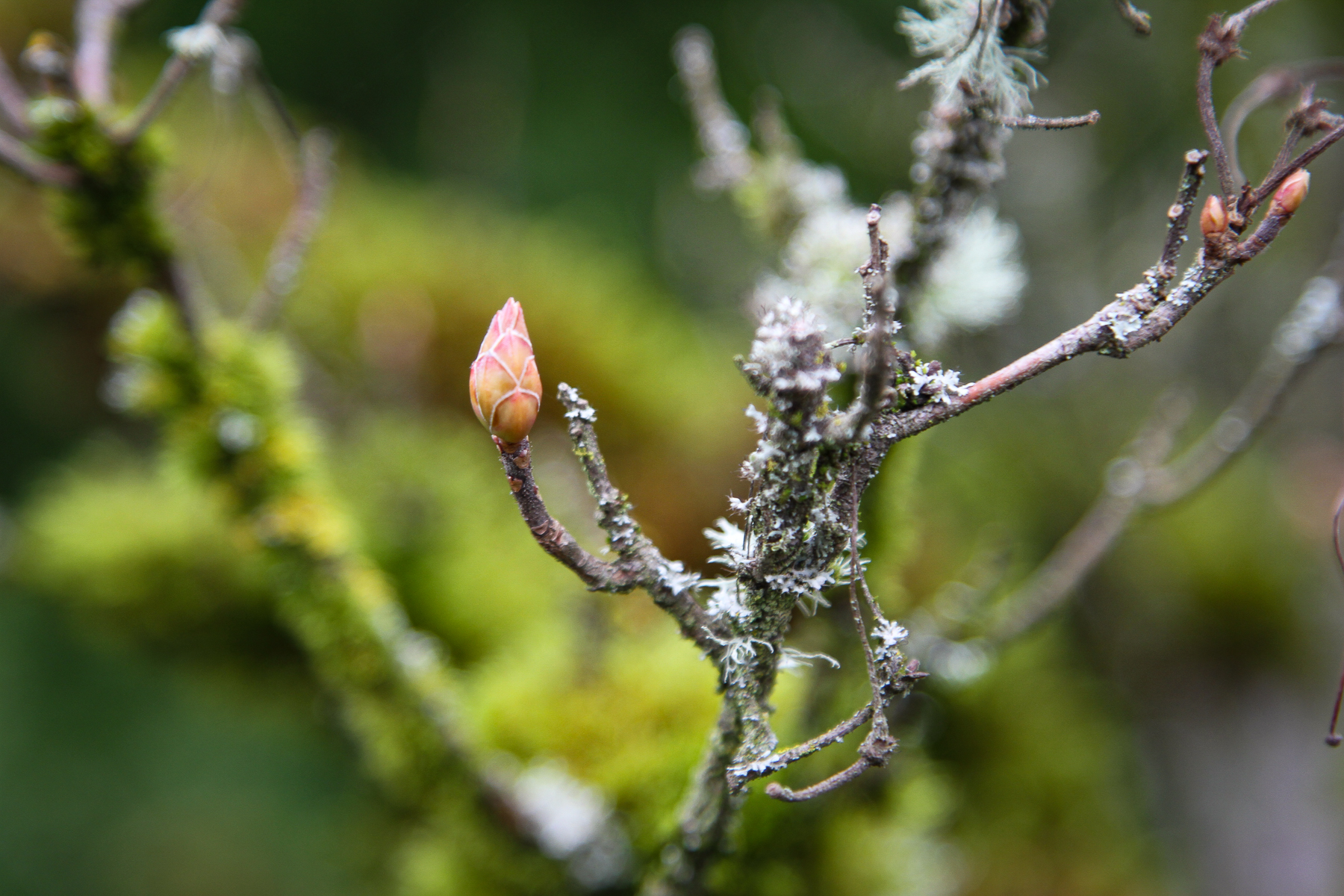
The featured image, “A Bud in Winter,” is courtesy of Lancia E. Smith and used with her glad permission for Cultivating.

A founding member of The Cultivating Project, Christina has been fascinated by beauty her whole life. Color, texture, pattern, fragrance, melody, light – all of the boundless ways in which creation shines – ignites her imagination, compelling her to create. Even as a wee sprite, Christina was dedicated to wordsmithing and sketching her way through its marvels in an attempt to capture, at least partially, the imprint of the Creator within it. But writing and drawing are not her only creative endeavors; several years ago she took on the laborious (but rewarding) task of nurturing a garden in the dismal soils of the Rocky Mountain foothills, and has eagerly employed her spade (alongside her pen) as a tool to cultivate and curate the beauty around her.
She has two little gardeners-in-training who embody all these marvels and more in their merry little faces. She and her husband Brian are the founders of the Anselm Society based in Colorado Springs, whose mission and calling is a renaissance of the Christian Imagination. She serves as the Director of the Anselm Society Arts Guild and her creative work can be found at LiveBeautiful on Substack and on Instagram.

♥️ I love this post! I had a hard time relaxing at first, but when I let myself rest in your invitation to enjoy my world, I found the peace and groundedness my soul needed to first breathe deeply and then get up to walk forward into my day… with new eyes to see it.