


The words I most loved to hear Grandma say were “Come and wash your hands!” And washed they must be—they’d be checked, both sides and under our fingernails. We all had to file past Grandpa’s chair, positioned conveniently where the hallway ended and the kitchen began, before we could slide onto the built-in bench against the wall and prop our elbows eagerly on the dinner table.
We lived several hours from my grandparents, but it seemed like no matter when we left home, we always arrived in that achingly long stretch of midafternoon. Lunch was a relic of the last age and dinner was still years away.
But dinner would be worth the wait, in the end. Crunchy steamed broccoli, cucumber salad in sweet vinaigrette, cold water and a cup of milk each to the kids and chocolate milk on special occasions, potato salad, cottage cheese, and Grandma’s perfect rendition of red hotdish, a Midwestern staple she made better than anybody else I knew.
Dad and Grandpa would tease and debate each other from opposite sides of the political aisle while I covered my hotdish in Parmesan cheese, ate heaping portions of cottage cheese, and choked down the required few bites of potato salad. Eventually we’d excuse ourselves to play games in the living room or poke around in the basement while we waited for the adults to finish talking and break out ice cream for dessert.

There is a wedding that happened thousands of years ago, and I wish I could have been there. It took place at Cana in Galilee. Jesus was there, and His mother and some of the disciples. They had wine, and it was good wine, though they ran out before they were done celebrating. Then a strange thing happened: Jesus made more. (John 2:12.) It was excellent wine—and doesn’t that just hearken somehow back to Genesis? “God saw everything that He had made, and behold, it was very good.” (Gen. 1:31.) Yet Jesus’ first miracle has always confused me. Why would Jesus first reveal Himself publicly with something as frivolous as good wine?
There is a moment in time that I forever associate with delight in God, and with knowledge of a delightful God. It is late spring or early fall—moderately warm in northern Minnesota, and windy. I feel the tickle of my hair blown across my face, the half-warm gusts of wind against my shoulder or back. I can see in my mind the four young children walking with us, running ahead and falling behind and catching up in bursts of speed. I know by muscle memory my half-inclined posture as I hang on every word of my friend and mentor, Tiffany, fully three inches shorter than me.
She was talking about the wedding in Cana. She did not expound on the theological theories around this miracle: Was Mary related to the bride or groom, helping with the hosting responsibilities like an aunt might? Was she asking Jesus for a miracle, or hoping He’d make some excuse to the guests on behalf of the family? She didn’t get into that. Tiffany looked at me as we walked, looked right through my over-serious teenage angst with a thoughtful smile, and said, “Gianna, He turned water into wine. This is a God who delights in joy.”
I had wondered about this miracle for a long time—a very strange declaration of God-hood. Wine? Water into wine? Poignant as her conviction was, I am still learning to trust Tiffany’s statement of God and His delight in our delight. But certain ministrations of the very world around me have begun to undo that suspicion.
Would the same God who invented baby giggles not have a finely tuned sense of joy? Could the Maker of seven-year-old boy humor not have a sense of humor Himself? Surely the Creator who gave us the power to make bread and cheese had wine in mind as a companion for charcuterie. For six days God worked and created and on the seventh He took time to delight in His creation. [1] Delighting in the goodness of His creation is simply an out-flowing of who God is.
Grandma kept Fruit Loops for breakfast, but I tended towards my usual staple: toast. Toast at home meant a choice between butter or peanut butter, sometimes jelly. Toast late in the morning with Grandpa meant toast just slightly too crunchy but spread lavishly with butter and a thick layer of peanut butter. Toast with Grandpa meant being teased about why you were so grumpy in the mornings but getting a wink when you spread just a little more butter than you figured you actually were allowed, and then again if you asked for a second cup of orange juice. Toast with Grandpa may not have been the breakfast of champions, but it was the breakfast of introverts: simple and rather solitary, relational with no real need to talk. I still think of Grandpa when I spread too much peanut butter on top of buttered toast.
Perhaps that is the same delight as the wedding feast in Cana. I wonder if Jesus stood there, reveling quietly in the joy of the bride and groom, the humanity in His divine heart filled to bursting. Like Grandpa watching me in mutual silence, as I sleepily enjoyed a lavish breakfast. Gruff teasing and abundant provision were the ways Grandpa showed love. A breakfast feast for his grumpy granddaughter was in accordance with who he was. The sheerly unnecessary abundance rang true to his very nature. Grandpa gave me abundant breakfasts because to do so was in fidelity to his very self. No wonder he let me have seconds of orange juice.
On one of my visits back to the Midwest years after I’d moved away, we spent a fleecy-clouded, blue-sky morning with Grandpa. He’d brewed coffee for us, though Grandma had since passed away and Mom’s never been one to drink it. I poured some into Grandma’s old white floral cup. Nostalgia, memory, abundance all seemed to be present while I sipped—not in waves rolling over me as I’d expect, but as tangible beings; they were as solid as the white countertops and the filmy curtain over the kitchen window, they squeaked predictably when we pulled the heavy table out from the wall to make room on the kitchen bench, and they scalded my tongue when I drank the coffee too hot and black, just like Grandma used to.
It was buttered toast and orange juice that paved the way for the words Tiffany gave me on a windy afternoon in Minnesota. Feasting is in all our natures, whether we’ve learned to see it or not. It is in us because it is in God. Water into wine isn’t an outlandish trick, meant to startle partygoers into somber worship. It is one way that God reveals His nature as a God of delight. His gift of feasting is simply fidelity to Himself.
I cannot visit my grandparents anymore. There will be no more visits to the little farmhouse; Grandpa’s chair in the kitchen is empty. Our times of having breakfast or a quiet cup of coffee together have passed. But sometimes I still spread butter and peanut butter together on toast and remember again those early lessons in feasting. I still think of Tiffany when I hear of Jesus’s first miracle of abundance. And when my mother-in-law offers my children one more cookie than I think they really need, I’ll try not to notice.
[1] From Alexander Shmemann’s book For the Life of the World.
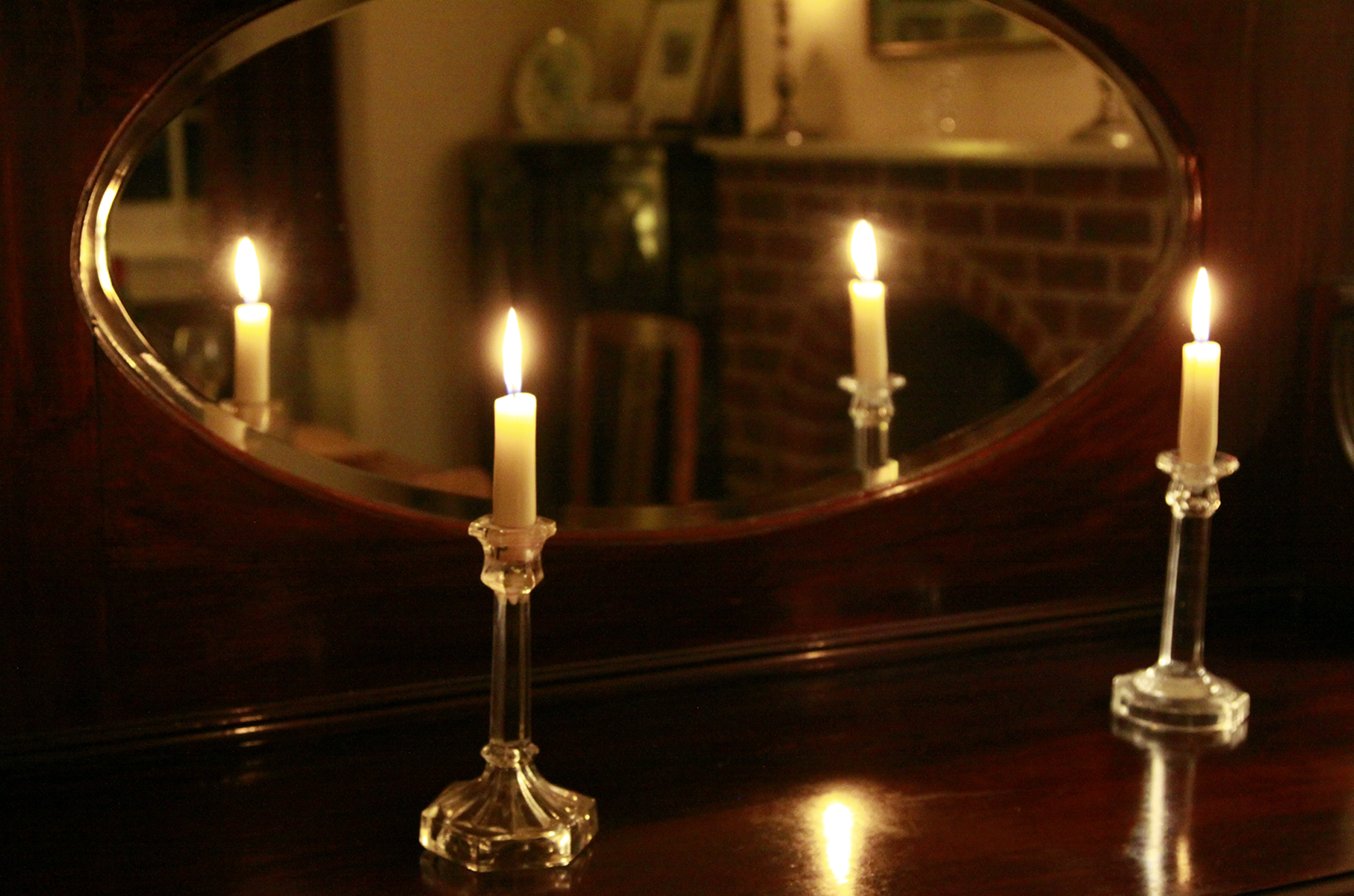
The featured image, “Kilns Dining Room Candlelight,” is courtesy of Lancia E. Smith and is used with her glad permission for Cultivating.

Gianna Soderstrom is a contributing writer for Cultivating Magazine and the Anselm Society, and she serves as Assistant Director of the Anselm Society Arts Guild. Adventure-hearted, but also a connoisseur of cozy, book-ish evenings. She is equally fascinated and challenged by the myriad ways that small and steady faithfulness transform a strange place into a home. She is a working writer and editor, co-laborer in ministry; a dreamer, wife to Grant, mama to E1 and E2, and more than the sum of her parts, just like you. Gianna is currently at work on her first full-length book, due out in 2026-27.

Add a comment
0 Comments