




Every year from Thanksgiving to Christmas, the Stonegate Farmers Market was transformed into a tree lot and Christmas shop. For the last several years, Stephen Bennett accompanied his son Robb and his four grandsons to pick out a tree, buy Christmas candy, and drink some hot apple cider.
Robb and his boys were collectively called the Bennett boys. Twins Stevie and Danny were eight; twins Joshua and Caleb were five. When together, the family always caused something of a sensation, because the boys looked like staggered quadruplets, and all four looked like their dad.
Missing this year was their mom, Lindsay. She was now living with the man she called the real love of her life, a doctor who practiced with her at a children’s oncology clinic.
“How about this one?” Robb said to the boys, pulling a twelve-foot Douglas fir out into the walkway so everyone could get a better view. They’d already checked out a Scotch pine that Stephen thought was perfect, but the younger boys had shaken their heads. The older twins were barely participating; Danny was especially subdued and saying very little. Robb had said Danny was taking the divorce the hardest.
Stephen knew that wasn’t true; Robb was taking the divorce the hardest. The two-day court hearing had been awful. Stephen still shuddered at what had been revealed. Robb’s attorney had been like a frenzied terrier, managing to shred Lindsay’s testimony and reputation so badly the judge awarded Robb full custody of the boys.
The news media had had a field day. The story was irresistible—prominent children’s cancer doctor abruptly abandoning her husband, owner of the most successful homebuilding business in the region, and her children.
But nobody had won, not really. Robb least of all.
Stephen Bennett was feeling every one of his sixty-seven years, and a few extra. As he watched Robb and the four grandsons in the tree lot, he knew their hearts weren’t in it. In past years, the boys had been all over the place, excitedly shouting to each other and arguing over the best tree. But not this year.
While most people thought Robb was managing extremely well, Stephen knew his son’s real state of mind. And his heart. Robb was suffering. Stephen remained angry with Lindsay, her boyfriend, and all the lying and deception that had gone on.
Stephen now understood his son’s nine-year marriage as give-and-take. Robb gave; Lindsay took. Robb was the caregiver, the parent, the chauffeur, the one who always made excuses for his wife’s demanding schedule. How Robb also found the time to manage a $500 million homebuilding business was beyond Stephen’s comprehension. Someone needed help? Robb was there. Someone had financial reverses? Robb stepped in. The big storm crashed a tree into the church, and Robb was there with a crew to make temporary fixes and then donated the permanent materials and repairs. His son had to be exhausted. It would be nice to see Robb on the receiving end of something good for a change.
“Maybe I should ask if anyone doesn’t like this tree?” Robb said, giving the Douglas fir a little shake. He looked at the boys.
“Sold!” he said.
Stephen helped carry the fir the short block-and-a-half to Robb’s house, something of a local attraction. In downtown Stonegate, across from the Stonegate Library, the home was a three-story brick-and-stone townhouse with a large side extension that housed the dining room and kitchen. Robb had acquired the dilapidated and condemned boardinghouse that stood there, tore it down, and built the townhome. With the brick patio and garden in the back, it was a spectacular residence. And, as Robb had pointed out, a great advertisement for Bennett Home Construction.
Stephen and his second wife, Jane, lived in a condo three blocks away. Stephen’s first wife, Robb’s mother, had died twenty years before when Robb was in college. Stephen had remarried five years ago. It didn’t help matters that Jane was Lindsay’s aunt and her mother’s twin sister. Stephen was sure that was the origin of the twin gene that had found its way to his grandsons.
The tree fit easily in the large family room, thanks to its fourteen-foot ceiling. Stephen had a minor flash of concern when the boys opened the ornament boxes, thinking memories of Lindsay might surface. But it didn’t happen, and all four boys were soon laughing and telling stories about ornaments they’d made in school and Sunday School.
The tree completed, and the boys now in bed, Stephen, Robb, and Jane, who’d joined them during the decorating, now sat with cups of eggnog with a dash of rum, admiring what was indeed a beautiful tree.
But Robb had a far-off look in his eyes, as if he were seeing something else.
“Penny for your thoughts?” Stephen said.
Robb broke the stare and smiled. “Just remembering. That first Christmas we were married was like magic. We’d been married four months, and I was still head over heels. We were in that farmhouse I’d redone off Valley Road and just starting to plan this place.” He lapsed into silence.
Stephen eyed him with concern. “How are you doing?”
“Okay, Dad,” Robb said. “Mostly tired. Worried about the boys. Trying to stay focused on us as a family.” He paused. “I’m keeping a close eye on Danny. He’s really taking this hard. And he feels a lot of anger with Lindsay. Which I understand. He’s at least open to talking about it. Stevie listens when we talk; he and his brother are like one soul in two bodies.”
“And Joshua and Caleb?”
“The little guys are pretty resilient. They’re younger and understand less, and that’s a blessing. Thursday at dinner, Danny kind of acted out about his mother, and Josh said something that surprised us all. ‘It’s not like we ever saw her. She was always at work.’ And it’s true. I think I’d ignored it. I mean, I noticed she was at the clinic a lot, like twelve hours a day and even weekends, but what Josh said prompted the thought that even when she was with us, she wasn’t.” He glanced at Jane. “I’m sorry. I don’t mean to put you in a bad spot.”
“You’re not,” Jane said. “Robb, when she had lunch with me the day after she told you about filing for divorce, my first reaction was shock. She rushed through the conversation, because the subject obviously made her nervous. She wanted my advice on how to tell the family, because they all were crazy about you and the boys. She expected a sympathetic ear; instead, she heard my anger. I wonder now if I’d handled it better it might have made a difference.”
“Not likely, Jane,” Robb said. “When Lindsay makes a decision, it’s as good as done. I keep asking myself what I might have done differently. But that’s a blind alley.” He shook his head. “I’ve been trying to put on a happy face for the boys for Christmas—it’s going to be okay, we’re moving on, we still have our lives to live. But nobody ever said how tough this would be. I don’t think any of us want to celebrate this year.”
Stephen cleared his throat. “How are you sleeping?”
“Fits and starts, Dad, to tell you the truth. But I’ll be okay. People at church have been great, and they’ve helped in so many ways. But my heart just isn’t in Christmas right now. I’ve got gifts ordered, but even thinking about this tree has been an ordeal. I don’t want to go look at Christmas lights. I don’t want to go caroling. I’ve somehow got to get myself through the big Christmas party at work—I can’t let that go. But it all feels like drudgery.” He shook his head. “This isn’t the Christmas I thought we’d be having.”
“Robb,” Stephen said, “you give a lot. You’ve always given a lot of yourself, your time, and everything else. I know Christmas is a lot about giving, but maybe it’s about something else, too. Especially this year.”
“Something else?”
Stephen nodded. “Think about the first Christmas. Yeah, we had the wise men bringing gifts a couple weeks later or whenever it was. But even if no one understood it at the time, the actual birth was a gift for us to receive. We stay so busy decorating, buying gifts, sending cards, and having office parties that we forget that Christmas was first a gift for each of us. A gift of life and hope.”
“Think of your boys asleep upstairs,” Jane said. “They’re gifts, Robb, to you and even to Lindsay, but also to the rest of us. Lindsay’s brothers have only girls. I love my eight nieces, but your four boys cannonballed into the family, and they’ve blessed all of us.”
Robb grew quiet. They could see tears in his eyes.
As Stephen and Jane prepared to leave for the short walk home. Robb helped them with their coats.
“Thank you for all your help today,” he said as they stood at the front door. “I didn’t expect an early visit from the wise men, or should I say the wise man and the wise woman?”
Stephen smiled at his son. “We’re just people who love you, Robb, people who want to give you a little of what you give to others. Merry Christmas, son.”

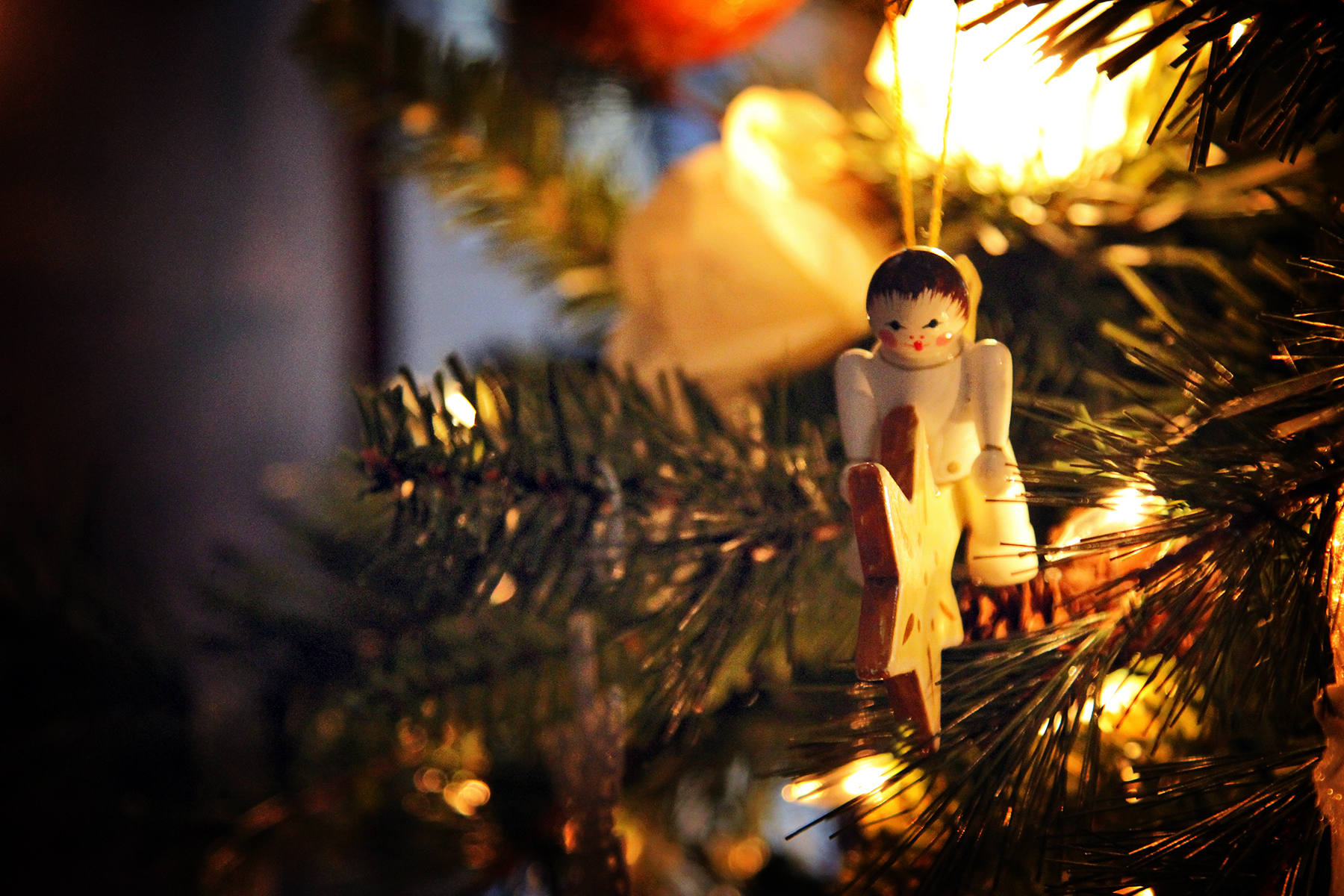
The featured image, “Angel on a Star Ornament,” is courtesy of Lancia E. Smith and used with her glad permission for Cultivating.

Glynn Young wrote his first story when he was 10 – a really bad mystery having something to do with a door behind a grandfather clock and a secret cave. At 14, he discovered Great Expectations by Charles Dickens, but he secretly wanted to write James Bond stories. At 21, he became a Christian, and the verse he was given, Philippians 1:6, became the theme of his life.
Glynn received a B.A. in Journalism from LSU and a Masters in Liberal Arts from Washington University in St. Louis. He spent his professional career in corporate public relations, and mostly executive speechwriting. Since 2009, he’s been an editor for Tweetspeak Poetry, writing a weekly column. Since 2011, he has published five novels in the Dancing Priest Series, the nonfiction book Poetry at Work, and the historical novel Brookhaven.
He and his wife Janet live in suburban St. Louis.

Thanks a bunch Glynn for bringing tears to my eyes. I have not experienced anything like this, but I know folks who have. I pastor a church of broken people. One will spend her first Christmas without her adult daughter. I ache for those like Robb who face this holiday alone or all out of sorts. But may we all find wise people to share our lives with and who will share theirs.
Bill, thanks for the comment. It’s loosely based on real situations we know about, both from some 30 years ago and more recently.