


Nine years ago I made the seasonal move from small suburban home to cozy lodge in the mountains for the first time. My husband had taken a job at a summer camp and from May until August, we’d be living out in the woods—away from everyone and everything I knew.
I drove very slowly on that first Saturday morning as we climbed up the winding, potholed gravel road. The woods were a dead, gray blur around me, interspersed with burned-black trees and stony granite outcroppings. It seemed desolate and deserted, and I wondered whether even God could meet us there. But then, I am not the first to make my way into the wilderness.
I wonder if Abraham felt that way at all when he left Ur and ventured into Canaan, acting on the spoken voice of an unknown God. Acting on the hope that this God was powerful enough to make him a home in the wilderness and make two elderly wanderers into parents.
The promised son of laughter was still twenty-five years away when Abraham first heard that promise, but they were not twenty-five years of silence. God was faithful while Abraham waited. The numerous stars turned the night across the sky, the sea pushed uncountable grains of sand into ripples. And Abraham and Sarah remained childless. But they were not God-less. God was with Abraham when he left to rescue Lot. God made a covenant with Abraham, naming the so-far-unrealized nation—“You and your descendants after you.” (Genesis 17.10). He appeared suddenly to Abraham on a hot afternoon, hours before Sodom and Gomorrah were destroyed. The personal presence of God was too visible to ignore: even the neighboring Philistine lords could see it. “Abimalech and Phicol… said to Abraham, ‘God is with you in everything you do.’” (Genesis 21.22 NIV)
Perhaps Abraham recalled those encounters with God on sleepless nights. Maybe he pictured again the firepot and torch, passing through the covenantal blood. Maybe he remembered the three visitors who’d eaten with him beneath the oak trees. When doubt crept in on sleepless nights and the stars shimmered mockingly overhead, perhaps those memories were the ones that kept watch with him, teaching him to trust.

Asaph is not one of the men in the Bible I’m familiar with. When I came across Psalm 77, I looked for David’s name in the inscription above it and found Asaph’s instead. There is only one story of Asaph—his appointment by King David to worship before the ark of the covenant. But he is called a seer, a see-er. And he saw, at least sometimes, in the same way we do: by looking back.
Psalm 77 says, “When I was in distress, I sought the Lord; at night I stretched out untiring hands and my soul refused to be comforted” (verse 2).
Asaph is distraught. The stars wheel above him as they did for Abraham and doubt creeps in through the dark. For half the psalm he questions and wonders whether God will ever hear. But then there is a turn. It is not the same turn I often see in Psalms—a gritty grasping at hope, declaring that God will come through again. Asaph stops looking at the world around him and changes his gaze.
“Then I thought, ‘To this I will appeal: the years of the right hand of the Most High.’ I will remember the deeds of the Lord; … I will meditate on all your works” (verses 10-12).
With Your mighty arm You redeemed Your people,
the descendants of Jacob and Joseph …
The waters saw You and writhed,
the very depths were convulsed …
Your thunder was heard in the whirlwind, …
Your lightning lit up the world …
Your path led through the sea, …
though Your footprints were not seen.
You led Your people like a flock
by the hand of Moses and Aaron.
(Psalm 77.15–20 NIV)
Asaph props up his faltering faith in perhaps the best way we know—reciting to himself God’s faithfulness from before. He re-thinks of the way God led forth the Israelites, the descendants of Abraham, Isaac, “Jacob and Joseph.” With poetic lyricism he says “Your path led through the sea, though Your footprints were not seen” (verse 19).
My isolated summers are not the only times that have seemed to lead through a wild sea, devoid of footprint or path. And yet the old ways have left another sort of map. The same stars that looked down on Abraham’s faith and Asaph’s hope also looked on God’s faithfulness to those men. Those same stars look down on me, sitting at night on a wooden deck at a summer camp.
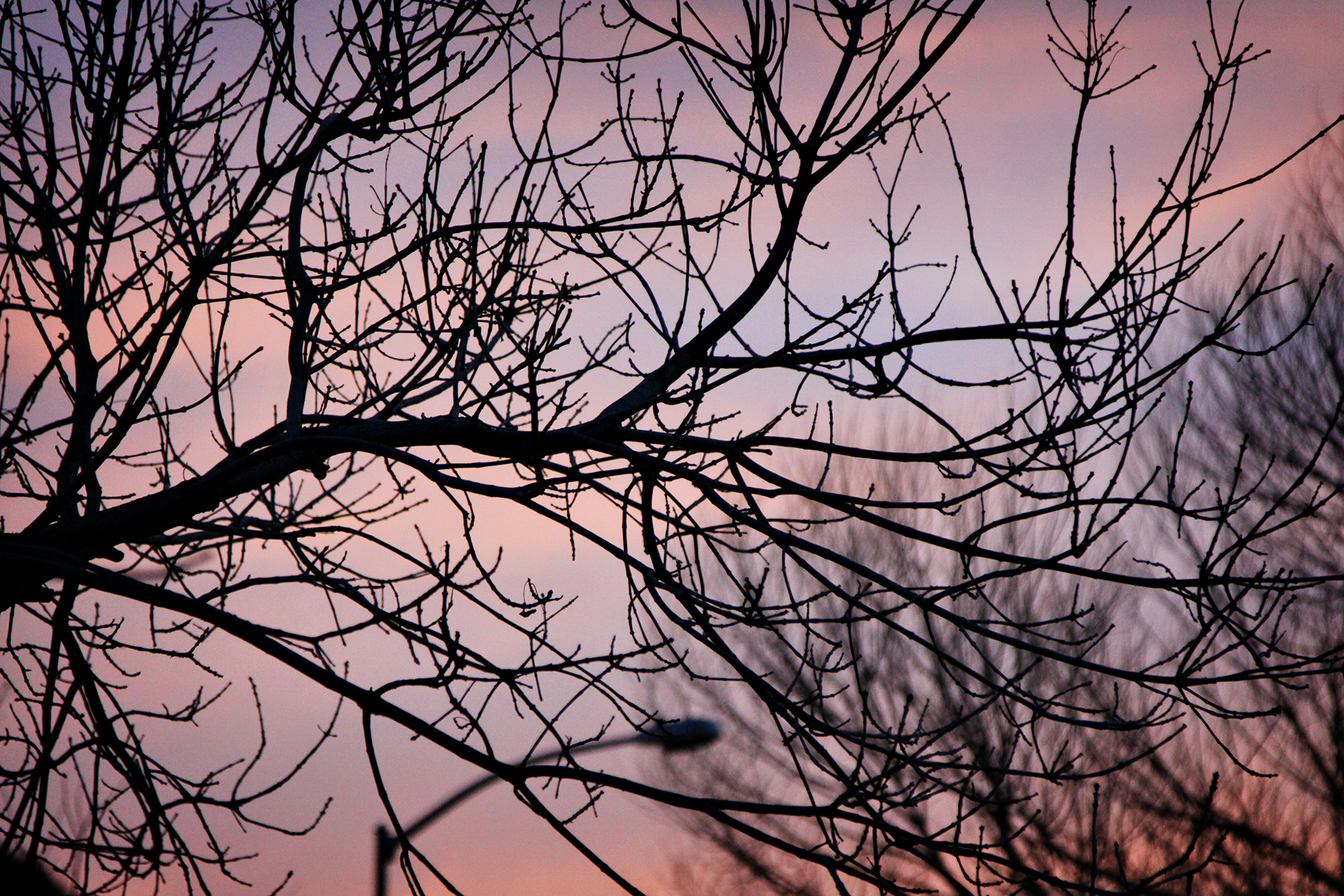
After nine years of moving up to camp, those gray and black trees whisper a welcome to me. There is loneliness at camp, but also friendship and fellowship. The trees are stark now, but I remember that in just a few weeks green will creep over them like a mist. The soft, transparent shade of barely-there leaves is a herald of spring slowly working her way up through the earth.
It took time to believe that herald. Again and again the green mist came and the wind whispered her prophecies through the trees, and after years of watching life come out of death, I began to believe.
In Abraham’s case, the wandering continued for generations. My children have never known a summer away from camp; it is a steady summer home to them. Abraham’s descendants, the patriarchs Isaac, Jacob, and Joseph, were never fully at home in Canaan. And yet despite their wanderings, each of their lives were bent toward God over time, tugged toward trust through encounters with the Almighty. Abraham bartered with God over Sodom and Gomorrah. He made a meal for the Lord. He had a son, the son of Laughter. The stars, as unnumbered as Abraham’s promised and unseen children, still wheeled overhead while Jacob wrestled with the Angel of the Lord. He was given a new name—Israel. The one who strives with God.
I may be more settled than Abraham, but I haven’t fully arrived at home either. I only spend three-quarters of the year in my real home. And yet the pattern of promise circles across the year like the stars spin across the sky. I can say, in echo of Asaph’s words in the Psalms, that God has led us on this path through the mountains even when His footprints are washed away in the spring rains.
Trust builds this way, in tissue-thin layers. Trust grows slowly, flaky and paper-thin like pastry dough folded many times. But as the seasons circle and God’s presence becomes clear again and again across the year, I begin to trace the circle of trust myself. I turn my footsteps toward the trail that our forefathers have worn, following in the footsteps of their faithfulness. Year by year I walk in hope through the gray trees until they turn misty-green once more.

The featured image, “Making Space For Marvelous,” is courtesy of Lancia E. Smith and is used with her glad permission for Cultivating.

Gianna Soderstrom is a contributing writer for Cultivating Magazine and the Anselm Society, and she serves as Assistant Director of the Anselm Society Arts Guild. Adventure-hearted, but also a connoisseur of cozy, book-ish evenings. She is equally fascinated and challenged by the myriad ways that small and steady faithfulness transform a strange place into a home. She is a working writer and editor, co-laborer in ministry; a dreamer, wife to Grant, mama to E1 and E2, and more than the sum of her parts, just like you. Gianna is currently at work on her first full-length book, due out in 2026-27.

Add a comment
0 Comments