


If I were about to meet a man I’d cheated out of his status and inheritance fifteen years ago, I’d be nervous. Probably too nervous to sleep well, but at least I’d try.
Jacob—camped beside a creek on his return journey towards home … and Esau—couldn’t sleep either. At first it was probably the nerves. He gave up for a time and arranged his family and his belongings across the creek from himself, and then he went back. To pray? To try again to sleep? But God came striding out of the darkness to wrestle with Jacob, and kept at it until the first hues of dawn spread up the eastern horizon. Jacob was winning, finally. He had prevailed, or at least endured. Would Jacob never give up at anything? And then a touch on his hip. Was this a wrestling move only God could pull off, or just a “touch” that twisted his hip out of place? I imagine Jacob falling to the ground—I’d have lost my balance. His leg twisted awkwardly out of place, probably not weight-bearing at all. But if he fell, he pulled the strange man down with him.
“Let me go, for the day has broken,” the Angel of the Lord says (Genesis 32.26 ESV). But Jacob hadn’t held on all night for nothing. “I will not let you go unless you bless me” (verse 26b).
I have never had a serious limp. I’ve had the sort that comes of playing rough—an occasional twisted ankle from a soccer match in high school, but nothing even as bad as a sprain. I suppose the only limp I’m familiar with is an all-over sort. I’ve had chronic fatigue for years now. Some Bible translations say that Jacob walked “with a halt” because of his dislocated hip. I have walked haltingly because it feels as if I am walking in water up to my neck. Because the weight of weariness makes it hard to play with my children or wash up the dishes. Because an afternoon walk through our neighborhood leaves me too tired to stand in the kitchen and start a pot of rice for dinner.
Endless nights I have wrestled, sleepless, with this quiet, invisible illness. I have wrestled with God too—jabbing my fistfuls of angry prayers against Him as if somehow, I could prevail. Keeping my grip on God by whatever my fingers found to hold, just hoping my grasp would not give out before I could wrest a blessing from Him; dawn has been long in coming.
“Count it all joy, my brothers, when you meet trials of various kinds,” James writes, “for you know that the testing of your faith produces steadfastness” (James 1.2-3 ESV).
I don’t think I’ve ever felt grateful for the fatigue. Mostly it’s left me sparing of my own strength, counting tasks accomplished like Jacob numbered his sons and his herds, and dreading the coming day as if it would bring a cheated Esau. I have been protective and possessive. I traded supplement regimens and elaborate bedtime wind-down routines as if they could buy me the peaceful night’s sleep Jacob also craved. I strove with chronic fatigue, struggling against it, refusing to look for what grace, what blessing it might have to offer.
Ann Voskamp writes in her book One Thousand Gifts that to see grace better, we must get down lower. “If the heights of our joy are measured by the depths of our gratitude, and gratitude is but a way of seeing, a spiritual perspective of smallness might offer a vital way of seeing especially conducive to gratitude.” [1] Jacob lay in the dirt, lightning in his hip, gripping God maybe by the shoulder. Laid low, made small. Grace was near. It loomed above him in the person of this Lordly figure; maybe Grace was all he could see.
I have never felt particularly grateful for the fatigue, but I have been grateful for things through the fatigue. Perhaps it is strange that I find gratitude most when I lie down, too tired to stand. When I’m too worn out to get off the couch, I feel the comforting weight of my boy when he climbs up and rests, stretched out, on top of me. Or the mornings when my daughter has brought me her favorite stuffed animals to snuggle with because I’m too sick to get out of bed right away. I have learned what Jacob discovered lying on the rocky ground by the stream, the taste of dirt in his mouth: that past the end of my own strength, there is God’s. Perhaps it is just as our tender, wrestling God intended. Get down, look up. Do you see Him looking at you with eyes full of love, ready to bless you?
I have found another kind of gratitude too. More than the company of my son resting with me, more than the ministrations of my daughter and her stuffies, living on the far-flung fringes of physical death I started to look for the resurrection. Like Jacob, forced to come face-to-face with God and His work of weaving Jacob into a greater story, being laid low brought me to the end of hope in myself and the beginning of hope in the final healing He is working out.
In all my mental constructions of resurrection and restoration there is light. Light always and everywhere. Light radiating from the saints, from the horizon—the way the gentle blush of dawn reached around the curve of the world and shone on Jacob and the stranger. And with eyes that have been baptized to look past death, even the wintery afternoon light on the pines outside my window takes on a faint radiance of eternity. I see it and I am reminded that one day I will look at death as the Angel of the Lord looked at Jacob and say, “Let go of me, for the day has broken,” (Genesis 32.26 ESV).
Gratitude is both the grip and the blessing. In the strangest of ways, it is only when I open my hands, palm up to receive, that my grasp on God—or His grasp on me—is tightened.
It is usually true—no matter how pinned down I am by frailty or anxiety, by the sheer weight of my wounded body or by my fear, I must get up and find my way forward into the day, halting and stumbling across the stream and then onward. But there is still this: dawn is breaking in the east, and I will see God.

[1] Ann Voskamp, One Thousand Gifts (Grand Rapids: Zondervan, 2010), 167.
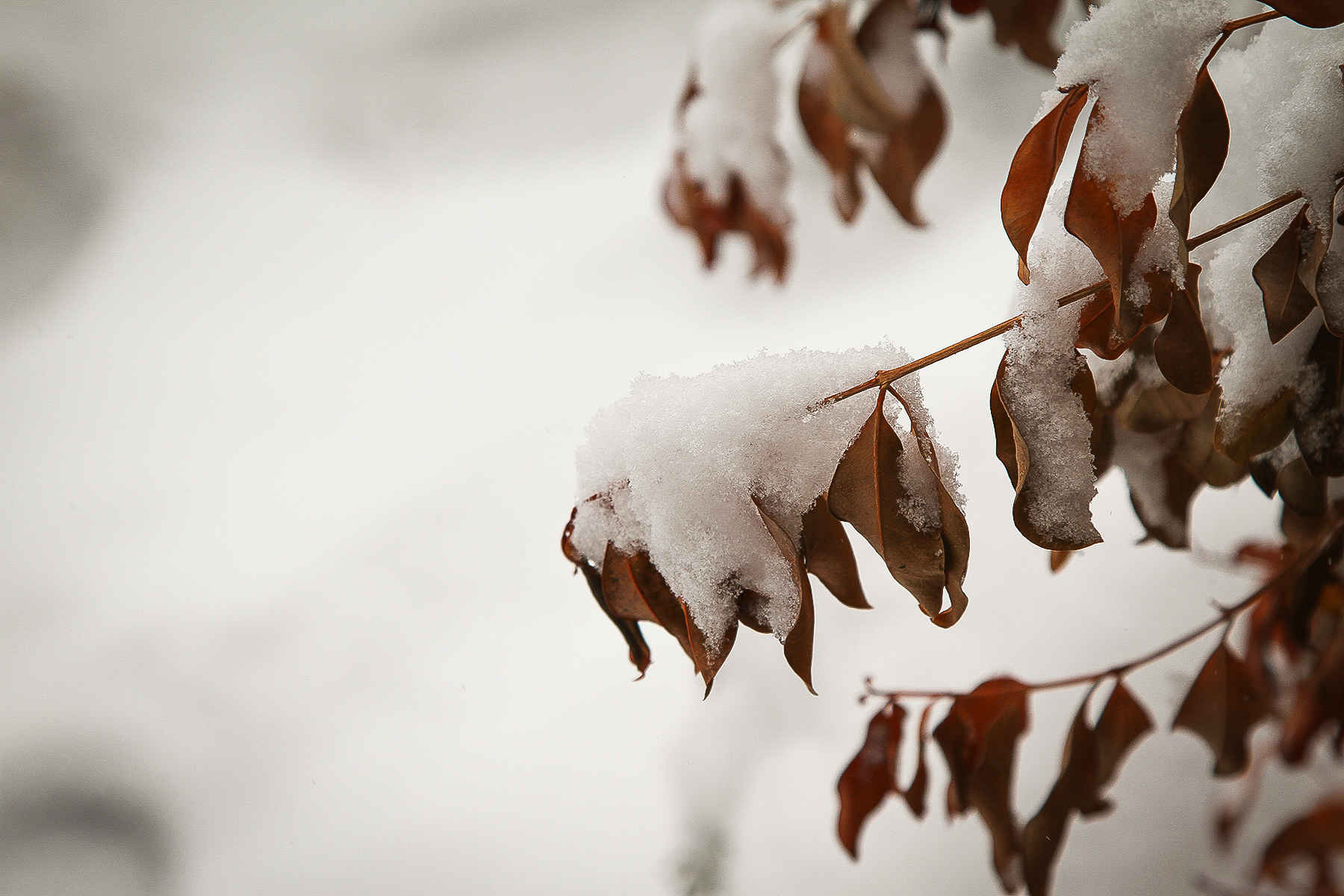
The featured image, “Holding On In Winter,” is courtesy of Lancia E. Smith and used with her glad permission for Cultivating.

Gianna Soderstrom is a contributing writer for Cultivating Magazine and the Anselm Society, and she serves as Assistant Director of the Anselm Society Arts Guild. Adventure-hearted, but also a connoisseur of cozy, book-ish evenings. She is equally fascinated and challenged by the myriad ways that small and steady faithfulness transform a strange place into a home. She is a working writer and editor, co-laborer in ministry; a dreamer, wife to Grant, mama to E1 and E2, and more than the sum of her parts, just like you. Gianna is currently at work on her first full-length book, due out in 2026-27.

Truth. The best writing resonates with truth. We find it at the end of ourselves. ❤️
“Gratitude is both the grip and the blessing.”
Oh, Gianna! This is so beautiful! I am deeply moved by your honesty and vulnerability, and by the beautiful truth you found in the midst of a long trial. Thank you, friend, for your good, courageous heart!