


As summer approaches here in Central Asia, the weeds ramp up their annual virulent attacks on my flower and veggie seedlings. One particularly nasty invader grows just a few centimeters high and produces small grenade-shaped spiky balls that, if left to dry out, stick to the bottom of bare feet with wince-inducing persistence. My other least favorite is the insidious rootless creeper which wraps almost invisible tendrils around stems and leaves, slowly thickening itself by sucking fluid parasitically from its victim. It can strangle a rose cane in several days, winding around the lower levels of the plant and reaching out weblike to ensnare others. If not caught early, its sickly green coils must be broken off in sticky chunks, leaving deep puncture marks in the stem.
Each spring finds me crawling around my garden, trying to yank every tiny specimen of “spiky weed” while it is still green, before the ground becomes a painful minefield. While I’m on my knees, I keep careful watch over the underside of the rose bushes, peering between the canes to break off anything entwined with “snaky weed” and dumping it all in a metal pail to burn to a crisp in the sun.
During these weeding sessions, I’ve been thinking at length about what’s involved in renewing and maintaining charity in my heart, especially towards people who have hurt me. As I research the word, I discover it originated from the Old French charité, meaning “(Christian) charity, mercy, compassion; alms,” and from the Latin caritatem, which carries a sense of “costliness; esteem, affection,” and carus, meaning “dear, valued.” It did include “benevolence for the poor,” as now, but it also originally carried the connotation of “the demonstration of Christian love in its highest manifestation.”[1] In other words, when the word first came into use, a person was charitable not just out of duty or generosity, but because the object of the giving or help was genuinely esteemed and counted valuable by the giver. In a word, loved.
Is true charitable love in its original sense even possible? I wonder, feeling slightly desperate. In my experience, the answer is often a resounding “no,” not if I’m relying on my own abilities.
Genuinely esteeming and counting others as valuable, especially someone who has hurt me or who I find it hard to get along with, often feels out of reach.
Hebrews 12.14–15 (NIV) says, “Make every effort to live in peace with everyone and to be holy; without holiness no one will see the Lord. See to it that no one falls short of the grace of God and that no bitter root grows up to cause trouble and defile many.” In order to “make every effort to live at peace with everyone,” to keep giving the benefit of the doubt and believing the best, I have to first “take every thought captive to Christ” (2 Corinthians 10.5, NIV), checking my heart for signs of resentment, self-pity, or pettiness. If I ignore them, these “weeds” can become “bitter roots” which threaten to strangle the flowers of charity, grace, forgiveness and love. My heart, like my garden in June, is every inch a battleground.
As I kneel on the garden path and dutifully pluck at the green, still-soft grenades, I’m thwarted by the dry, hard soil. Here in Central Asia, the spring season is brief; the weather can shift in a few short weeks from frigid cold to hot summer temps. As seedlings emerge each year, we might get a few early rain showers which keep the soil soft, but they soon peter out, and the blazing sun starts to bake the earth hard as rock. If I try to pull weeds while the soil is clamped around their roots, they break off in my hands and sprout again in the same spot with redoubled vigor.
A few years ago, my husband helpfully gave me several lengths of leftover drip-line from his orchard. I laid them in loops around the garden, curving the black coils between sunflower seedlings and blooming irises, corn sprouts and baby tomato plants. If I turn on the drip-line for several hours, the earth under each tiny hole becomes saturated, leaving dark rings of softened soil. Any weeds inside those moistened rings come away smoothly, roots and all.
After tugging in vain at the weeds of resentment and self-pity in my heart, finding their roots stubbornly stuck so they re-sprout over and over, I need to “turn on the drip-line” by spending time with Jesus.
If the presence of Jesus is the drip-line, His love is the constant drops of softening water. I invite Him to soften my heart with a sense of His own charity towards me in the deepest, truest, most loving sense of the word. The experience of His love saturates my heart like a sponge. As it soaks in, and He starts to gently extract the bitter roots of complaining, judging, and impatience, I find I’m somehow able to stay soft and open towards others even if they continue to hold me at arm’s length.
Renewing charity is especially challenging when I’m trying to walk out my forgiveness towards someone but they’re unwilling or unready to do the same. After extending myself with little to no response, I’m tempted to gripe about their insensitivity, immaturity, or spiritual poverty, patting myself on the back with smug self-satisfaction for taking the high road and being “the bigger person.” Giving in to the temptation to have a good whinge, even to a sympathetic listener, doesn’t usually improve my mood, however. Instead of feeling validated and vindicated, I just feel tired, heavy, discouraged, and lonely.
I’m becoming convinced that God asks us to extend charity towards the humans near us—maybe even especially the ones who have hurt us—not because they deserve it, or because they are treating us with the same care, but because it is good for our hearts. When in order to love someone I have to first ask Jesus to fill me with His love, I benefit immensely. If facing a difficult interaction or conversation, my acute awareness of my own lack of love makes me desperate to stay connected to Jesus as my “drip-line.” My Source. To not lose contact with Him for a single moment. I want a sense of “costliness, esteem, and affection” to emanate like a fragrance from my face, words, and actions, whether or not the other person is in a place to receive or appreciate it. The truth is, God esteems and values that other person just as much as He does me. With my own heart permeated by His endless charity towards me, I can do more than just “take pity” or “give the benefit of the doubt.” I can genuinely love when it feels impossible.
Is there ever a time when a relationship is damaged to the point where, as well as forgiveness and charity, boundaries are also necessary? I think the answer is yes. In my own life I have experienced relationships where I have regularly asked God to massage His love into my heart to keep my spirit malleable and protected from bitterness, but the hoped-for concurrent renewal in the other’s heart is not forthcoming. I’m finding that God’s grace makes it possible to continue to extend charity towards a person while at the same time choosing healthy distance and good boundaries. I can’t control the timing of the other person’s renewal, if it happens at all, but I can invite the Holy Spirit to keep my own heart soft and not allow it to harden with resentment or become prickly with spite.
Renewing trust and charity after hurt cannot be forced or commanded; like plants in a garden, these things have to grow naturally. God has to prepare the heart-soil Himself, plant the seeds of forgiveness and fresh trust, and water the vulnerable seedlings daily with His grace as they grow. He alone has the power to pluck out by the roots the sneaky weeds of comparison or unforgiveness. The renewal process takes time and patience, especially if the “soil” is tightly packed or the “weeds” deeply rooted.
When the flowers of fresh trust and charity finally begin to bloom in a heart deeply saturated with the love of God and not reliant on others’ responses, the fragrance of those blooms might just produce a long-awaited softening effect on someone else’s heart too.
At the very least, a heart permeated by God’s love is nourished, healed, and affirmed in ways that protect it from further hurt and allow encroaching “weeds” to be easily plucked and kept at bay.
And, if more charity, more “costliness, esteem, and affection,” is needed to prepare and soften the ground, Jesus has all we could ask for and more.
In the warm June afternoon, the results of my labors are evident. Seeds have sprouted and matured in the soft, watered earth. Zinnias nod cheerfully in front of tall golden sunflowers. Rose bushes emit heady fragrance into the still air, their clean canes laden with blooms. Petunias spread velvety arms into walkways, while spicy tomato plants, freshly staked, sport promising yellow stars. My bare feet are happy on the sun-baked, prickle-free path. I breathe in the summer scents, my heart grateful and content.

[1] These insights on the etymology of charity were gleaned from Etymonline.com.
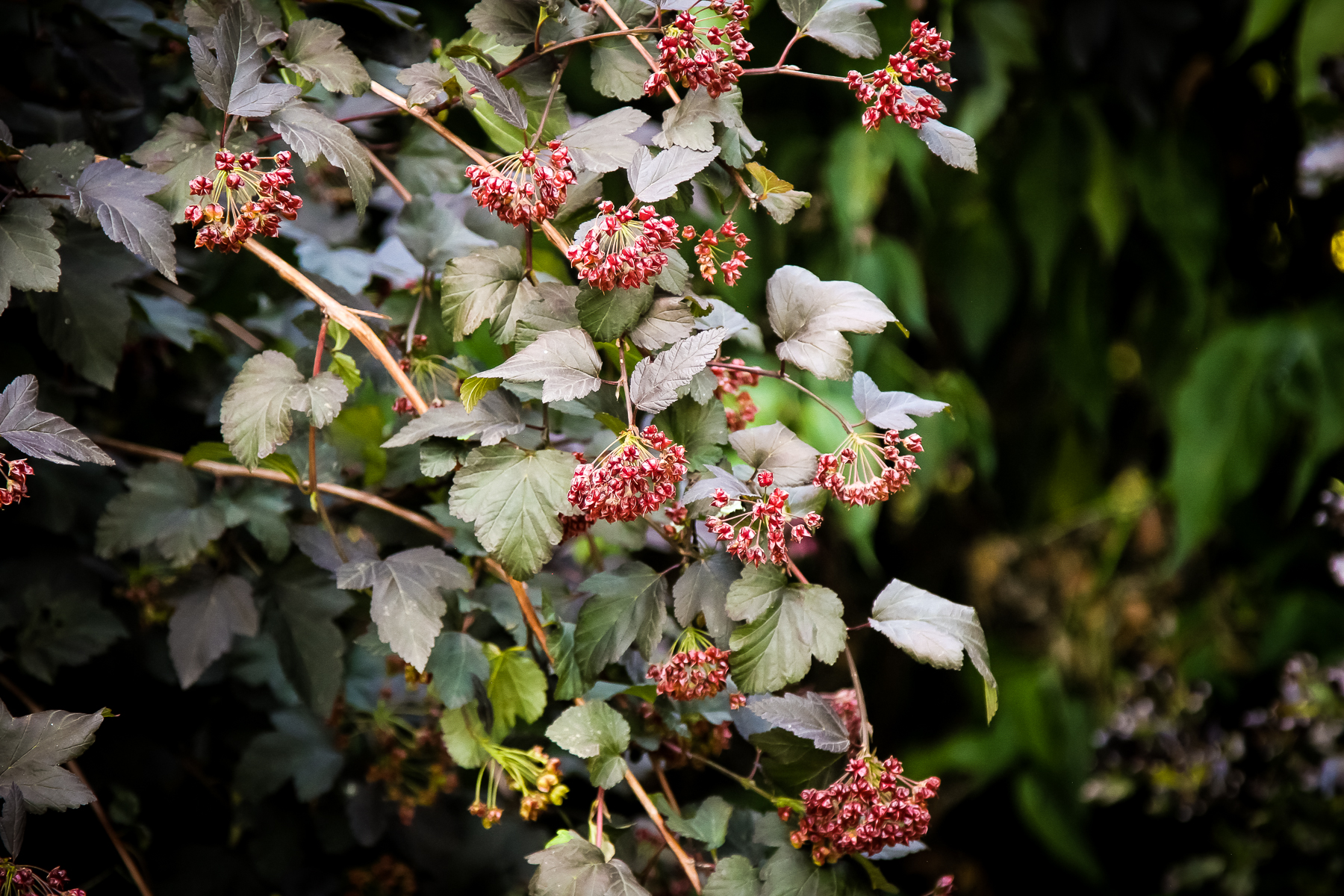
The featured image, “Ninebark Draping Magdalen,” is courtesy of Lancia E. Smith and is used with her glad permission for Cultivating.

A writer, songwriter, and amateur music producer, Carolyn holds a Bachelor of Music from Wheaton College, where she pursued her twin passions for music and spiritual formation. Living overseas for the past twenty years has given her a keen interest in the connections between the inner life, the craft of making, and the art of sojourning, especially how tending her own soul affects her ability to tend the souls of others. Carolyn has contributed to an anthology of pandemic art, Beauty from Brokenness, and to Yet We Still Hope, a collection of honest, vulnerable essays by women serving overseas. You can connect with Carolyn and find her music and resources for the sojourning life at www.carolynbroughton.com.

Add a comment
0 Comments