



Walking with a friend a couple of years ago near our home in northern Croatia, I was thrilled when he assured me that the nearby woods were public property. I had often looked with longing at the other side of the creek we were following. But I thought the beautiful area might be someone’s private property, so I’d never crossed the storybook bridge, a long tree trunk halved vertically and laid across the creek, with wooden slats on top.
A few days later, I eagerly crossed over and followed a meandering trail, discovering a picturesque wood with high rounded knolls, one after another, forming deep pathways between them. I followed the most-trodden route and found that it wound around the largest small hill and offered a couple of ways up the steep hillside. I carefully climbed up and found myself in an enchanted world. February was nearing its end, and the ground was covered in the bright green of late winter grass. Bare trees surrounded me like silent new friends, waiting their turn to welcome spring by filling the air with green to match the ground.
Town and traffic felt far away from this silent green paradise where everything seemed more real.
A barely discernible path wound all around the outer edge of the knoll, so I slowly followed it, circling the green plateau, dodging branches, savoring the silence. Eventually this led me to a tiny, worn wooden bench that had seen many years. I sat down.
From that spot I could see, through the branches, the creamy white chapel down below with its terra cotta roof, the only remaining structure from a monastery complex founded in the fourteenth century.
I couldn’t help thinking that for 500 years, monks and priests had surely come here to walk and pray. Perhaps they even had a bench at this spot, which had been replaced repeatedly over the years.
Further along the path, my eyes met a sumptuous carpet of purple—periwinkle blooming, its green vines spreading out further than I could see. I’d once read that periwinkle has historically been used in cemeteries, and I wondered if that area had been used for burial at some point in time.
This hidden wood has become a place of prayer and grounding for me in a time of great transition in moving back to Croatia after thirty years. I’ve gone there frequently since then and think of it as a trysting place where I can meet with God and even with those who came before, who surely prayed there also. “Trysting” in the way it was used around the time the monastery was built—as a meeting place for quiet companionship, not for hidden affairs. “Trysting” in the way an eighteenth-century hymn I grew up singing describes a “refuge tried and sweet”with Jesus and His love.
Recently, I was talking with a friend who lives on the street near the little wooden bridge. He shared that his grandparents had their property taken away when the Communists took over Yugoslavia at the end of World War 2. This led to stories of other people he knew who had suffered under Communism.
He told me that the woods I love so much hold a horrific story. After the war ended, the Communists rounded up people who had opposed them. They took them down the very street his family now lives on, across an older bridge and into the woods, where they shot them and left their bodies in a pit, covering it with earth but not carefully. Over a hundred people died there that day. The bones were discovered years later, when the Communists were no longer in power; eventually the hushed story became public.
Days after our conversation, I made myself go back into the woods. It was something like falling off a bike or a horse—you know if you don’t get back on quickly, the memory can set into fear that will make it much harder to try again.
The woods were beautiful, the grass a vibrant green. Little snowdrop wildflowers were coming up in multiple places, one large area covered in them.
Traditional symbols of new life, renewal, perseverance, the end of winter. Peace reigned in that place—life all around, beautiful life, with more waiting to spring forth.
A few days later, I walked the longer walk to a place along the creek where a memorial had been placed sometime after the war that ended the Communist government in Croatia, the one my husband and I had lived through. I’d seen the large cross, actually a crucifix, many times over the years, as it’s visible from a road I sometimes walk. I saw it without knowing its meaning.
After that disturbing conversation with my friend, this site had personal meaning, and I felt drawn to go and see the crucifix up close. It was large, about twenty feet high; the wooden cross was black at the base; the crucified Christ and the rest of the cross painted silvery white, contrasting starkly with the dark, leafless trees behind it, almost shimmering in the dying light. The Christ figure was sculpted in metal, a muscular Christ, strong in His surrender. That sorrowful strength seemed fitting for a people who have persevered through so much war, so much grief.
Candles stood sentinel below, one with a heart and ljubav nikada ne prestaje on its side: love never ends.
And it hit me—that “trysting” hymn was “Beneath the Cross of Jesus!”
I was struck deeply in that moment with the reality that this horrible evil had been responded to with a crucified Christ, with candles, with words from scripture about the power of love. And I have been told that people gather at this spot, this trysting place, on special occasions for prayer and song, remembering, honoring.
I’ve since learned that over sixty such sites exist here, in an area almost exactly the same size as the county surrounding Memphis, Tennessee, where we lived for years.
During those years in Memphis, I went through times when I struggled to trust God. The pain that came from witnessing and living through that more recent war would combine with other struggles in my life and cause me to wonder, How can I ever trust God again? He let this happen, and this, and this. . . I trusted Him, but He has let me experience so much pain.
I see things differently now, for many reasons. Thirty years’ worth of reasons.
One reason is that I found a retreat center near Memphis, surrounded by woods, and I went often for solitude and prayer. I walked for hours a day, soaking in scripture and beauty; resting and praying. It changed me. More accurately, God changed me. Through time together, He was able to still my soul and work on healing the hurts. In those woods, my eyes and heart were opened to know Him better.
Over time, trying to figure things out became less important as I realized He had always been there, He had brought me through all the hard things, and He was teaching me many things that I could not have learned without the suffering. He was letting me join in His suffering, transforming my suffering into love that could help Him heal others in theirs.
These recent days caused me to realize for the first time that the words “trust” and “tryst” share a history. Originally, the word “tryst” held simply the idea of a place where one goes, trusting that the other will show up.
Around the same time the monastery was founded, the word “trust” is found to be used for “reliability, trustworthiness; trustiness, fidelity, faithfulness.” And for “comfort and consolation.”
The woods I have come to love here have witnessed the faith and labor of monks and priests. And they have witnessed the horror of unspeakable, long unspoken, evil.
And a faithful God has brought green leaves and beautiful flowers spring after spring, offering love and life to anyone who would accept it.
I can imagine the trees in these woods groaned with sorrow and compassion at what happened there that dreadful day. Other flowers would have been blooming in the woods, testifying to the God who continues sustaining life and beauty despite all sin and evil and death.
And that crucifix, along with a new church built near the old chapel, testifies to a God of great compassion who sees our suffering and offers healing and grace and hope—comfort and consolation.
The day I’m writing this, snow has fallen for ten hours straight, blown by strong winds, covering everything in immaculate white beauty. My heart senses God saying, “Behold, I make all things new.” That day will come.
Meanwhile, I will keep walking in the woods, trysting with a trustworthy God who always shows up.

The featured image, “The Road Goes Ever On,” is courtesy of Lancia E. Smith and is used with her glad permission for Cultivating.
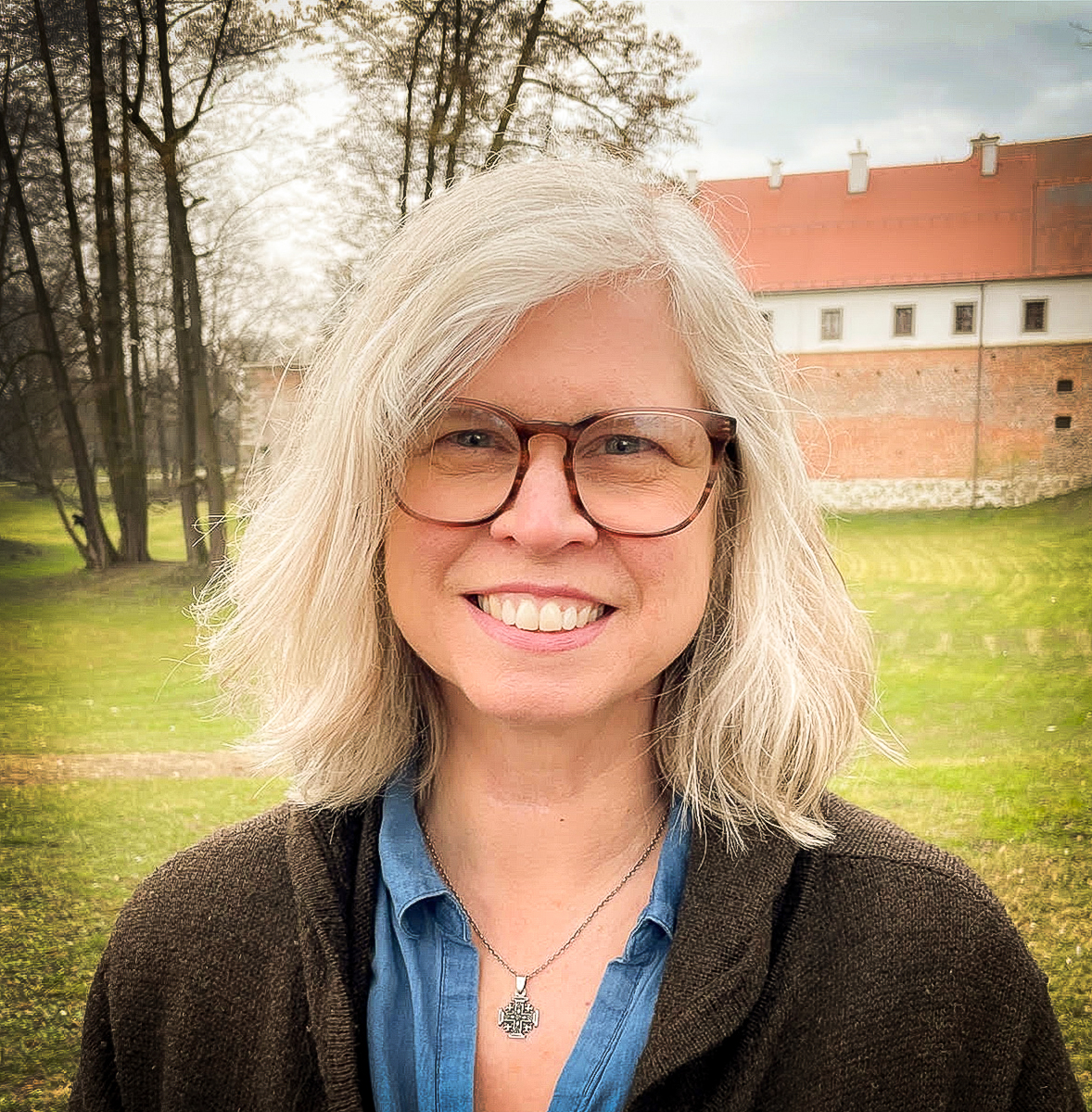
Sheila Vamplin learned early to love God through words, music, and people. Her English degree, piano study, and choral singing somehow led her to Italy and then to Croatia. Landing back in the U.S. after three years of war, she earned a counseling degree. Now a licensed marriage and family therapist with a DMin in spiritual formation, she has concurrently taught piano students and has sung with the Memphis Chamber Choir and the Rhodes Mastersingers Chorale. Her current focus is translating the Italian memoir of beloved friend Tosca Barucci Chesi. As a counselor and spiritual director, Sheila has a heart for artists and those in professional ministry. She loves Gerard Manley Hopkins. With her husband she plans to return to Croatia, anticipating more surprises and trusting that the Holy Ghost will continue brooding over the bent world, even and perhaps especially there.

Add a comment
0 Comments