


“It was under the coconut tree, dah’lin’
It was under the coconut tree…”
So goes the well-known Jamaican folk love-song of a starry-eye’d lover recalling the place where her beloved popped the question. But for my husband and I, though it was in Jamaica, the question was not popped under a coconut tree but another iconic tree, the banyan. On our last visit home, though our purpose in the country was sombre, we determined to visit our spot—the concrete bench under the tree, on the grounds of Devon House. At that happy spot, he had fumbled about having forgotten the promissory necklace at his lodging and I had sat, half-shocked and in wonder, recalling the confirming spiritual experience I had awakened to that very morning.
Devon House is located less than a mile away from Half-Way-Tree, one of Jamaica’s busiest town centers. This stately artifact has signaled significant seasons of the country’s history with grace and notoriety. Originally comprising 56 acres, the property once accommodated the rectory of the region’s Parish Church and saw up to 128 rectors pass through from the mid-18th century to 1881, when it was sold to George Stiebel, Jamaica’s first black millionaire. Stiebel it was who built Devon House, the mansion of Caribbean-Georgian design, that today sits on the remaining acres surrounded by beautiful lawns, gardens and stately trees … banyans among them![1]
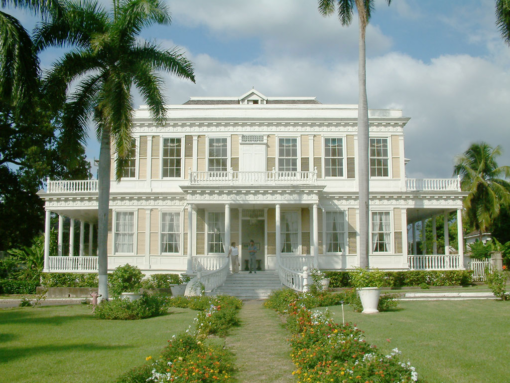
Wake-up Call at Dawn
My goal that “momentous” morning was to simply get my visiting American male-friend to the most accessible souvenir shop, the tourist stopover located behind the Devon House of my youth. I had heard there was now an ice cream shop somewhere behind the mansion, but though I had passed the landmark hundreds of times, going to and from places of study, work, and worship, I had never turned aside to see beyond its ornate wrought iron fences and lush trees. After all, mine was the focused and often harried life of a student and/or teacher, busy with little room for nonessential activities involving time or cash. A veteran foreign missionary once told me, that kind of BUSY translates “Burdened Under Satan’s Yoke”; I had laughed, missing the folk wisdom behind it. I was to learn that God had a totally different perspective on my life and that Devon House had a part to play in it.
He tried to clue me in— causing my Bible to fall open to Jeremiah 29:11, after a morning of my having searched in vain for the words that filled my mind as I had come awake:
“For I know the plans I have for you, declares the Lord, ‘plans to prosper you…to give you hope and a future.” (Jer. 29:11 NIV)
These very words, though yanked fully out of the context of God’s directives to errant Israel about to enter exile, had been offered to my waking mind by a relatable God, as relevant and mine to entertain, along with my guest that very day. Our morning plans shifted as I had a friend bring him by, responding to God’s prompt to arrange a deeper welcome of my friend into my world. Somehow, the church conference context, which had been the central event of his visit (I thought), had not quite cut it, in God’s eyes. The more intimate occasion of breakfast with Dad, followed by a relaxing time with my grandmother and a young cousin on the other side of our two-family dwelling, while I finished getting dressed, seemed to hit the mark. Later that morning, stepping from the bus onto the property of Devon House, my guest transformed into my suitor. Taking my hand, he escorted me to a quiet place under a banyan-shaded bench, and popped the question that would transform our lives, and Devon House into our place.
The early-morning Scripture prompt had flooded back; time had stood still, and I said “yes,” despite the forgotten necklace. When we parted next day at the airport, he quoted John 14:3. “And if I go and prepare a place for you, I will come back and take you to be with me that you also may be where I am.” (14:3 NIV) And he did. About a year later, we exchanged marriage vows before God, family and friends, under skies of a warm Jamaican morning, followed by a joyous reception involving speech, music and dance, on a terrace overhung by a large mango tree.
Reclaiming an Abandoned Space
The widow of Cecil Lindo, a subsequent 20th century owner of Devon House, abandoned it to live in New York after her husband’s death. She might have been able to imagine her one-time dream-home on “millionaire’s corner” becoming a space where wealthy patrons would host lavish receptions in the mansion’s courtly halls. She may have hoped its unique history and design would have led to its being designated a national monument by the Jamaica National Heritage Trust. If business-minded, she may have imagined the now beautifully terraced areas with planter-sculpted nooks and umbrellaed seating, artisan pastry shoppettes, natural fruit drink bars, gift shops offering souvenirs of all sorts. And she would have been right, for so it has become!
However, I doubt she ever imagined the sight that greeted me on my recent visits—little children with hands still sticky from the ice cream filling their tummies, sometimes still in school uniform, ran footraces on her lawns. Meanwhile, their parents and other ordinary Jamaicans relaxed nearby on weekend evenings, or after work, daring to seize a moment of merriment before once again donning the yoke of daily demands. I also doubt that she expected it would one day again be a place where young lovers would come to “plight their troth” beneath her trees.
Yet, as I pondered how it was that the lovely private yet public spaces of Devon House became places for the extravagance of merriment to all comers, not just tourists, I lighted on love.
That is what it had taken for me. A space I had written off as being for those with the luxury of cash and kind was now transformed to a place of merriment for anyone who felt enough love to venture into her spaces with a heart to share it: Like the little boy who felt enough of the safety of love to stop my friend Maria, a total stranger to him, on her way from the restroom, to have her share his joy at running really fast, back to his parents looking on; and the widowed matriarch treated by a group of young adults to an evening out for ice cream, pastries and stories recalling with gratitude her kindness in their vulnerable youth; and groups of church singles and college students, gathered for a time of just being together, sharing kindred company and ice cream— that treat that sets little feet hop-skipping and adults laughing, forgetful of cares.
Transformed Spaces and the Believer’s Hope
It was love too that drew us back to Devon House, even if just for a photo-op by our tree. We wanted to relive the first moment when what I thought was merely a hostess duty became the start of a 30-year love-journey. I had had my head down, so doggedly diligent on performing roles, I almost missed my own marriage proposal! God had to intervene with a wake-up call! In love, He guides us out of spaces of insecurity, fear, shame, regret, want, and loss, shaping us into places from which He works to transform our world. Our hearts, homes, churches, and communities can become places where others can come and lay their burdens down. There, freedom and forgiveness lead to true merriment—liberation at the cross of Jesus Christ that supplies tastes of the flavors of heaven … like delicious ice cream is to the child in us.
Recalling Jesus’s words in John 14 to His worried disciples who could not imagine living any place on earth without His visible presence, I can sympathize. It was a new and unique pain when my betrothed and I first parted. Discussions today about what exactly Jesus meant by those words John recorded, and others, have been stirring afresh. The believers’ “blessed hope,” based in such familiar scriptures, is being subjected to closer scrutiny by reputable scholars.[2] The new heaven coming down to the renewed earth is being emphasized, rather than the promise of the saints flying away to glory, as centuries of believers, weary of earth’s toil and sorrows, have sung with great anticipation.
I am convinced the divine Architect has it figured out. Architects envision, design, measure, and draft spaces for human habitation and function, like Devon House. But love restores hearts, setting captives free. The vision Jesus cast of the road to the Ultimate Reunion gives clues: a prodigal Father running fast to meet a prodigal son once burdened under Satan’s yoke; party clothes, party food, music and dance follow … I hear the sound of merry-making! I doubt we’ll regret coming in from our fields of labor and joining in, even this side of heaven, wherever it is.

[1] The history of Devon House.
[2] N.T. Wright leads a study on his book about heaven, Surprised By Hope.
The image of Devon House is courtesy of João Xavier Mendes dos Santos and is licensed under the Creative Commons Attribution-Share Alike 3.0 Unported license.
The featured image is courtesy of Lancia E. Smith and is used with her glad permission for Cultivating.

Denise Armstrong (née Stair), blogs from a Christian cross-cultural perspective at denisesarmstrong.com. Born Jamaican, she received her Diploma in Education and a BA degree from Shortwood Teacher’s College and the University of the West Indies, Mona, in Jamaica.
She delights to serve in areas of Christian discipleship, alongside her husband Claude. Their marriage of over thirty years which has joyfully produced three ‘Jamerican’ offspring, has also generated much fodder for marriage ministry to young couples. They thoroughly enjoyed serving in this capacity in their recent five-year tour of duty in Germany where they ministered among the US military community there. She also earned an MA in Christian Cultural Apologetics while there.
Denise’s work in playwriting, poetry, and creative-non-fiction essays, has appeared on Jamaican television, in international poetry reading events, and in The Joyful Life and Cultivating, as well as in The Caribbean Writer, a Literary Journal of the Virgin Islands.

My Dear Denise,
It’s events, activities, and moments like the ones you described, especially our betrothal story, that define the meaning of how a “spaces” (3 dimensional area) becomes a “places” (that which gives meaning and purpose within an area)—in this case merriment. You could be a planner. I trust that, you who read this, you will take time to reflect on your “places” of merriment as you traverse an unfriendly world. God will meet you there as in green pastures, another “place”.
Denise! what a lovely reflection…thank you for the bit of Jamaican history and your history, too.
My dearest,
All I know about spaces becoming places is from you! Literal ones and figurative. With you, I am grateful to share a shadowy hint of what being with our Savior in that place called ‘heaven come down’ will be like. Let’s keep making merry memories! Your D
Jody!
Thanks for engaging! Of course, a good portion of any enjoyment you received is bread returning to you on the waters of your past kindness to me! XO
Sincerely,
Denise