


Come, Thou Fount of ev’ry blessing,
Tune my heart to sing Thy grace.
Streams of mercy never ceasing,
Call for songs of loudest praise …
— Robert Robinson
There’s a curious phenomenon happening in the Durbin household of late. I suppose this curiosity has been occurring for a while—several years, in fact, but I have only recently become aware of it. My awareness of it is largely because it isn’t an isolated event, but rather is a slow-moving epidemic. It’s a tuning, of sorts.
I remember the first time I heard a piano tuned. I was about 10 years old, and Granny’s piano was abominably out of tune. I remember her complaining quite vehemently—even from our refuge out in the garden—about the gentleman patiently drawing each string back to where it needed to be. Granny didn’t appreciate the “pecking” (her word) repeatedly on each note until it sang truly. I loved it. I still do.
When Chester, our current piano tuner, comes to adjust our piano, it is one of my favorite things— to hear something so out of focus and strained be carefully restored to perfect order. Sure, it sounds pretty wonky for a while. But slowly, slowly the chords begin to ring true until one final moment when he no longer plays single notes or pairs, but rather an entire arpeggio spanning the length of the keyboard, and fills the house with pure C-major beauty. It usually takes a couple of hours to tune our machine of wood and strings, felt and ivory (yes, ivory. It’s a very old piano). Tuning a person takes a little longer.
My second-born, Judah, is 18 years of age and in his tenth year of cello study. He has God-given musical abilities that I envy no small amount. At six years old, he taught himself to play recorder quite proficiently. When he was eight, I discovered during our morning choral lessons that he has perfect pitch. He is basically a walking metronome. I am a mediocre violinist, vocalist, and pianist, and Judah regularly looks at me with a degree of confusion, as though to say, “How can you not hear that note is F-sharp, Mom?”
When he began playing cello, it was not the challenge that many young people find fretless stringed instruments to be. He truly took to it like a fish to water, rapidly moving through beginner books and into more advanced repertoire. He is the youngest musician to play with the adult symphony where we both participate.
But.
Then.
Almost two years ago, his instructor needed to take a break from teaching, and we were forced to look for someone new. After a couple of inquiries, we found a wildly talented and disciplined cellist who has become a dear friend. I will never forget the first lesson Judah took, though.
“Let’s begin with scales,” Davíd said.
Judah played exactly three notes before being stopped and corrected.
“Again.”
Jude began the scale again, and I think only played two notes this time. The rest of the one-and-a-half-hour lesson proceeded in a similarly dissected manner.
It was—a little—excruciating. I’m not a thin-skinned person, but I knew that I would have come out of that lesson in tears. I wondered how my tender-hearted child would handle this level of exacting instruction. It was never unkind or mean, but a veritable downpour of correction.
Almost overnight, our young cellist went from sounding accomplished, polished, and delightful to squeaky and ragged and hesitant and strained. My ears bled a little.
But.
Again.
It was a slow, slow process, but nearly two years later, all those scales up to the very highest reaches of the fingerboard are being drawn into focus. Every day, not just their intonation, but also their quality and richness and confidence sound purer, cleaner, and better.
On another front, Isaac is our twelve-year-old artist. If I had kept every single piece of paper that child has drawn a minuscule cartoon character, woodland animal, or map of an enchanted castle upon—well, to quote John, “I suppose that the world itself could not contain the books . . .” (John 21.25b ESV).
I remember vividly the day he began drawing. He was two years old, and we were driving to Georgia for Thanksgiving. It’s about a twelve-hour drive, and other than a brief nap, Isaac drew.
His characters for years and years were so tiny it was hard to tell what they were. Sometimes they seemed to be nothing more than a small pink blob with a yellow blob on top. “It’s the princess Rashda. She’s been stolen, but she knows where the magical books are that lead to the seven jeweled keys which will bring the hedgehogs to life again.” It never mattered to Isaac if anyone else could see what he did. He has never been deterred, discouraged, or disheartened. If there is a textbook definition of determination and persistence, it is this child.
I have attempted to nudge, instruct, inform, and encourage him in ways to better practice his artwork. “Try to use more of the paper. Fill it all the way to the edges. If you make Professor Ferdinand (a zebra) a little bigger, you’ll have more room to fit the details on his tunic.” He usually listened for a moment and swiftly returned to his rough, tiny drawing proportions.
But.
Within the past year, I’ve noticed a shift. Isaac consistently spends more time on each piece, not rushing to create a thousand quick sketches. Instead, he carefully details each piece, erasing and redrawing until the hair lays just right across the dog’s forehead. Castles are given walls and forests of identifiable trees and flower gardens. The scale of each drawing, too, is a little larger so that details can be seen.

“Tilda at the Church” by Isaac Durbin – 4″x4″ original graphite on cold press watercolor paper

“Jingle Klaus” by Isaac Durbin – 8.5″ x 11″ graphite and colored pencil on paper
These aren’t the only examples of long-term practices bearing fruit. After nearly two decades of failed sourdough bread, I have finally found a method that produces the tangy, rustic, soft-yet-crusty loaf I love. This year, I have accrued 48 cumulative years of homeschooling across the span of my five children. I’ve told multiple friends that I feel like this is the first year I’ve “succeeded.” As an aside, my oldest is a senior.
Please don’t hear me saying that everything in my life is suddenly flourishing and lovely. There are plenty of relationships, habits, and outright brokenness and sin that need weeded and pruned and fertilized. But I’m so thankful for a God who keeps tuning. He doesn’t lose patience with that one string that doesn’t want to hold in place or with how many times He has to nudge me to make my drawings a little larger. He consistently applies the perfect amount of pressure to the strings of my heart so that one day it will play a beautiful C-major arpeggio to the praise of His glorious grace.
Tuning an instrument is rather quick. I can tune my violin in a minute or so, although a piano may need a couple of hours. Tuning a musician takes longer—maybe a decade or two. Tuning a heart? I think that must require a lifetime.

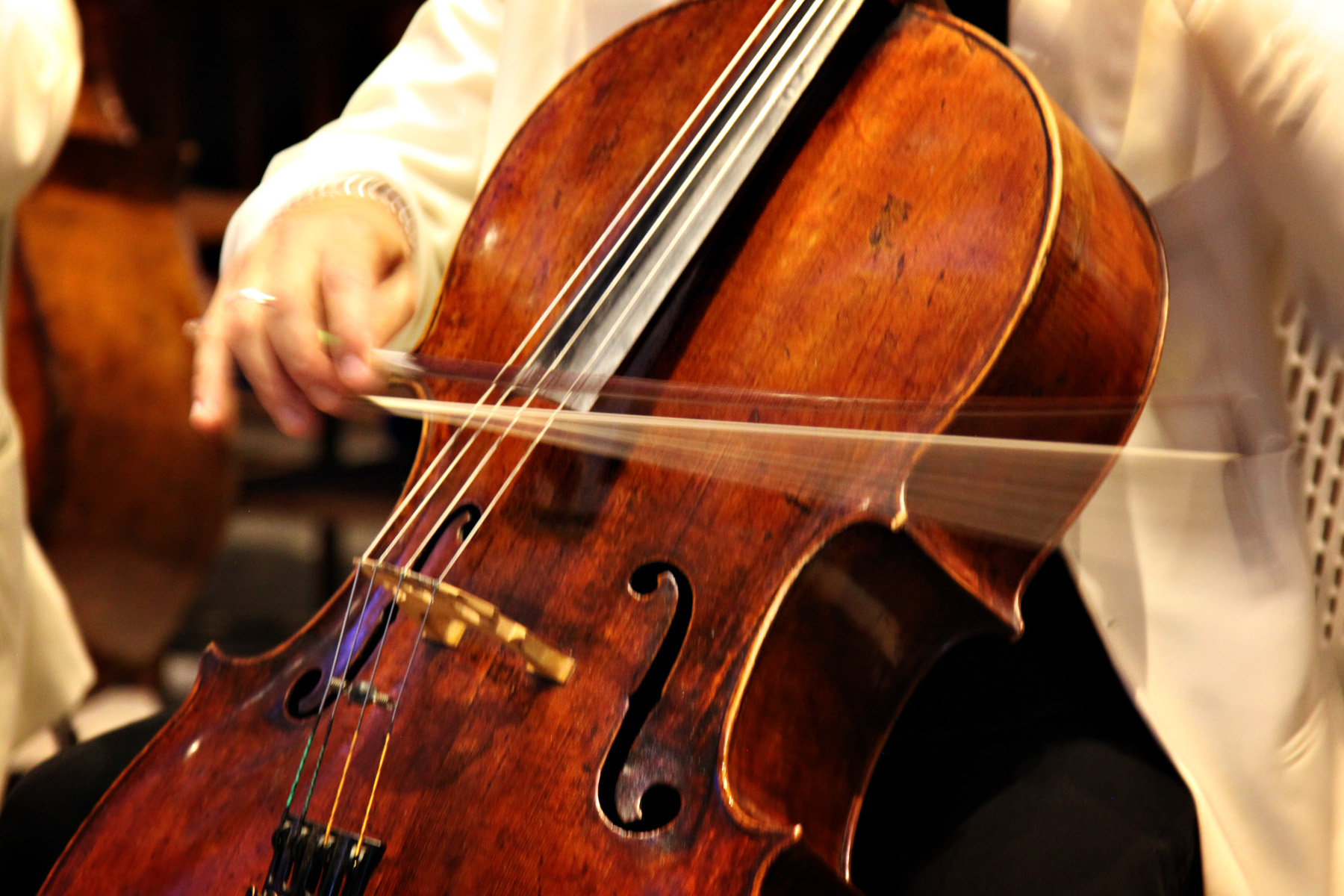
The featured image, “Oxford Cello,” is courtesy of Lancia E. Smith and is used with her glad permission for Cultivating.

Jordan Elise Durbin is a cultivator of five wondrous children, a slightly out of control garden, and a small-but-efficient pottery studio. Her laundry piles can attest to her many activities and willingness to do anything but manage said piles. She can frequently be found running Ohio’s magical trails with her children, baking large quantities of buttery goodness, and writing about the woes and wonders of medieval chickenry. She is the author of The Chicken Pox: A Feathery Retelling of Hansel and Gretel, Periwinkle, and The Prodigal Fox. She has contributed to Cultivating since 2018. Jordan is the curator for the column “Cultivating A Maker’s Life”. She looks for the glory of God in every corner of creation and regularly finds it.

Add a comment
0 Comments