




I welcomed the generous tree-lined sky view that greeted me through the picture window our first morning back home, but missed the blazing ball of orange that had rewarded my vigil most mornings, at summer’s end back in Germany. I wrestled to re-establish a devotional rhythm, striving to regain a sense of equilibrium through fresh grasp on scriptural meditation. My husband and I were grateful for the accommodation afforded us on the commodious military lodging facility in our home state, as we awaited our household goods’ arrival from across the Atlantic. In truth, we were just grateful to be home. We knew the cultural ground under our feet had shifted in major ways. Things were not the same as we had left them a mere five years earlier—but neither were we. We purposefully embraced that we had both become seniors while away and wondered how that would play out, now that we were back home.
Leaving the Ranks of Those Who Boldly Go . . . and Go
Our admiration had grown tremendously for the military servicemen, -women, and their families who live daily with readiness to release a loved one into harm’s way, for defense of our ideals of freedom and justice; and I developed a deepened appreciation especially for their embrace of the task of multiple relocations. Some even admitted to feeling “antsy” as the two, three or five-year marker would approach without their spouses having received orders. Yet, the toll is undeniable, however bravely borne by both children and adults, who constantly have to say goodbye and re-orient to life elsewhere, repeatedly. Many beat an early exit, often disillusioned, scarred externally, or wounded within.
With the season of Advent approaching, visions of Mary and Joseph came easily to mind, as, peering through the stubborn steely grey spectrum above the tree-line outside my window, I pondered their travels.
How hard was it for them to pull up stakes, in obedience to the orders of ruling authorities, and again, later in flight from Herod’s heinous death command?
I wondered how that blessed young woman, great with Child, had prepared herself for the move. Hers was not just a journey to a new, and usually facilitated, accommodation. Her goodbyes had to have been at least as wrenching, if not worse, being guaranteed that these would likely be final farewells. The rigors and dangers of travel back then, by donkey no less, were already markedly difficult, let alone for one in advanced pregnancy; not to mention the many uncertainties of the prospect of delivering a baby in unfamiliar, inconvenient circumstances, away from family and friends — and all this in a political climate of harsh military occupation.
In search of solid ground
How did Mary steward her mental, emotional, and spiritual state under such conditions, knowing What or Whom it was that was developing in the holy room of her body, a womb made more so by God’s overshadowing? My early morning vigil suddenly developed a focus—apprehending purpose, beyond catching glints of an actual sunrise, I now sought the rising of the Son of righteousness in a bold new way for this next season of life, in a world desperate for the healing found only under His shading wings. What could I learn from Mary about how to harness my own thoughts and emotions and wield the joy that commemoration of the Incarnation should reflexively elicit, rather than fall victim to the morose moods that lurk behind the commercialization of the holy, as the year winds down in increasingly darkening times? My imagination became pregnant with possibilities as I pondered the world that shaped Mary and prepared her room to bear the Lord of Life Himself. I became convinced of clues glinting out from between the lines of Scripture, from the angel Gabriel’s Annunciation to Mary, to her glorious Magnificat when she visited her relative, Elizabeth.
Found, a Faithful Record of Both Doubt and Trust in Israel[1]
My mind traveled through Luke’s careful Gospel account in chapter 1, throwing the full weight of my imagination at the unwritten details between the lines of major players in the process of earth’s most important conception. First, we find the priest, Zacharias, dutifully performing his rare lifetime honor of burning incense in the temple, the official place of expected encounter with God and of His self-revelation to a longing Israel. Suddenly, God’s powerful angel, Gabriel, arrives with the good news of emerging fulfillment through a miraculous birth of Messiah’s forerunner through this chosen Levite and his barren wife, Elizabeth. But instead of rejoicing and relief, the gospel writer Luke describes an unenthusiastic, skeptical response from the dutiful but doubtful priest. Only after experiencing the angel’s dread sentence, pronouncing him mute for the duration of his wife’s incredible pregnancy, does Zacharias’ heart and emotions catch up, and burst forth in an appropriate cathartic benediction!
The maiden, Mary, on the other hand, finds it possible to deliver the right response on the front end of her even more amazing pregnancy, by Luke’s description. Despite the prospect of misjudgment and the attendant risks it portended, she only wonders aloud at the process by which the angel’s words would be fulfilled and fully submits to whatever God wants. What made her so much more open to accommodating God’s unique advent through her, than her foil, Zacharias, a trained and respected priest of Israel?
A Faithful Shepherd Looks Up and Leads
Our first Sunday back in church, shed light on the subject, as well as glorious sunshine on the region. “Slow down and look up!” urged our pastor, to the faithful congregation that had survived the ravages of covid controversies and deaths, politically motivated member attrition, and that now reeled with the rest of the country over two heinous and senseless killings. “Slow down and look up… to the Heavenly Father, the holy One!” he preached, guiding us through the Lord’s prayer. “ Seek His Kingdom’s reign; trust Him to supply our need; forgive as we have been forgiven; and follow Him to victory over evil and into the ultimate glory of His eternal Kingdom.”
As I later pondered his words, it dawned . . . Are these not the very sentiments Mary reflected in her Magnificat: casting a vision of the Messiah’s kingdom reign, the rise of true freedom and justice, and the demise of pride and evil by the hand of an almighty and loving God?
Mary’s scripture-laden celebration, and Elizabeth’s affirming, confirming words, sealed that holy moment when two ordinary women rejoiced together, daring to believe the messenger’s words from God, that they would literally embody the herald and the Fulfillment of Mankind’s hope.
Like her predecessor Hannah, mother of Israel’s last judge and first prophet, Samuel, Mary grasped the promises of God.[2] Both her and Elizabeth’s recorded words welcomed the ancient scriptures right into their present challenging circumstances. But was it in just a moment? Did they both arrive in a divine flash at that place of readiness to house divine purpose, despite the oppressive powers and manifest evil of their times?
Daughters of the Book, Bearers of the Light
Luke’s record provides us enough evidence to the contrary. These daughters of Israel were familiar with the promises of God written in Scripture, and bore them personally. They had to have intentionally practiced “Slowing down and looking up” in their challenging lives and uncertain times. Girls and women were often kept busy and had to be purposeful to learn Scripture in that culture. Boys went to Torah school at the synagogues, but girls learned at home, and that only from conscientious parents or husbands. Elizabeth’s words to Mary at their famous meeting, and Mary’s Magnificat thereafter, are telling. They reflect knowledge and grasp of Scripture’s promises to Israel and, by extension, to the whole world. And more important, they demonstrate a prophetic embrace of God’s promises, born of time in intimate fellowship by the Holy Spirit, in meditative reflection over His Words, God’s sovereign choices notwithstanding.
Pondering my own new season of ordinary womanhood, I concluded that like these two women on either end of female physical fruitfulness, time spent looking up—despite a “slow dawn” or days fluctuating between somber grey and intermittent outbreaks of sunshine—will always illuminate Advent’s path. Time with the Divine Paraclete in meditative reflection unveils scriptural truth, confirming the reality of God’s redemption, which though one might not always be able to see proof of it, like the Sun, it enables us to see everything else by it.[3] This fills us with present celebration, anticipating days when loved ones will return home safely, never needing to be sent into harm’s way ever again; for freedom, justice and truth will never more stumble in the streets. Like Jesus taught, like Elizabeth and Mary practiced, and like the preacher admonished—we fix our eyes in faith-filled expectancy clinging to His sure promises, rejoicing, knowing that the Son of Righteousness has arisen and will rise again, once and for all, with healing in His Wings.

[1] The writer of Luke’s Gospel amazingly captures the primary events and characters involved in the early events of Jesus’ first advent in chapter one, mentioned in this paragraph.
[2] Biblical scholars point out the similarities between Hannah’s prayer of praise recorded in 1 Samuel chapter two and Mary’s Magnificat, suggesting her familiarity with that text.
[3] This line alludes to C.S. Lewis’ famous quote, inscribed on his memorial stone in Poet’s Corner at Westminster Abbey.
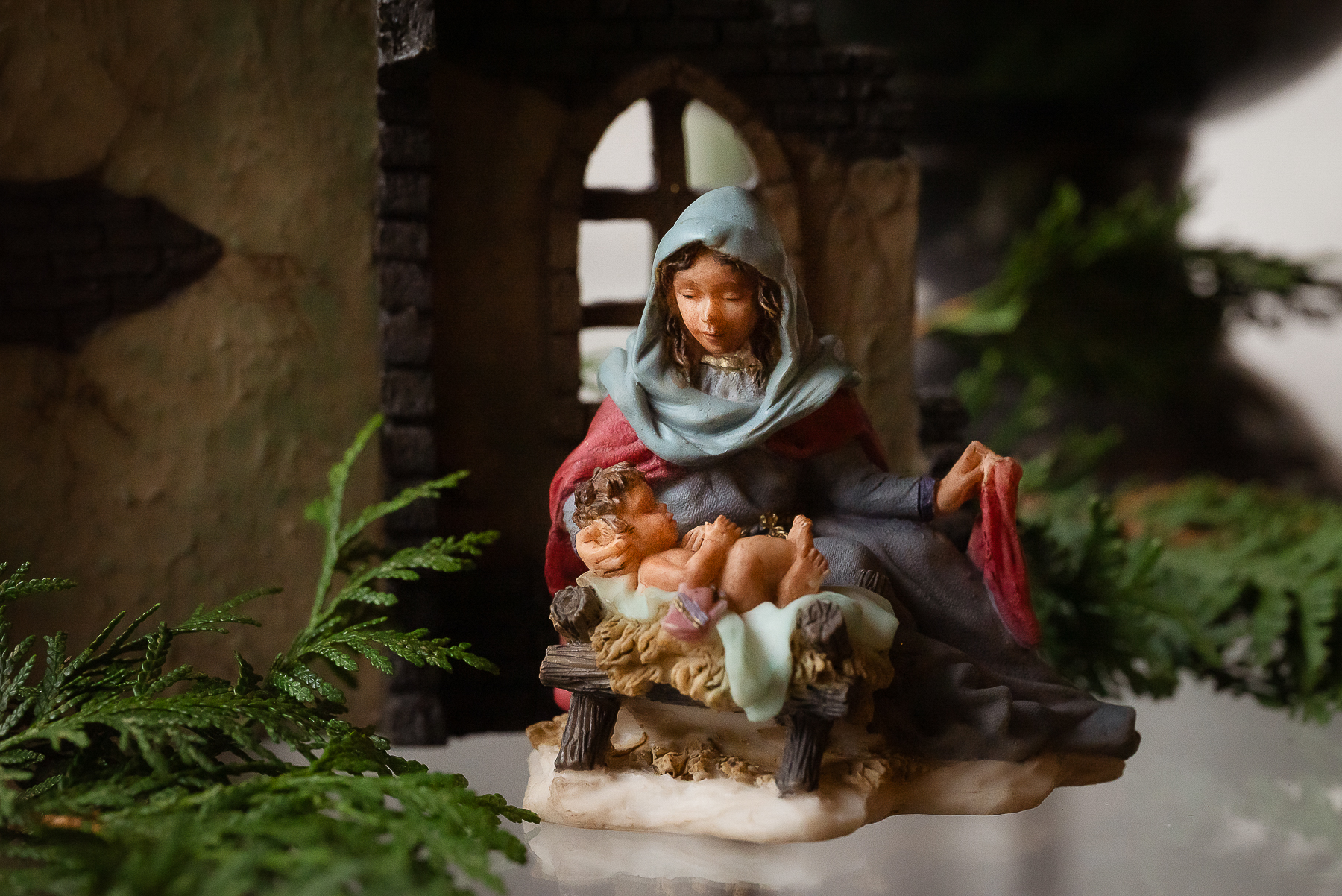
The featured image, “Away in a Manger,” is courtesy of Julie Jablonski and used with her kind permission for Cultivating.

Denise Armstrong (née Stair), blogs from a Christian cross-cultural perspective at denisesarmstrong.com. Born Jamaican, she received her Diploma in Education and a BA degree from Shortwood Teacher’s College and the University of the West Indies, Mona, in Jamaica.
She delights to serve in areas of Christian discipleship, alongside her husband Claude. Their marriage of over thirty years which has joyfully produced three ‘Jamerican’ offspring, has also generated much fodder for marriage ministry to young couples. They thoroughly enjoyed serving in this capacity in their recent five-year tour of duty in Germany where they ministered among the US military community there. She also earned an MA in Christian Cultural Apologetics while there.
Denise’s work in playwriting, poetry, and creative-non-fiction essays, has appeared on Jamaican television, in international poetry reading events, and in The Joyful Life and Cultivating, as well as in The Caribbean Writer, a Literary Journal of the Virgin Islands.

Reading this today was very heartwarming as you touched on 2 things that has recently captured my heart again afresh. Mary and Elizabeth’s preparedness in their different stages of life , to what the Father would bring to them and draw them to each other for Divine purpose.
Thank you for always getting me to relax and read, and hear your heart.
Thank you for your thoughtful and informative presentation “Receiving Advent Light.” It was the first time I reflected on Mary’s knowledge of the Scriptures. What if that was possibly part of what caused her to be the most suitable woman to be the mother of Jesus? Women are so privileged today as far as having access to the Word is concerned. May we be used for God’s glory.
Oh you are such a blessing, Cheryl!
Thanks for opening your heart to the thoughts I hoped to share! I have always loved the relationship suggested in Scripture, between Mary & Elizabeth! Perhaps it reminds me of ones with whom I’ve been similarly blessed to share fellowship with! Like you!
Warmly,
Denise
Dear Winsome, Thank you for taking the time to read and comment!
Mary’s ready response was, doubtless, the result of God’s transformative work in her heart, by His word!
Glad to have exemplary vessels like yourself who pursue God similarly!
Fondly,
Denise