




Cultivating a Maker’s Life is a column that explores creative living expressed in a whole life. Generous, creative living is not something that is confined to a studio or workspace. It is conceived in the garden, gestates on hiking trails, nurtured in cinnamon-scented ovens, and matures at family dinner conversations. Come with me while we explore all the stages of making and living.

About two years ago, I realized that an awful lot of the emotional and mental weight I carried every day was because of saying “no.” I said “no” about a thousand—maybe two thousand—times a day. That sounds like a lot, but divided between five kids, it worked out to a pretty OK average.
More often than not, I was saying “no” out of habit or some idealistic sense of what I thought a mom was supposed to be. I pictured a stone statue of myself with a self-satisfied smile and an iron fist, and maybe a plaque: “Here stands Mother—Crusher of Hopes and Dreams, Disappointer of Children, Steadfast Pillar of Disciplinary Standards—you shall not pass her, question her, faze her.” Almost the instant that this image materialized in my imagination and I examined it more closely, I realized that it was not the legacy I wanted. I wanted out of the “meanest mom” competition.
I didn’t make a rule or take an oath, but I recognized that I was exhausted from saying “no” to everything all the time. I saw and felt the disappointment I was handing out in a steady stream of “no,” but more importantly, I questioned the why of it all. The heaviness of holding up all of those “noes” lifted. I felt like Atlas—one tiny shift and the whole world went tumbling off my shoulders.
And I started to say “yes.” Obviously, not to every single thing, but as often as I could. I quickly weighed the cost of my answer and surprised myself by how frequently “yes” was OK. You want a Mario Kart race in the middle of the afternoon? Game on! You would like a soda with dinner? On a weekday? Go for it. Does my “no” actually matter for life, health, and godliness, or am I saying it out of routine? I stopped giving only as a reward for hard work or willing attitudes and gave just because I loved. Within a few days, my kids started to look at me like I had been the recipient of a lobotomy—in actuality, it was more like a heart transplant. Their expectations—built through long years of laws and rules—were blown away.
Does it matter?
The Puritans in 17th century Great Britain said a hard “no.” While they didn’t tear Christmas out of the Bible, they literally outlawed any celebration of Christ’s birth. It was slightly understandable—slightly—in the light of the raucous parties those celebrations had become, but if there were ever a case of throwing the baby out with the bathwater, this was it. Maybe Theodore Geisel found a bit of inspiration for his furry green anti-hero in their zeal.
I wonder at a heart that doesn’t rejoice at the remembrance of Christ’s coming. I know there is pain and disappointment and sorrow at Christmastime. Maybe the expectation that those things don’t belong here in that season or on that day is the elephant at the manger. But look up, friends! Redemption is at hand! That baby’s cry split history in two. When Jesus filled His lungs for the first time and mewed into the Judean night, it might as well have been an earthquake. The whole picture of Bethlehem is unexpected.
Does it really matter?
I went searching the Scriptures a couple years ago—specifically the Psalms—for evidence that it matters, and here is what I found. In a moment of curiosity, it occurred to me that Christmas songs are the very best songs. Since this is a timeless and indisputable truth, I wondered if—perhaps—God the Father had long ago, in times past, written any Christmas songs in preparation for His Son’s birth. As I write this, I realize it sounds far-fetched, unlikely, unverifiable, and maybe even a little silly. But God made pangolins and giraffes, so there.
I combed through psalm after psalm. Many, of course, reference Christ’s death and resurrection. Lots of storytelling ballads about God’s power and faithfulness. But then, Psalm 98. I have a working theory that this particular psalm is the fourth movement in a six-movement ancient Hebrew symphony. Psalm 95 is a multifaceted opening prelude of worship and creation and joyous music made to the Creator God, reminding us that we are His sheep and warning us against hardening our hearts. Psalm 96 is a glowing celebration of the greatness of a God who comes to His people. It talks about forest trees singing for joy, which seems especially appropriate for Christmas. Say what you want. God knew about tinsel and fairy lights when He wrote it. Psalm 97 sounds like a rich bass aria reveling in the mighty displays of God’s power.
Then, Psalm 98.
Oh sing to the LORD a new song,
for He has done marvelous things!
His right hand and His holy arm
have worked salvation for Him.
The LORD has made known His salvation;
He has revealed His righteousness in the sight of the nations.
He has remembered His steadfast love and faithfulness
to the house of Israel.
All the ends of the earth have seen
the salvation of our God.
Make a joyful noise to the LORD, all the earth;
break forth into joyous song and sing praises!
Sing praises to the LORD with the lyre,
with the lyre and the sound of melody!
With trumpets and the sound of the horn
make a joyful noise before the King, the LORD!
Let the sea roar, and all that fills it;
the world and those who dwell in it!
Let the rivers clap their hands;
let the hills sing for joy together
before the LORD, for He comes to judge the earth.
He will judge the world with righteousness,
and the peoples with equity.(Psalm 98 ESV)
Psalm 98 rings with praise for the coming salvation of the Lord. I don’t know how else God the Father would talk about the birth of His Son who would be named “Salvation belongs to Yahweh.” Its words are echoed in the Magnificat, in Zechariah’s song, and in Simeon’s prophecy. I realize it’s not a “traditional” Christmas passage, and I think that’s one of the reasons I love it so much. It’s unexpected. Just like Bethlehem. Just like saying “yes” to children who have had a decade of “no,” it repeats sounding joys of “yes.” “Yes,” hope is coming! “Yes,” the Lord has done marvelous things! Break forth in song! “Yes,” His blessings flow and flow and flow—as far as the curse is found!

Editor’s note: The English Standard Version translation does not capitalize pronouns referring to God; these have been added by Cultivating editors.
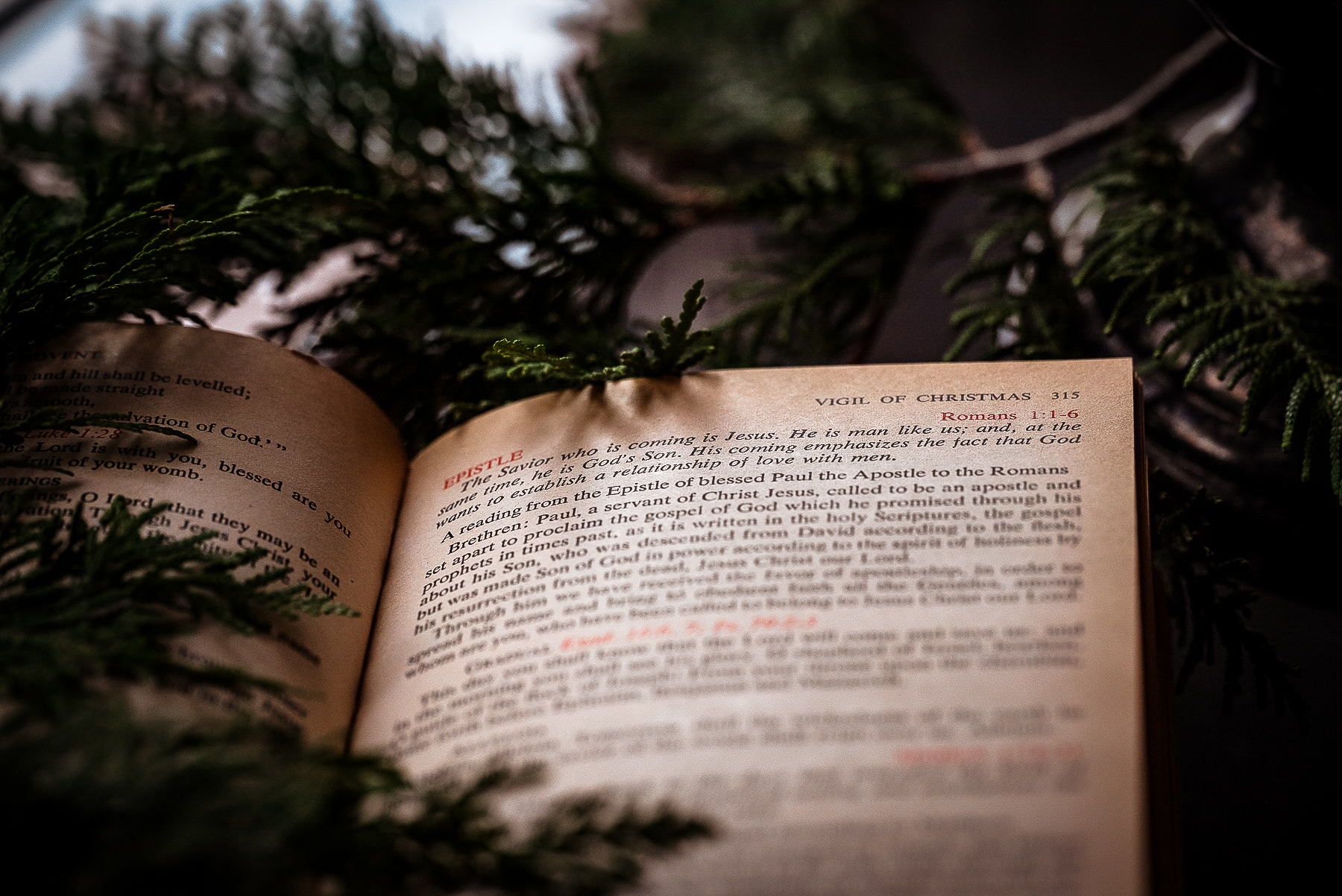
The featured image, “Vigil of Christmas,” is courtesy of Julie Jablonski and used with her kind permission for Cultivating.

Jordan Elise Durbin is a cultivator of five wondrous children, a slightly out of control garden, and a small-but-efficient pottery studio. Her laundry piles can attest to her many activities and willingness to do anything but manage said piles. She can frequently be found running Ohio’s magical trails with her children, baking large quantities of buttery goodness, and writing about the woes and wonders of medieval chickenry. She is the author of The Chicken Pox: A Feathery Retelling of Hansel and Gretel, Periwinkle, and The Prodigal Fox. She has contributed to Cultivating since 2018. Jordan is the curator for the column “Cultivating A Maker’s Life”. She looks for the glory of God in every corner of creation and regularly finds it.

Add a comment
0 Comments