




Gerard Manley Hopkins reminds us that ‘Christ plays in ten thousand places’ and, given the truth of this, we should expect Him to meet us and minister to us in every space He leads us into. Cultivating a Pastored Heart looks at the worlds of literature, culture, and everyday life, finding lessons that pastor our hearts and equip us to care for others in turn.

The first person you meet when you exit the wardrobe and enter Narnia is a fellow between seasons, stuck in winter.
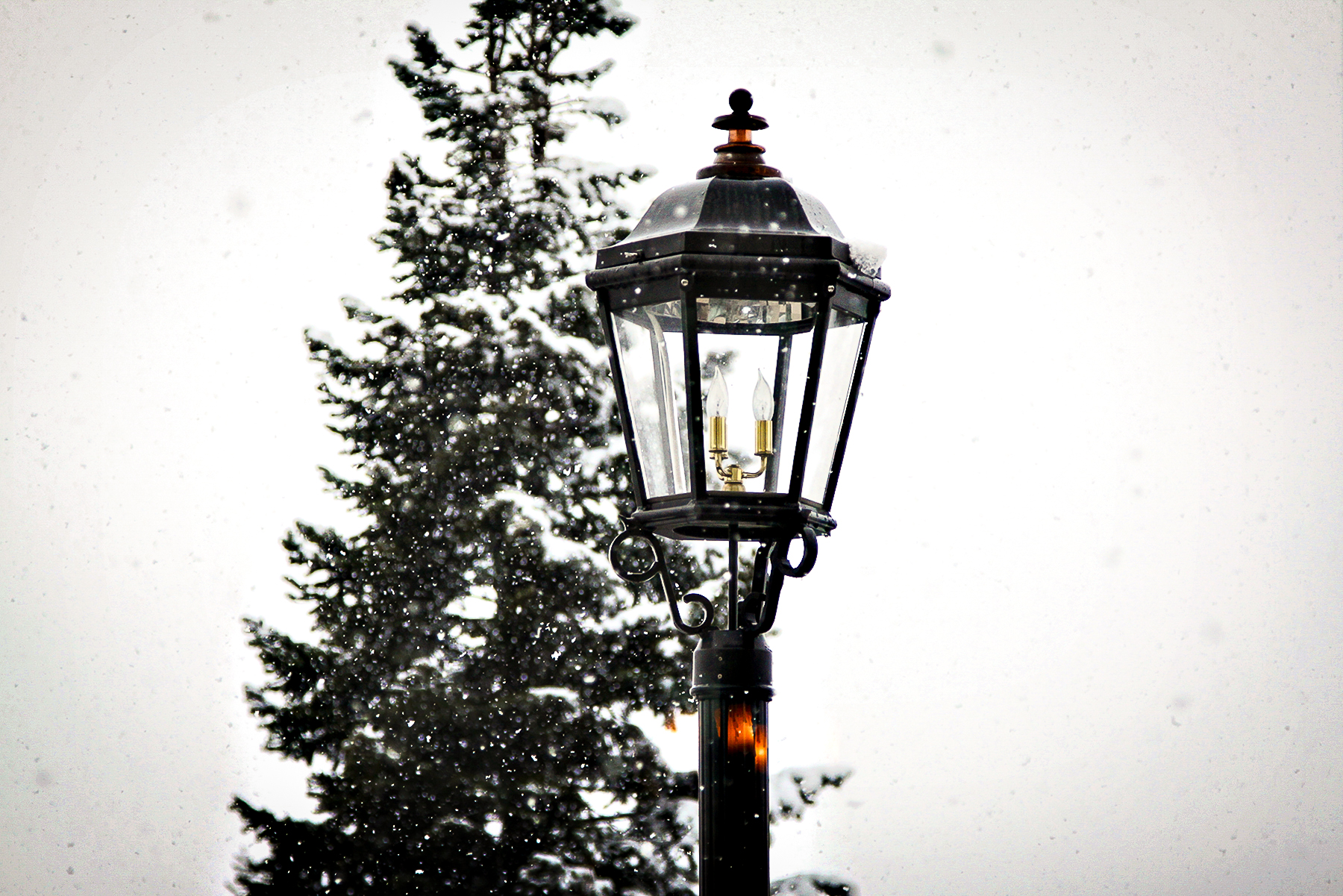
Mr Tumnus is not just Lucy’s first encounter with the creatures of that deeper country, but his was the first figure that came to CS Lewis when he was conceiving the entire series. A faun by a lamppost became the keynote whose echo resounds across the entire storied world that Lewis birthed in his writings.
I want to examine the nature of the never-Christmas landscape and how Tumnus stands not just as a sayer of that interminable season, but one who seeks to address it both externally and internally. Tumnus is a blessed and beloved Everyman for all who struggle to conjure the Christmas spirit and cultivate joy in midwinter, and his example can serve as a powerful pastoral model for us when Yuletide feels dull, grey and insufferably weather-bound.
Parcels and Piping as Acts of Resistance
Given Lewis’s love for etymology, Mr Tumnus carries counter-cultural hope in his very name. The most likely source for the naming of the faun is the Roman god, Vertumnus. The Routledge Dictionary of Gods and Goddesses, Devils and Demons describes him as follows,
In origin, an Etruscan god (→ Voltumna) who was taken over by the Romans in the third century BC. He was revered as the god of change, i.e. of the changing year (Latin vertere = to turn, change). His feast, the Vortumnalia, was celebrated on 13 August.
That Lewis might have had this very god in mind when creating Mr Tumnus is supported by a poem by Russian poet, Joseph Brodsky. With no discernible influence or connection between the two writers, Brodsky’s depiction of Vertumnus bears striking resemblance to how we encounter Mr Tumnus in The Lion, the Witch and the Wardrobe,
Knee-deep in snow, you loomed there: white, moreover naked,
in the company of one-legged, equally naked trees,
in your part-time capacity as an expert
on low temperatures. “Roman Deity”
proclaimed a badly faded notice,
and to me you were a deity,
since you knew
far more of the past than I (the future
for me in those days was of little import).
On the other hand, apple-cheeked and curly
– haired, you might well have been my agemate.[1]
Here are two writers approaching the same subject in isolation from one another, and yet the physical and contextual parallels are unavoidable. Tumnus and Vertumnus bear striking resemblances.
A Semblance of Christmastide
Taking this resemblance into account, Tumnus is a figure of change in an intransigent winter. He is an individual whose life may be stuck circumstantially but whose nature and temperament are bent towards change and renewal. This is evident in the earliest descriptions we have of his character.
Lucy meets him carrying (and dropping) some particular burdens. One of his hands, as I have said, held the umbrella; in the other arm he carried several brown-paper parcels. What with the parcels and the snow it looked just as if he had been doing his Christmas shopping.
Lewis’s first description of Tumnus is that, regardless of the ever-winter-never-Christmas world he inhabits, his regalia is redolent with festive tones and shades. His is not docility in the face of permanent mid-winter, but his attire and his trimmings carry allusions to the traditions of Advent.
This living against the grain of a relentless season is also evident within Tumnus’s little home. There is fine food for Lucy to enjoy and the faun’s tales take in the total life of his world with fond recollections of other seasons, including the summers,
“…when the woods were green and old Silenus on his fat donkey would come to visit them, and sometimes Bacchus himself, and then the streams would run with wine instead of water and the whole forest would give itself up to jollification for weeks on end.”[2]
When his words are all spent, Tumnus takes up his little flute, and its notes lead Lucy to nod off into deep slumber.
Parcels, provender, piping and the sharing of cherished tales turn the always-winter to other seasons for Tumnus, albeit briefly, and there are beautiful pastoral encouragements for us in this as well. As Yuletide rolls around, as shops signal the season with blinking lights and the code of carols, our own circumstances can leave us feeling an absence of Advent. It is not that we don’t normally welcome winter seasons with their quieter air, their space for deeper slumber and slow, unseen growth; it is the winter’s bewitching, its unnatural withholding of light that undoes us.
Tumnus helps us in our own tale. His domestic rituals, his stories and songs, his hearty food, remind us that while Christmas might tarry, while a witch’s work might curse our ever-winter, there are consolations and blessings that allow God to cater for us through his common grace.
This Christmas season might be surrounded by chronic things – ill health, relational breakdown, financial burdens, political dislocation, spiritual homelessness – and Tumnus’s confession to Lucy liberates us to give words to such things. But God also sees and blesses your own quiet work in private lodgings, the little comforts that you appeal to daily, the personal balms that just get you through – but get you through they do! Tumnus tells us that this is one way to navigate our never-Christmas seasons, and he is, after all, a fellow sojourner between seasons, stuck in winter.
Thawing the Winter Within
Lewis’s primary Narnian character is not without conflict, though. His hospitality is hemlock for Lucy, so that he might deliver her to the White Witch. His problem is that not only is he in a winter without Christmas, but that winter is also in him. The pressure of circumstance, the totalising power of evil, has led him to make terms with the unnatural season that is Narnia’s lot for now.
Yet Lucy’s openness and earnestness, the presence of a real living person in his home, melts any inherited malice he may have held, and allows him to walk a future path of integrity and honour, even of hope.
This sidenote is also helpful to us if winter simply won’t deliver Christmas. It could be that our own long sojourn through snowbound straights and the chill of a world that won’t change has frozen something in us. It could be that we have stopped navigating our never-Christmas world and started negotiating with it, allowing it to freeze some parts of our souls which were once warm in return for limiting its harm to our hearts.
If this is the case, we may need the light that Lucy represents throughout the Narnia novels to enter our dwelling and turn us in our tracks. Just one small factor, one small figure, one tiny exercise of influence, might help us to reckon up the damage that has been done to us, and that we might do in turn because we are so wounded. Perhaps the first thoughts that you have towards this thaw are now, as you read these words, dear reader. If so, this writer sympathises with your snowbound heart because his own has so often been chilled by the challenge of unchanging seasons, and as these words fall to my page like snowflakes, I am praying for you.
Navigating our never-Christmas seasons is hard work; the chill will threaten our homes and our hearts at every level. But if we can prepare a table, raise a song, tell the sun-dappled stories of summer, and allow our souls to be warmed again by grace and light, there is yet hope for us and our always wintering world.

[1] Brodsky, Joseph. Selected Poems: 1968-1996 (Penguin Modern Classics) (p. 127). Penguin Books Ltd.
[2] Lewis, C. S. The Lion, the Witch and the wardrobe. London: HarperCollins Children’s Books, 2023.
The featured image, “A Lamppost in Narnia,” is courtesy of Lancia E. Smith and used with her glad permission for Cultivating.

Andrew Roycroft is married to Carolyn, and they have two teenage daughters. Originally a
medievalist by training, Andrew served for 24 years in full-time Christian ministry – mostly in
local church pastorates. Andrew is a visiting lecturer at the Irish Baptist College, teaching
Biblical Theology and Apologetics. An active writer, Andrew has published poetry in a number of
Irish and British literary journals, has produced work for BBC Radio 4, has contributed to Arts
Council Northern Ireland projects, and written commissioned work for New Irish Arts. Andrew is
also a regular contributor to the Rabbit Room Poetry community. His first poetry collection, 33
(published by Square Halo Books in 2022) is a collaborative work with visual artist Ned Bustard,
offering reflections on John’s gospel. Since leaving pastoral work in November 2024, Andrew is
working as a freelance editor and writer.

Add a comment
0 Comments