


He’d seen what had to be all the major sites London had to offer. The Tower. The Abbey. St. Paul’s. Parliament. A play at the Old Vic and one at the Gielgud. The National Gallery. The Tate Britain and the Tate Modern.
Robb Bennett was spending a month here. He’d never spent a month on vacation anywhere, ever. But family, friends, and his pastor had urged, and kept urging, a break, a separation from the shambles his life had become. The betrayal. The divorce that had become so public that it made the newspapers. The impact on his four young boys, of whom he now had full custody. And this all while running one of the largest home construction businesses in their city.
It had nearly broken him.
His father finally prevailed and said Go. Not just for a few days, but something extended. His parents had moved into his house to watch the boys. Work had been delegated, helped by the fact he hired good people. His upscale hotel in London was just across the Thames from Parliament. And for the past two weeks, he’d lost himself in seeing the major tourist sites, walking streets in Belgravia and Mayfair, and finding small neighborhood restaurants and pubs
He was walking now. He’d taken a red double-decker bus to Trafalgar Square and walked the Strand to Somerset House and the Courtauld Gallery, recommended by his concierge for its collection of Impressionist paintings. The concierge had been right. Leaving, he walked until the Strand became the short stretch known as Fleet Street. Though the area was once the center of journalism in Britain, the only vestige he’d seen was an “Evening Express” fading on a building’s brick wall. He’d followed alleyways to Dr. Johnson’s House, which was closed that day, and then backtracked to Fleet.
He almost passed it without noticing. An alley between two buildings showed one of the most famous steeples in the world. It was St. Bride’s Church, with the tiered steeple that inspired tens, probably hundreds, of millions of wedding cakes. He walked down the alley and entered the church.
The first surprise was how new everything looked. Then he checked his London guidebook, which said the church had been almost destroyed during the London Blitz in 1940. An attendant smiled and handed him a pamphlet, which explained that something had stood on this site since 43 AD. After the bombing, the church had been rebuilt, reopening in 1957. That’s why it looked so new.
Its proximity to Fleet Street had provided the nickname the “Journalists’ Church.” The wall and displays included memorials to journalists who died during wars and others who’d been regular congregants, like Samuel Pepys, Samuel Johnson, and Malcolm Muggeridge.
He was about ready to leave when the attendant told him not to miss the crypt, which included a small museum. Descending the stairs, he saw the crypt was divided into two, the museum on the right and a roped walkway on the left. He looked through the museum first and then followed the walkway, which included artifacts from the church built by Sir Christopher Wren and salvaged after the bombing. The walkway ended in a small chapel.
It was about the size of Robb’s family room at home. Painted white, it included two back-lit contemporary artworks separated by a cross, behind a small altar of white stone with a large circle cut into the base. The only seating was a curved stone bench with room for eight, backlit by a glass sculpture similar in design to the stained class by the altar.
He sat. Compared to the rather ornate church above, the chapel was sheer simplicity. It was clean and bright, but it felt almost as if it had been there from the beginning.
Robb closed his eyes. He felt a quiet in his mind and heart that he hadn’t experienced since before the divorce, before he knew of his wife’s affair with a fellow doctor, before the night of their anniversary dinner when she told him she was leaving him and the boys.
The chapel seemed to impart the quiet. He found himself praying, not with anything precise in mind, but more a quiet listening.
Robb wasn’t sure how long he’d sat there, but when he opened his eyes, he jumped.
Sitting a seat away was a monk.
“I’m sorry,” the monk said. “I didn’t mean to startle you. I’m Brother Lionel.”
Robb, recovering from surprise, extended his hand. “I’m Robb Bennett.” The monk pronounced Lionel like it rhymed with “vinyl.”
“Ah,” the monk said, smiling, “you’re American. Are you an ex-pat?”
“Vacation. I think you call it holiday.”
“We do.”
“Are you on the church staff?”
Brother Lionel laughed. “No, I’m sent here from time to time to assist and help, show faith on the ground, so to speak. Today is one of those days.”
“I’m sorry I jumped, but I thought I was alone.”
“And I should’ve made my presence known.” The monk looked at his face. “You have cares. I see it in your eyes.”
“Don’t we all?”
Brother Lionel nodded. “We do. But your eyes suggest there’s something painful you’re trying to work through.”
“I’m in London on a break. Friends and family convinced me to get away.” He paused. “I’m just on the other side of divorce. It was unexpected, ugly, and became something of a public spectacle.”
“You’re by yourself, so I assume you’re the wronged party.”
Robb didn’t know this rather odd monk at all, but he surprised himself with what happened next.
He told Brother Lionel. All of it. From the shock of the announcement at dinner to the court filings, the newspaper reports, the shock for his sons. “The one thing that wasn’t changed was my business. It’s growing. We’re hiring more people. But my home life was a train wreck.”
The monk listened, not responding.
“I keep asking myself,” Robb said, “what could I have done differently? Should I have seen what was happening? Will I keep making the same mistake?”
He stopped, embarrassed. “I’m sorry. I didn’t mean to share my problems.”
“Tell me something, Robb,” the monk said. “Have you forgiven your former wife?”
Robb stared at the man. “Forgiven her? I haven’t thought about it.” He paused. “The answer is complicated. Maybe yes, on some days. No, on other days. People say I can’t move on until I do. But I’d be lying if I said I didn’t feel any anger. I do. It still hurts. It makes me question everything I thought about myself.”
“I’m no expert on marriage, Robb,” Brother Lionel said, “for obvious reasons. But over the years, I’ve listened to people’s stories—quite a few, in fact. The stories of betrayal are all very different and, inexplicably, also very much alike. Forgiveness is hard, very hard. But what I’ve learned is that it starts with something unexpected.”
“Unexpected?” Robb said.
The monk nodded. “Before you can forgive the person who betrayed you, you must first forgive yourself. Forgive yourself for what you missed, for what you didn’t see, for what you did see and deliberately decided not to see. You have to forgive yourself for the wreckage that followed, wreckage you feel responsible for if even someone else caused it. And part of forgiving yourself is learning to trust yourself again. And it’s hard, very hard, to do that. Because your trust in yourself had been damaged, and trust is a difficult thing to repair once it’s been broken. Especially self-trust.”
Robb was quiet.
“I haven’t thought of it that way. If anything, I’ve spent months trying to forgive her.”
“Whatever her reasons,” Brother Lionel said, “no matter how she might try to justify it, she made a choice. You were not given a say in that choice. You and your sons became a consequence, what some call collateral damage. It’s hard to see her walk into a new life and get on with it while you and your children are left floundering. You feel responsible, and you carry that load of guilt. It’s not your load to carry. You may never be entirely free from it, but you don’t have to carry it.”
“How do I start to do that?”
“Pray for yourself. Ask God to take it from you. He will. It may be sudden or over time, but He will.”
Robb closed his eyes and prayed, a prayer with the specific request. He didn’t know how long he prayed, but when he opened his eyes, Brother Lionel was gone.
He stood. He walked quickly back toward the entrance to the museum. The monk was not there. He hurried up the stairs to the nave. The only people he saw were the attendant who’d greeted him and a woman at the small sales counter.
Robb spoke to the attendant. “Did you see Brother Lionel leave?”
The man looked surprised but shook his head. “No, I didn’t. I’ve been standing here except for a moment when I answered a question for those visitors. Perhaps he left then?”
Robb nodded. He felt disappointed; he would’ve thanked the monk for the words and the advice.
The attendant following, Robb walked to the display of booklets, histories, and various souvenirs. He selected an illustrated guide to St. Bride’s that included several photos of the chapel.
The volunteer at the sales register smiled and said, “Six ninety-five.”
He handed her a hundred-pound note. Her face fell. “I don’t know if I have enough—”
“Consider the rest a donation.”
“Oh, my, thank you.”
The attendant stared at the visitor, the only one they’d had for the last two hours. The man standing before him looked ten years younger than the man who had walked in less than an hour before, as if he’d dropped a great weight he’d been carrying. “That’s very generous.”
“Not for something that likely changed my life,” Robb said. “Will you tell Brother Lionel thanks the next time you see him? Tell him Robb the American is grateful for his words. And his time.”
The attendant nodded, and Robb left.
“Who is Brother Lionel?” the woman said.
The attendant shook his head. “It’s happened once or twice before. I’ve never met a Brother Lionel, here or anywhere else. But it’s happened before. Rare, but almost precisely the same. A visitor tells us about meeting Brother Lionel in the chapel.”
He walked to the door. The American had stopped midway down the alley leading to Fleet. He was looking at the guidebook. The attendant watched as the man straightened his shoulders and resumed walking, turning right in the direction of St. Paul’s. And then he was gone.

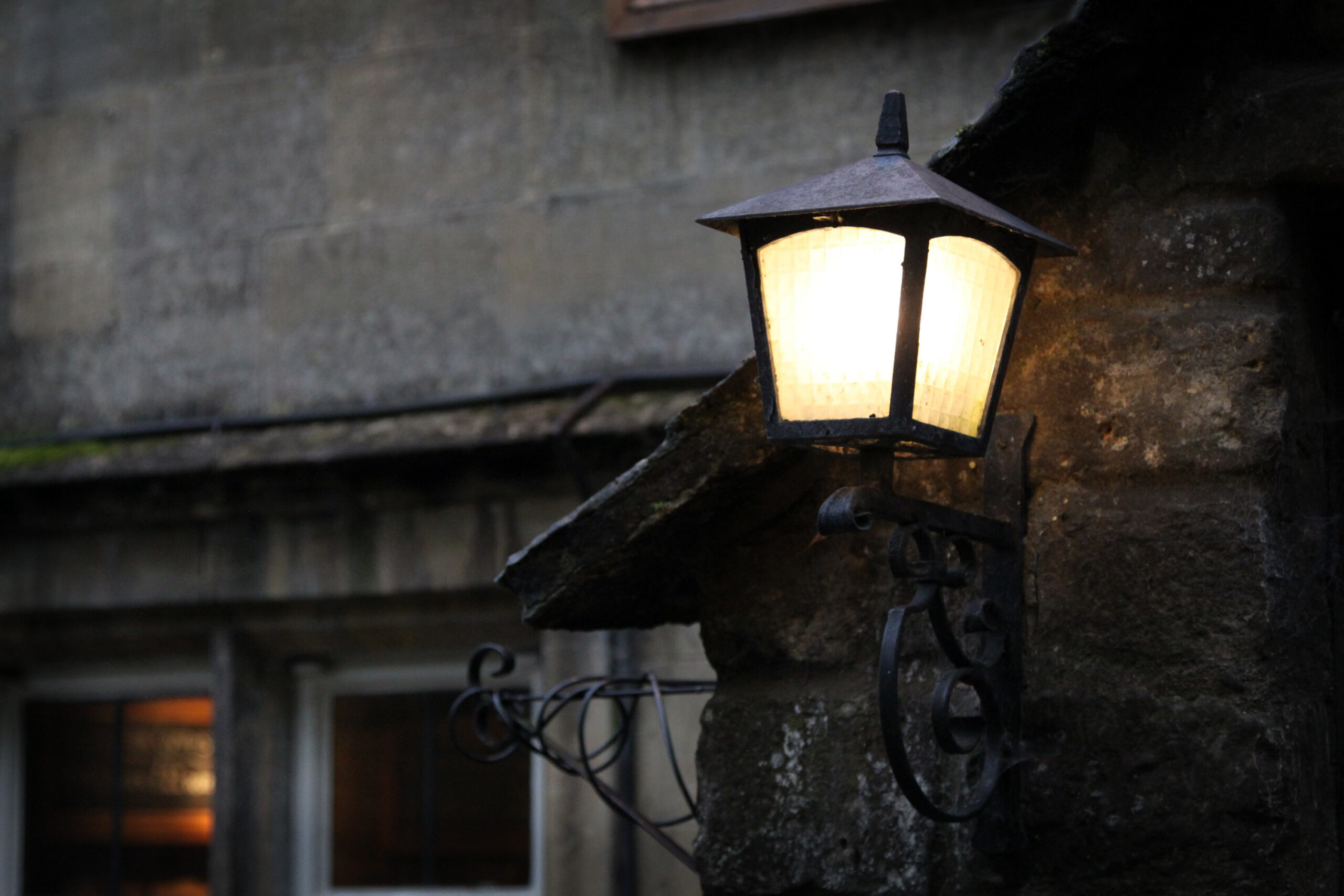
The featured image, “Cotswold Inn Lamp,” is courtesy of Lancia E. Smith and is used with her glad permission for Cultivating.
Glynn Young wrote his first story when he was 10 – a really bad mystery having something to do with a door behind a grandfather clock and a secret cave. At 14, he discovered Great Expectations by Charles Dickens, but he secretly wanted to write James Bond stories. At 21, he became a Christian, and the verse he was given, Philippians 1:6, became the theme of his life.
Glynn received a B.A. in Journalism from LSU and a Masters in Liberal Arts from Washington University in St. Louis. He spent his professional career in corporate public relations, and mostly executive speechwriting. Since 2009, he’s been an editor for Tweetspeak Poetry, writing a weekly column. Since 2011, he has published five novels in the Dancing Priest Series, the nonfiction book Poetry at Work, and the historical novel Brookhaven.
He and his wife Janet live in suburban St. Louis.

Oh Glynn,
What a beautiful story…actually, to be precise, what a beautifully told story! I don’t even wish to know if it’s fictional; that hardly matters since its truth-load outweighs the necessity of particularity. May its message travel far & wide…so needed. Sincerely, Denise